Answer: Cash flow vs. appreciation is one of the most important decisions in Huntsville real estate investing. Cash flow focuses on monthly income, while appreciation focuses on long-term property value growth.
Neither strategy is automatically better. The smarter choice depends on what you need the property to do for you.
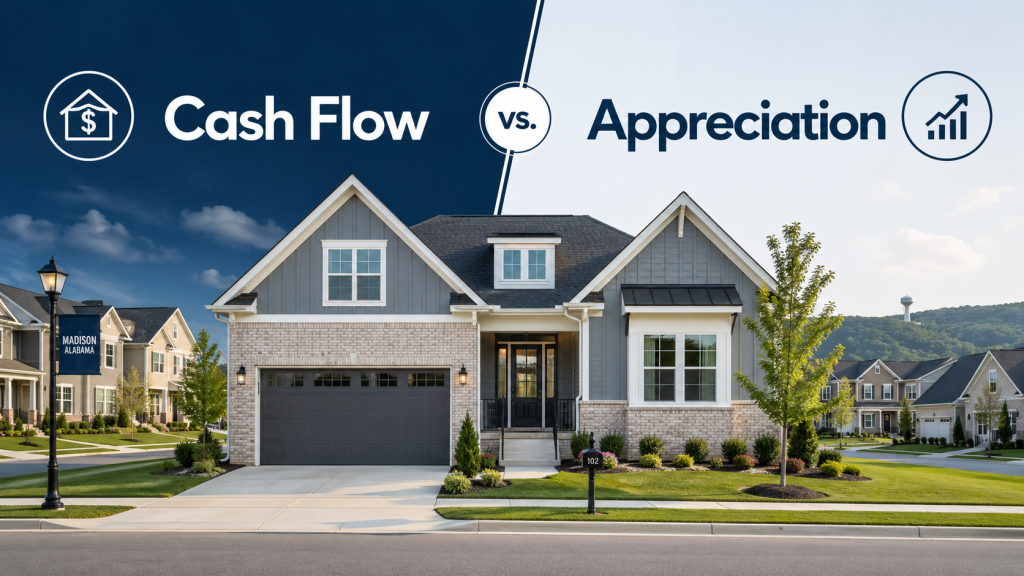
How investors can choose between monthly income and long-term growth when buying rental property in North Alabama.
Some investors want rental income right away. Others are willing to accept thinner returns today because they believe the property, location, or land value will become more valuable over time. In Huntsville, Madison, Athens, Harvest, Meridianville, and other parts of North Alabama, both strategies can make sense, but they should not be judged the same way.
What Is Cash Flow?
Cash flow is the money left over after a rental property’s income pays its expenses.
In simple terms:
Rental income minus property expenses equals cash flow.
Common expenses include:
- Mortgage payment
- Property taxes
- Insurance
- Repairs and maintenance
- Vacancy allowance
- Property management
- HOA fees, if applicable
- Utilities paid by the owner
- Capital reserves for bigger repairs
A property with positive cash flow produces income after these costs are paid. A property with negative cash flow costs the owner money each month.
What Is Appreciation?
Appreciation is the increase in a property’s value over time.
An investor buying for appreciation is usually focused on future resale value, equity growth, or long-term wealth building. The property may not produce strong monthly income at first, but the investor believes the location, demand, or future development will support higher values later.
Appreciation can come from several sources:
- Market growth
- Local job growth
- Improved infrastructure
- New retail, schools, or amenities nearby
- Limited housing supply
- Property improvements
- Neighborhood revitalization
In North Alabama, appreciation-minded investors often pay close attention to location, commute patterns, development corridors, and proximity to major employment centers such as Redstone Arsenal, Research Park, and Huntsville’s expanding commercial areas.
Cash Flow vs. Appreciation: The Core Difference
Cash flow is about income now. Appreciation is about value later.
Here is a simple comparison:
| Investment Focus | Main Goal | Best For | Main Risk |
|---|---|---|---|
| Cash Flow | Monthly income | Investors who want income, stability, or portfolio support | Repairs, vacancy, rent pressure, financing costs |
| Appreciation | Long-term value growth | Investors with patience and a longer timeline | Market shifts, slow growth, weak resale demand |
| Balanced Strategy | Income plus growth potential | Investors who want risk spread across both outcomes | May not maximize either income or growth |
The mistake many investors make is expecting one property to do everything. A house with strong appreciation potential may not cash flow well at today’s price and interest rate. A property with excellent cash flow may be in an area with slower long-term value growth.
When Cash Flow Makes More Sense
Cash flow may be the better priority if your goal is income, stability, or portfolio growth.
This strategy often makes sense when you want the property to help pay for itself from the start. Positive monthly income can also protect you when unexpected expenses show up.
Cash flow is especially important if:
- You are using financing
- You want rental income to supplement your household income
- You plan to buy multiple properties
- You want the property to support its own expenses
- You have limited cash reserves
- You are not planning to sell soon
- You want lower dependence on future market appreciation
For newer investors, cash flow can provide breathing room. A property that barely breaks even on paper can become stressful when a water heater fails, a tenant moves out, or insurance costs rise.
When Appreciation Makes More Sense
Appreciation may make more sense when you have a longer timeline and can handle lower income in the short term.
This strategy is often used by investors who believe the property’s location will become more desirable over time. That could mean buying near a growing employment area, a popular school zone, a redevelopment corridor, or a place where future demand may outpace supply.
Appreciation may be a good fit if:
- You have strong cash reserves
- You do not need immediate income
- You plan to hold the property for many years
- You are buying in a high-demand location
- You are comfortable with lower short-term returns
- You believe the area has strong long-term fundamentals
- You are focused on equity growth instead of monthly income
For example, a property in a highly desirable part of Madison or near a convenient Huntsville commute route may not produce the strongest monthly cash flow, but it may attract steady tenant demand and better resale interest over time.
That does not guarantee appreciation. It simply means the investor is making a different kind of bet.
Why Huntsville Investors Should Think Beyond One Metric
Huntsville real estate investors should avoid judging every property by the same return metric.
A duplex, a small single-family rental in an established neighborhood, and a newer home near a high-growth area may all behave differently. One may offer stronger monthly cash flow. Another may attract higher-quality long-term tenant demand. Another may have better resale potential.
The right question is not, “Is this a good investment?”
The better question is, “Is this a good investment for my goal?”
The Role of Financing
Interest rates and loan terms can change the answer quickly.
A property that cash flows with a large down payment may not cash flow with a smaller one. A property that works with a lower interest rate may become thin or negative with a higher rate. Investors need to evaluate the actual financing they plan to use, not a best-case version of the deal.
Before buying, look closely at:
- Down payment
- Interest rate
- Loan type
- Monthly principal and interest
- Taxes and insurance
- Repair budget
- Vacancy assumptions
- Property management costs
- Expected rent range
The numbers should still make sense after realistic expenses, not just before them.
The Role of Location
Location affects both cash flow and appreciation, but not always in the same way.
Some areas may offer lower purchase prices and stronger rent-to-price ratios. These can be attractive for cash flow. Other areas may have higher prices, stronger buyer demand, and better long-term resale potential.
In the Huntsville area, investors often compare opportunities across places like Huntsville, Madison, Athens, Harvest, Monrovia, Meridianville, Hampton Cove, and Owens Cross Roads. Each area can appeal to different tenants and buyers.
A rental near Research Park, Redstone Arsenal, Bridge Street, Town Madison, or I-565 access may attract tenants who care about commute convenience. A home farther out may offer more space, a lower purchase price, or a different rent-to-price balance.
The best location depends on the strategy.
Cash Flow Properties: What to Watch For
A property that looks good for cash flow still needs careful review.
Strong rent numbers can hide problems. Older systems, deferred maintenance, high turnover, or weak tenant demand can reduce returns fast.
Before buying for cash flow, review:
- Current rent compared to market rent
- Age of roof, HVAC, plumbing, and electrical systems
- Property tax estimates
- Insurance costs
- Vacancy history, if available
- Condition of nearby homes
- Tenant demand in that specific area
- Repair and maintenance needs
- Local rental competition
Good cash flow is not just about rent being higher than the mortgage. It is about durable income after real-world costs.
Appreciation Properties: What to Watch For
An appreciation-focused property also needs discipline.
The biggest risk is overpaying based on a hopeful story. Growth potential matters, but the purchase still needs to make financial sense.
Before buying for appreciation, consider:
- Recent comparable sales
- Buyer demand in the area
- Long-term neighborhood appeal
- Access to employment centers
- Future resale audience
- Lot size and property features
- Nearby development patterns
- Condition compared to competing homes
- Whether the property can rent if plans change
A good appreciation play should have more than optimism behind it. It should have clear reasons why future buyers or renters may value the property.
Can a Property Offer Both Cash Flow and Appreciation?
Yes, but investors should be realistic.
The best properties often offer a balance: reasonable cash flow, strong tenant appeal, and good long-term resale potential. However, these deals are usually harder to find and may require patience, local knowledge, or quick decision-making.
A balanced investment may not have the highest monthly income or the most dramatic appreciation potential. Instead, it may offer a more stable mix of both.
That can be a smart approach for investors who want to build wealth without relying entirely on one outcome.
How to Decide Which Strategy Fits You
The right strategy starts with your personal investment goal.
Ask yourself:
- Do I need income now, or am I focused on long-term equity?
- How long do I plan to hold the property?
- How much cash reserve do I have?
- Can I handle months with no rent or unexpected repairs?
- Am I comfortable with a lower monthly return if the location is stronger?
- Do I want one property or a larger rental portfolio?
- Would this property still make sense if values stay flat for several years?
Your answers will usually point you toward cash flow, appreciation, or a balanced strategy.
A Practical Way to Compare Deals
When comparing Huntsville real estate investments, use the same framework every time.
Look at each property through three lenses:
1. Income
Will the rent realistically cover expenses and leave room for reserves?
2. Risk
What could go wrong, and how expensive would it be?
3. Exit Strategy
Who is likely to buy this property later, and why would they want it?
This keeps you from getting distracted by one attractive number. A high projected rent does not matter if the property needs constant repairs. A great location does not help if the property drains your cash every month and you cannot afford to hold it.
The Bottom Line
Cash flow and appreciation are both valid strategies in Huntsville real estate, but they serve different purposes.
Choose cash flow when you need income, stability, and a property that can support itself. Choose appreciation when you have patience, reserves, and a strong reason to believe the location will become more valuable over time. Choose a balanced approach when you want both income and long-term growth without depending too heavily on either one.
The best investment is not the one with the flashiest projection. It is the one that fits your financial goal, risk tolerance, timeline, and local market reality.
Before buying, run the numbers carefully, study the location, and make sure the property still works when you use conservative assumptions.
If you are comparing rental properties in Huntsville, Madison, Athens, or nearby North Alabama communities, get local guidance before you commit. A second set of experienced eyes can help you spot the difference between a property that looks good on paper and one that actually fits your investment plan.
FAQ:
Is cash flow or appreciation better for Huntsville real estate investors?
Neither is automatically better. Cash flow is better for investors who want monthly income and stability. Appreciation is better for investors focused on long-term equity growth and future resale value.
Can a rental property have both cash flow and appreciation?
Yes. Some properties offer a balance of rental income and long-term value potential. These deals can be attractive, but they are usually harder to find and still need careful analysis.
Why is cash flow important in real estate investing?
Cash flow helps a rental property support itself. It can cover expenses, reduce financial stress, and provide income even when property values are not rising quickly.
What makes a property a good appreciation investment?
A good appreciation investment usually has strong location fundamentals, buyer demand, tenant appeal, and long-term desirability. The investor should have a clear reason to believe future demand may support higher values.
Should new investors focus on cash flow first?
Many new investors benefit from focusing on cash flow because it provides a margin of safety. However, the right choice depends on the investor’s finances, reserves, timeline, and goals.
Have a question about the Huntsville housing market?
Get straight, local answers about selling, buying, relocating, investing, or building in the Huntsville area. No pressure.
Since 2005 · 500+ Families Served · 250+ Five-Star Reviews · BBB A+ Rated
About Steve Stinson
Steve Stinson is a REALTOR® and Broker Associate with Keller Williams Realty in Huntsville, Alabama. He has served buyers and sellers across Madison County since 2005.
Steve specializes in getting sellers the best result, with particular strength in new construction homes, relocation, downsizing, and buying or selling investment properties. He works with clients in Huntsville, Madison, Hampton Cove, Owens Cross Roads, and the surrounding North Alabama area, and helps owners weigh open-market sales against local cash-buyer offers so they can compare speed, price, and terms with confidence.
He has helped more than 500 families make A Wise Move and earned 250+ five-star reviews. Steve is a Best of Zillow award recipient and consistently ranks in the top 5% of the local MLS as a listing agent. A lifelong Alabamian and 40-plus-year resident of the area, he brings deep local knowledge and pricing strategy to every move, whether you’re navigating a seller’s market or deciding how to compete for a home in a hot one.