How Does Redstone Arsenal’s Expansion Affect Huntsville’s Real Estate Market?
Redstone Arsenal’s expansion is fueling steady demand in the Huntsville real estate market and across Madison County by attracting federal, military, aerospace, and contractor jobs. The clearest effects are relocation activity, new construction, and demand for homes with practical access to Arsenal gates, I-565, Research Park, the FBI, and Space Command.
The annual economic impact of Redstone Arsenal is $36.2 billion. New military, civilian, contractor, and technology jobs create demand for housing. This guide is for Huntsville-area home buyers, sellers, and investors who want to understand how Redstone Arsenal’s expansion shapes local real estate opportunities and challenges. You can already see the effect of that in relocation activity, new home construction, and a strong demand for homes that make it easy to get to the Arsenal gates, I-565, Research Park, the FBI, and Space Command.
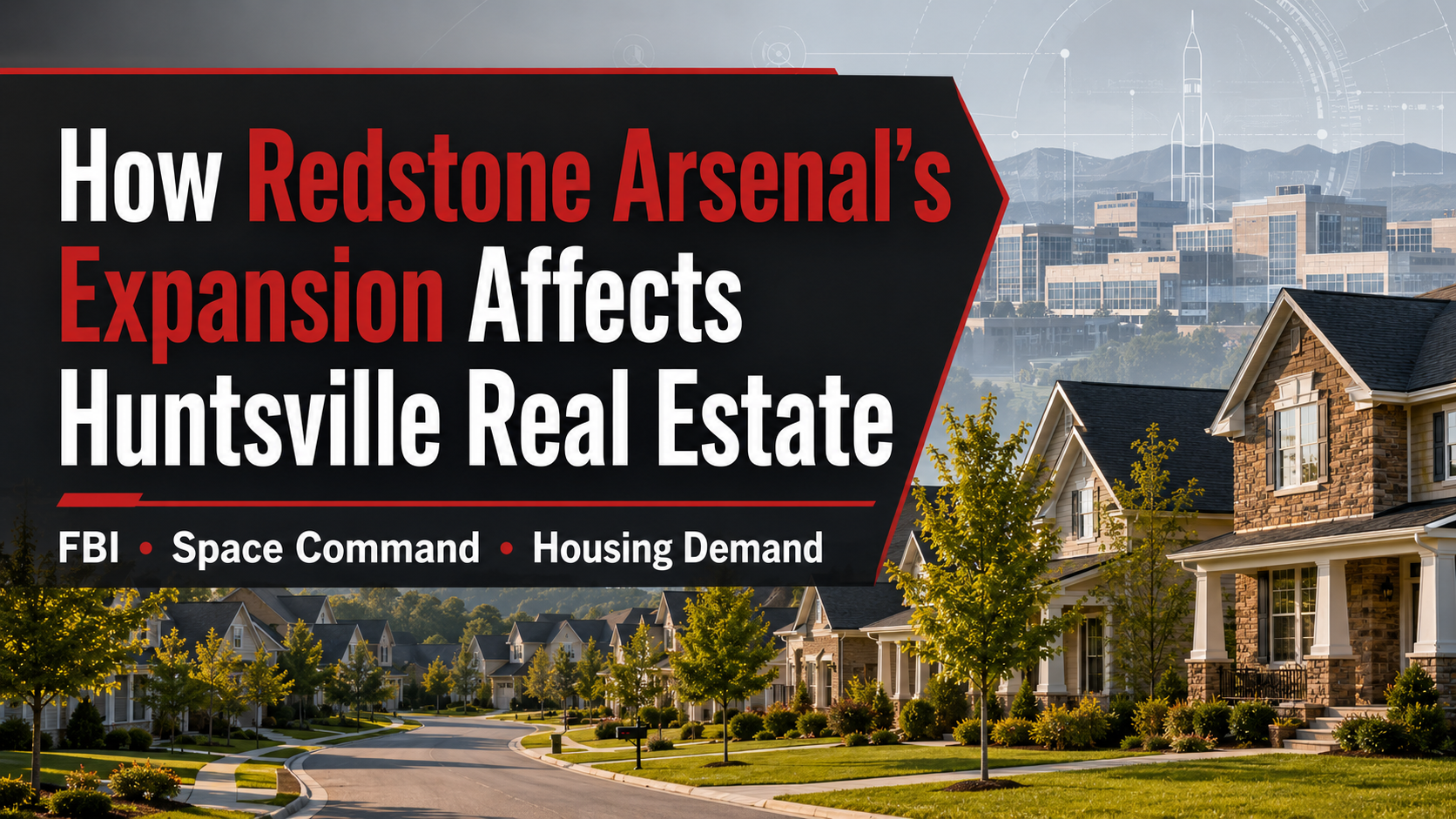
Huntsville’s housing market is transitioning to a more balanced market, making it essential for all participants to understand the evolving landscape.
Redstone Arsenal is one of the key reasons why Huntsville has a stronger housing market than many other cities of the same size. But its influence doesn’t stop at people who work right inside the gates—federal agencies, defense contractors, aerospace firms, research organizations, and service businesses all add households that need places to live in Huntsville, Madison, and surrounding communities.
What Does Redstone Arsenal’s Growth Mean for Huntsville Home Sellers?
Key Buyer Considerations
For Huntsville home sellers, Redstone’s growth means there’s a steady stream of buyers coming in with federal assignments, military moves, contractor hiring, and agency relocations. That demand helps keep the market ticking along, but it doesn’t guarantee that every home will sell quickly—or at any price.
Buyers are targeting homes in the $300K to $450K price range near Redstone Arsenal. Defense and aerospace employees prefer properties with optimized access to base gates. The bottom line for sellers is that there’s a bigger pool of buyers with defined relocation timelines, so you can bet they’re comparing several different neighborhoods and may only have a few days to make a decision. A home that’s priced right, easy to look at online, and ready to show can really stand out. Overprice it, and you risk losing that advantage fast—because relocating buyers don’t have a lot of time to faff about.
Neighborhood Comparisons
That’s why seller strategy still starts with looking at the competition. What’s out there on the market? What are the other homes like? What are the commute options? What’s the monthly payment? Redstone creates demand—but it doesn’t excuse poor pricing.
Seller Strategies
Well-priced and well-conditioned homes are selling, but sellers need to be realistic about their asking prices and what buyers can afford. Pricing and condition matter—a lot.
With this in mind, let’s explore how specific agencies are driving new demand in the area.
How Are the FBI and US Space Command Adding Housing Demand?
Agency Relocations and Market Impact
The FBI and US Space Command are adding housing demand through permanent personnel, support staff, contractors, and related private sector hiring. The FBI has more than 1,300 personnel working at Redstone Arsenal, and US Space Command started moving personnel and operations to Redstone in 2026—with about 1,400 direct jobs expected to move over the next few years. U.S. Space Command headquarters will relocate to Redstone Arsenal by late 2025.
The FBI has been operating at Redstone for decades, but its new campuses have made Huntsville a major hub for training, tech, logistics, and operational support. That creates demand from both permanent employees and the vendors who get to support the Bureau’s work.
And then there’s US Space Command, which isn’t just a future possibility any more. In April 2026, personnel from its intelligence directorate moved to Redstone, and the command took control of its very first dedicated facility right on the Arsenal. That’s going to happen in stages, which is good for housing because the demand is likely to build up over time rather than all at once. Huntsville’s real estate market benefits from steady incoming personnel rather than immediate surges.
With these agencies driving new demand, let’s look at where this impact is most visible in the local housing market.
Where Is Redstone-Related Housing Demand Most Noticeable?
Redstone-related demand is most noticeable in areas that combine good commute routes, the right price point, and the kind of housing that relocating buyers want. You can see it in:
- Southwest Huntsville
- Zierdt Road Corridor
- Madison
- County Line Road
- Harvest
- Monrovia
- Parts of Limestone County
The best choice will depend on the buyer’s specific needs and a clear view of Huntsville’s cost of living and typical commute patterns.
Southwest Huntsville and Zierdt Road Corridor
Southwest Huntsville is a great spot because it’s got direct access to Redstone’s Gate 7, the FBI campus, I-565, and all the employment centers near Cummings Research Park. It’s attractive to buyers who place a high value on commute time and want to be in a newer neighborhood or have easy access to Town Madison, MidCity, and the airport.
Madison and County Line Road
Madison remains a big relocation destination because it’s got newer construction, established neighborhoods, access to I-565, and a practical commute to both Redstone and Research Park. Seller demand can be strong, but buyers also have a lot of new-construction choices, so resale homes have to compete with builder pricing, incentives, and warranties—issues that come up often when buying brand new homes in Huntsville and Madison County.
Harvest, Monrovia, and the Limestone County Edge
Harvest, Monrovia, and eastern Limestone County appeal to buyers who want more house or land for their money. The trade-off is commute time—new roads and growth corridors can help, but buyers should always test the actual drive during normal working hours before making a decision on a neighborhood.
Now that we’ve covered where demand is most visible, let’s examine the latest housing numbers to see how these trends are reflected in the data.
What Do the Latest Madison County Housing Numbers Say?
The latest Madison County numbers show a stable market with steady appreciation, more buyer choice, and continued sales activity. In the second quarter of 2026, 2,271 homes sold, the median sales price reached $345,000, inventory totaled 2,706 homes, and the market had about 3.4 months of supply. Homes averaged 47 days on market.
| Metric | Q2 2026 | What It Suggests |
| Homes sold | 2,271 | Up 11.3% year over year |
| Median sales price | $345,000 | Up 1.8% year over year |
| Inventory | 2,706 homes | Stable overall supply |
| Months of supply | 3.4 months | Competitive but not overheated |
| Average days on market | 47 days | Pricing and condition matter |
Redstone Arsenal is having a stabilizing effect on the overall supply of homes in Huntsville. We’re not seeing any wild swings in the number of homes available to buy, and broader Huntsville real estate market trends and expert tips reinforce the picture of a steady, fundamentals-driven market.
Huntsville’s housing market is transitioning to a more balanced market. Redstone Arsenal—a key component of Huntsville’s housing market—continues to support stability, but buyers and sellers alike must pay attention to pricing, condition, and competition.
Next, let’s discuss how sellers can best respond to these Redstone-driven trends.
So, How Should Huntsville Sellers Respond to Redstone-Driven Demand?
Seller Strategies
The key is to price for the current competition, get your home ready for online comparison, and focus on the location in practical terms. What does that mean? Buyers want to know commute routes, nearby bases, access to major roads like I-565, the cost of ownership, and all that jazz. Giving them specific information is more persuasive than just saying you’re close to Redstone.
A good listing should tell buyers which gates and employment centers are a quick drive from the property, especially as Space Command’s move reshapes buyer demand and expectations. It should also acknowledge the competition from new construction—builder incentives can affect resale prices even if the homes aren’t identical.
It’s not about assuming a federal move will rescue an ambitious price. Instead, use Redstone’s demand as one part of a complete pricing and marketing plan.
With seller strategies in mind, let’s turn to what buyers should consider before making a move near Redstone.
What Should Buyers Consider Before Buying a Home Near Redstone?
Buyer Checklist
Before choosing a neighborhood, buyers should:
- Identify their likely work location and gate (Redstone is a big installation, and what looks close on a map may not actually be a quick commute)
- Compare property taxes
- Review HOA fees
- Evaluate new-construction incentives
- Analyze traffic patterns
- Consider the likely length of their assignment
- Use a structured Huntsville relocation and neighborhood-planning guide tailored to Redstone moves
- Conduct thorough inspections and due diligence (Alabama is a buyer-beware state; don’t rely on a standard seller disclosure form)
Now that buyers and sellers know what to look for, let’s consider the long-term investment outlook for Huntsville real estate.
Does Redstone Make Huntsville a Good Long-Term Investment Market?
The Long-Term View
Redstone Arsenal strengthens Huntsville’s long-term investment case, but a lot depends on the specifics of the property. A strong regional economy doesn’t make every property a good investment—purchase price, condition, rent potential, resale competition, commute patterns, and neighborhood-specific supply all matter, which is why a focused Huntsville real estate investing market guide can be so useful.
Redstone’s regional influence is significant, though. The City of Huntsville has reported more than 92,000 Department of Defense, government, and contractor jobs in the area, with a broad economic impact across the Tennessee Valley. That stability is a big plus, but investors still need to do their homework and look at the numbers specific to each property.
Let’s wrap up with answers to some frequently asked questions about Redstone Arsenal expansion and Huntsville real estate.
Have a question about the Huntsville housing market?
Get straight, local answers about selling, buying, relocating, investing, or building in the Huntsville area. No pressure.
Since 2005 · 500+ Families Served · 250+ Five-Star Reviews · BBB A+ Rated
Frequently Asked Questions
Is Redstone’s Expansion Raising Huntsville Home Prices?
Redstone supports demand and helps provide a stable employment base, but it’s not the only factor affecting prices. Mortgage rates, inventory, new construction, property condition, and neighborhood demand all play a role. Madison County’s Q2 2026 median sales price was $345,000, up 1.8% year over year.
What Are the Best Areas to Live If You Work at Redstone?
The best area depends on your work location, gate, budget, and commute preference. If you work at Gate 7, Southwest Huntsville and the Zierdt Road corridor are a good bet. If you’re near the I-565 intersection, Madison might be the way to go. If you’re looking for more space and don’t mind a longer commute, Harvest, Monrovia, or Limestone County are worth checking out.
Rent or Buy When Relocating for a Redstone Job?
Renting might make sense if you’re here for a short assignment or just getting to know the local commute. Buying makes more sense if you’re here for the long haul and can stomach the payment, maintenance risk, and likely resale timeline. Just think about your expected time in Huntsville and your complete ownership costs.
Will Space Command Create Immediate Housing Demand in Huntsville?
Space Command will add some demand, but it’s not going to be a big bang overnight. Personnel started permanently relocating to Redstone in 2026, and about 1,400 direct jobs are expected to transition over several years. The housing effect should build up gradually rather than all at once.
Is a Home Near Redstone Automatically Easier to Sell?
Nope. Being near Redstone can be a selling advantage, but you still need to price right, get the home ready to sell, and not assume that being close to work will get you top dollar.
What’s the Next Step for Your Huntsville Property?
Redstone’s expansion may improve the buyer pool, but the effect on your property depends on its location, condition, price range, and competition. First things first—get a sense of how buyers are comparing your home and whether it makes more sense to sell or rent your Huntsville property in the current market. Then you can decide whether selling makes sense for your goals and timeline.
Schedule a 20-minute strategy call to review your property, the current competition, and what Redstone-related demand may mean for your next move.
About Steve Stinson
Steve Stinson is a REALTOR® and Broker Associate with Keller Williams Realty in Huntsville, Alabama. He has served buyers and sellers across Madison County since 2005.
Steve specializes in getting sellers the best result, with particular strength in new construction homes, relocation, downsizing, and buying or selling investment properties. He works with clients in Huntsville, Madison, Hampton Cove, Owens Cross Roads, and the surrounding North Alabama area, and helps owners weigh open-market sales against local cash-buyer offers so they can compare speed, price, and terms with confidence.
He has helped more than 500 families make A Wise Move and earned 250+ five-star reviews. Steve is a Best of Zillow award recipient and consistently ranks in the top 5% of the local MLS as a listing agent. A lifelong Alabamian and 40-plus-year resident of the area, he brings deep local knowledge and pricing strategy to every move, whether you’re navigating a seller’s market or deciding how to compete for a home in a hot one.
Equal Housing Opportunity. This article is general information only. It is not legal, tax, or financial advice. Confirm your specific costs, tax obligations, and transaction details with your closing attorney, tax advisor, lender, or escrow officer. Broker compensation is fully negotiable and not set by law; no standard or typical rate exists.