Huntsville Cost of Living: Complete Guide
People often move to Huntsville for a career at Redstone Arsenal, NASA, Cummings Research Park or the FBI, but they stay because life here is surprisingly easy. If you’re considering moving to or living in Huntsville, this page will cover everything you need to know about the cost of living, housing, commute, and lifestyle in the area. Whether you’re relocating for work or simply seeking a better quality of life, you’ll find detailed information on what it costs to live here, what daily life is like, and how Huntsville compares to other cities. The reality is that Huntsville’s cost of living is about 9% to 10% lower than the national average, making it an attractive option for newcomers.
Before diving in, here’s a quick summary of what you’ll find on this page:
- A breakdown of Huntsville’s cost of living, including housing, rent, utilities, groceries, transportation, and healthcare.
- Insights into the local housing market and how far your dollar goes.
- An overview of commute times and transportation options.
- A look at Huntsville’s lifestyle, outdoor amenities, and social scene.
- Answers to the most common questions about moving to or living in Huntsville.
Huntsville Cost of Living at a Glance
Huntsville cost of living is about 9% to 10% lower than the national average. Here’s how key expenses compare:
- Housing: Average home sale price is $320,000 to $380,000. Many homes are priced between $250,000 and $350,000.
- Rent: Median rent ranges from $1,084 to $1,233 per month, about 30% cheaper than the U.S. average.
- Utilities: Typical monthly utility costs for single-family homes are $150 to $250, about 11% below the national average.
- Groceries: Grocery costs are approximately 8.8% below the national average.
- Transportation: Transportation costs are roughly 4% lower than the national average, with most commutes between 15 and 30 minutes.
- Healthcare: Healthcare costs are about 8% lower than the national average.
- Overall monthly expenses: Estimated at around $2,100 for a single person.
What Does “Cost of Living” Mean?
Cost of living refers to the total amount of money needed to cover basic expenses such as housing, utilities, groceries, transportation, and healthcare in a specific location. Understanding these factors helps you compare Huntsville to other cities and plan your budget accordingly.
Cost of Living and Real Estate: Your Dollar Goes Further
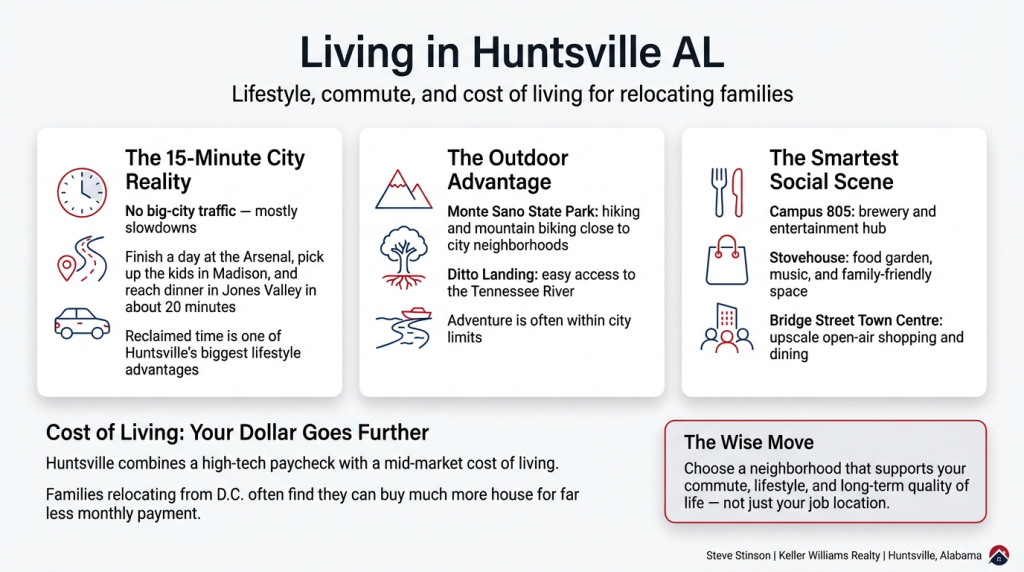
The reality is that Huntsville’s cost of living is about 9% to 10% lower than the national average. When families relocate from D.C. or other major metros, they often find they can buy twice the house for half the mortgage. Many homes here are priced between $250,000 and $350,000, with the average home sale price often landing around $320,000 to $380,000. I help you leverage that “equity gap” to either buy a home that builds wealth or a lifestyle that allows for more travel and family time.
Renting is also affordable, with median rent roughly $1,084 to $1,233 per month for multifamily and $1,800 to $2,200 for single family, over 30% cheaper than the U.S. average. Alabama has some of the lowest property taxes in the country, so buyers often get more space for their money.
Typical utility costs for single-family homes run about $150 to $250 per month, and monthly energy bills are generally 11% below the national average. Groceries in Huntsville are about 8.8% below the national average, and healthcare costs are about 8% lower than the national average. Transportation costs are roughly 4% lower than the national average, with most commutes between 15 and 30 minutes depending on location and traffic.
Understanding these cost factors is essential for anyone considering a move to Huntsville, as they directly impact your monthly budget, quality of life, and how you navigate current Huntsville real estate market conditions. Next, let’s explore what makes Huntsville’s lifestyle unique and how it complements the city’s affordability.
The Outdoor Advantage
Huntsville is geographically unique. We are nestled in the foothills of the Appalachians, meaning “adventure” is usually within city limits.
- Monte Sano State Park: Offering over 2,000 acres of hiking and mountain biking trails. If you live in Blossomwood, the trailhead is practically in your backyard.
- The Tennessee River: Ditto Landing is our gateway to the water. Whether you’re into boating or just want a quiet walk by the river, it’s a vital part of the local lifestyle.
Access to outdoor recreation not only enhances your quality of life but also provides affordable entertainment options, helping you make the most of Huntsville’s lower cost of living.
The “Smartest” Social Scene
Because we have the highest concentration of PhDs and engineers in the country, our social scene is a bit different.
- Campus 805: An old middle school converted into a brewery and entertainment hub. You can literally grab a craft beer in a former classroom. It’s fun, quirky, and uniquely Huntsville.
- Stovehouse: An outdoor “food garden” that is perfect for Friday nights. It offers live music, diverse food options, and plenty of space for kids to run around while the adults relax.
- Bridge Street Town Centre: An upscale, open-air shopping and dining district that feels more like a European village than a traditional mall.
These unique social venues contribute to Huntsville’s vibrant lifestyle, offering residents affordable and engaging ways to connect with the community while enjoying the benefits of a lower cost of living.
The “15-Minute City” Reality
In plain terms: We don’t really have “traffic” in the way people from Virginia or California understand it. We have “slowdowns.”
- The Reality: You can finish a day at the Arsenal, pick up your kids from school in Madison, and be at a restaurant in Jones Valley in about 25 minutes. That reclaimed time is the biggest “bonus” of moving to North Alabama.
Efficient commutes not only save you time but also reduce transportation costs, further enhancing Huntsville’s affordability and overall appeal.
Before we dive into the details, here’s a helpful FAQ section that addresses the most common questions about cost of living, housing, and lifestyle for newcomers to Huntsville.
FAQ
What is it like living in Huntsville, Alabama?
Huntsville offers a mix of career opportunity, affordability, and quality of life. The city is driven by technology, defense, and aerospace industries, which attracts a steady flow of professionals and families and fuels a consistently active Huntsville residential real estate market. In plain terms, it’s a growing city with a strong job base and a more relaxed pace than larger metros.
What is the cost of living in Huntsville compared to other cities?
Huntsville is generally more affordable than many major metropolitan areas, especially when it comes to housing. Alabama has some of the lowest property taxes in the country, and buyers often get more space for their money, but it’s still important to understand what your Huntsville home is worth in the current market.
Key cost comparisons:
- Housing: Average home sale price is $320,000 to $380,000; many homes are priced between $250,000 and $350,000.
- Rent: Median rent is $1,084 to $1,233 per month for multifamily and $1,800 to $2,200 for single family (over 30% cheaper than the U.S. average).
- Utilities: $150 to $250 per month (about 11% below the national average).
- Groceries: 8.8% below the national average.
- Transportation: 4% lower than the national average; most commutes are 15–30 minutes.
- Healthcare: 8% lower than the national average.
- Overall monthly expenses: Around $2,100 for a single person.
While some costs are higher than they were a few years ago, housing costs in Huntsville are still 9.34% lower than average, making it a strong value market for both homeowners and real estate investors in Huntsville.
How is the commute in Huntsville?
Commutes in Huntsville are typically manageable, and transportation costs are roughly 4% lower than the national average. Most commutes range between 15 and 30 minutes depending on location and traffic, which also affects whether it makes more sense to sell or rent out your Huntsville home if your job or lifestyle changes.
Areas near Redstone Arsenal and major employers can see congestion during peak hours, though gas costs still matter when choosing where to live. Choosing the right location can make a noticeable difference in your daily routine and what residents pay to commute.
What are the best areas to live based on lifestyle?
Madison is popular for convenience and schools, while Southeast Huntsville offers established neighborhoods and outdoor access. Downtown Huntsville provides a more urban feel with restaurants and entertainment, and many newcomers also consider buying brand new construction homes in Huntsville when comparing areas.
The right area depends on how you want to spend your time day to day.
Is Huntsville a good place for families?
Yes, Huntsville is often considered a strong choice for families due to its job stability, school options, and community environment. There are parks, greenways, and family-friendly amenities throughout the area.
Many families relocate here for both career and lifestyle reasons, and homeowners planning a move often want to understand what they’ll actually net from selling a Huntsville home.
What should I consider before a home sale or moving to Huntsville?
Key factors include job location, commute, housing budget, and neighborhood fit, but you should also research costs like groceries, utilities, and healthcare before moving, and think about how to price your Huntsville home to sell if you’ll be listing a property as part of the move.
- Groceries: About 8.8% below the national average.
- Utilities: $150 to $250 per month; energy bills are generally 11% below the national average.
- Monthly expenses: Estimated around $2,100 for a single person.
- Healthcare: About 8% lower than the national average.
It’s important to align where you live with how you plan to live. Having a clear plan before moving helps you avoid common mistakes, and with about $66,416 needed to maintain living standards, a living calculator can help you figure whether your budget will support the move and how to handle issues like a low appraisal on a Huntsville home sale if they arise.
The bottom line:
Huntsville isn’t just a place to work; it’s a community that supports your lifestyle. Making the move here is the first step, but choosing the right neighborhood to enjoy it is A Wise Move, especially if you’re thinking about longer-term strategies like acquiring rental property in Huntsville before year-end.
Ready to make A Wise Move?
If you’re thinking about selling in Huntsville or Madison County, let’s talk through the smartest way to approach it.
Since 2005 · 500+ families helped · 250+ five-star reviews · BBB A+ rated
About Steve Stinson
Steve Stinson is a REALTOR® and Broker Associate with Keller Williams Realty in Huntsville, Alabama. He has served buyers and sellers across Madison County since 2005.
Steve specializes in getting sellers the best result, with particular strength in new construction homes, relocation, downsizing, and buying or selling investment properties. He works with clients in Huntsville, Madison, Hampton Cove, Owens Cross Roads, and the surrounding North Alabama area, and helps owners weigh open-market sales against local cash-buyer offers so they can compare speed, price, and terms with confidence.
He has helped more than 500 families make A Wise Move and earned 250+ five-star reviews. Steve is a Best of Zillow award recipient and consistently ranks in the top 5% of the local MLS as a listing agent. A lifelong Alabamian and 40-plus-year resident of the area, he brings deep local knowledge and pricing strategy to every move, whether you’re navigating a seller’s market or deciding how to compete for a home in a hot one.