
How Much Will You Net Selling Your Home in Huntsville, AL?
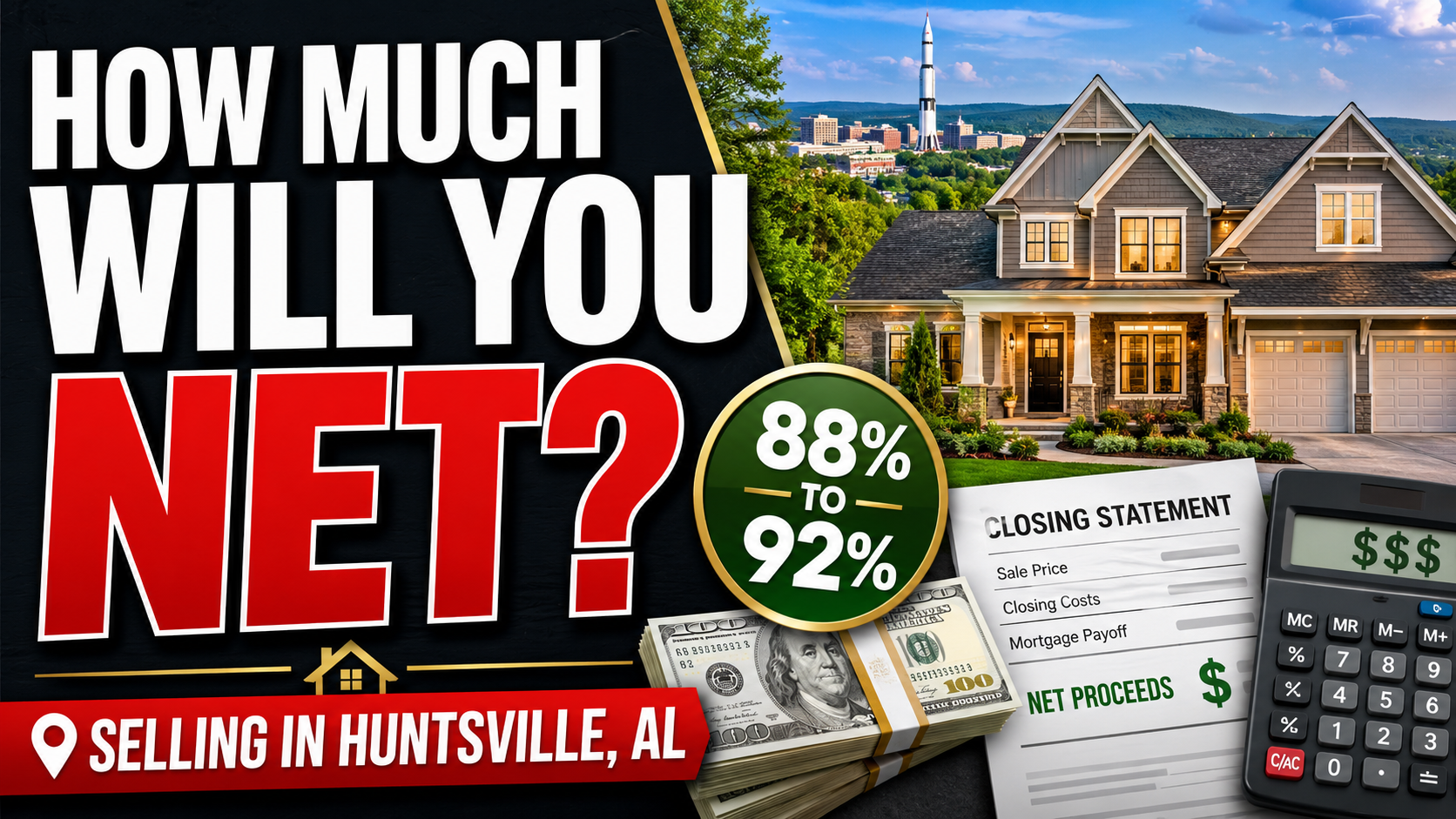
Answer: Most Huntsville home sellers net between 88% and 92% of their sale price after accounting for real estate commissions, owner’s title insurance, closing attorney fees, and any seller concessions. On a $350,000 home, that typically means walking away with $308,000 to $322,000 before mortgage payoff. Alabama has no real estate transfer tax, which gives sellers here a real cost advantage over many neighboring states. Your actual net depends on your remaining mortgage balance, how the home is priced and presented, and what terms you negotiate.
How much will I net from selling my home in Huntsville, Alabama?
Here’s the honest answer before anything else: you will not net your sale price.
That sounds obvious, but it catches sellers off guard every time. The number most people fixate on — the list price, the Zestimate, what the neighbor got — is the gross number. What you actually deposit into your account is different. Sometimes meaningfully different.
This is the question I get asked more than almost any other when someone calls to talk about selling in the Huntsville and Madison County area. And it’s the right question. You can’t make a wise move without knowing the real number first.
Video: How Much Money Will You Actually Keep When Selling Your Huntsville Home?
Selling your home in Huntsville or Madison County? Your selling price isn’t the amount you’ll walk away with at closing. Mortgage payoff, real estate commissions, closing costs, and negotiated buyer concessions all affect your final proceeds.
In this video, I explain how a seller net sheet works, which expenses homeowners should anticipate, and why calculating your estimated net proceeds before listing is essential to making an informed selling decision.
How Can You Estimate Your Net Proceeds Before Selling?
The most important number isn’t necessarily what your home sells for. It’s how much money you keep after all expenses and your mortgage payoff.
Two Huntsville homeowners selling at the same price can walk away with very different amounts depending on their loan balances, negotiated concessions, and closing expenses.
Below, we’ll break down the typical costs of selling a home in Alabama, walk through a realistic example, and show you how to use the seller net sheet calculator to estimate your own proceeds.
The Major Costs Sellers Pay at Closing in Alabama
Real estate commissions take the biggest piece of your proceeds. In the Huntsville market, the total commission typically runs 5% to 6% of the sale price, split between the listing agent and the buyer’s agent. On a $350,000 home, that’s $17,500 to $21,000.
Title insurance is a cost most sellers don’t anticipate. In Alabama, sellers and buyers customarily split the cost for the title insurance policy, which protects the buyer against future title claims. The seller cost typically runs $1,000 to $2,000 depending on your sale price. It’s a one-time cost at closing, and in most transactions in this area, the seller covers it.
Closing attorney fees are specific to Alabama. Unlike many states where a title company handles the closing, Alabama law requires a licensed real estate attorney to conduct the closing, review the title, and prepare the deed. The buyer typically selects and pays the closing attorney, but seller-side legal documentation may carry its own preparation fees. Budget $400 to $800 for the seller’s portion of related costs.
There is no state or local real estate transfer tax in Alabama. This matters. Many states charge a percentage of the sale price just to transfer ownership. Alabama does not. That’s real money you keep compared to sellers in Georgia, Tennessee, or several other neighboring states.
Seller concessions are negotiated, not fixed, but they’re common enough to factor in. A buyer might ask you to contribute toward their closing costs, particularly in a market where buyers have more negotiating leverage. In Huntsville right now, with roughly five to six months of inventory on the market, concession requests happen. Budget 1% to 3%, depending on how your home is priced and presented.
Your mortgage payoff is the number most people forget to subtract. Whatever you still owe comes off the top before you see a dollar. Request a payoff statement from your lender early in the process. The payoff amount changes monthly, so you’ll need an updated figure right before closing.
Schedule Your Strategy Call
What That Actually Looks Like on a Real Number
Here’s a straightforward example for a $350,000 home sale in Madison County:
- Sale price: $350,000
- Agent commissions (5.5%): -$19,250
- Owner’s title insurance: -$1,400
- Closing attorney and document prep (seller side): -$600
- Prorated property taxes and HOA (if applicable): -$500 to $1,000
- Seller concessions (estimate 1%): -$3,500
- Estimated total closing costs: approx. $25,250 to $25,750
- Estimated gross proceeds before mortgage payoff: approx. $324,250
Your mortgage payoff determines what you actually net. If you owe $200,000, you’d walk away with around $124,000 in this scenario. If you’re nearly paid off, you net significantly more.
These numbers are estimates. Your specific home, the condition it’s in, how it’s priced, and the terms you negotiate will all affect the final figure. The only way to know your real number is to run it with someone who knows the Huntsville market and your specific situation.
Seller Net Sheet
What About Capital Gains?
Most sellers in Huntsville and the surrounding Madison County area don't owe capital gains tax on their home sale, but it's worth knowing the rule.
If you've lived in the home as your primary residence for at least two of the last five years, you can exclude up to $250,000 of gain from federal taxes if you file as a single person, or up to $500,000 if you're married and file jointly. For most homeowners in the $250,000 to $700,000 price range, that exclusion covers the full gain.
If your situation is more complex — an investment property, a home you've rented out, or a gain that exceeds the exclusion — talk to a CPA before you list. Alabama taxes capital gains not covered by that exclusion at 5% as ordinary income.
The two-year rule doesn't have to be continuous. If you lived in the home for a year, rented it for a period, then moved back in, you may still qualify. A tax professional can confirm.
The Variables That Actually Move Your Net
A few factors affect your net more than any single line item on the closing statement.
Pricing. Homes priced correctly in Huntsville right now sell and close in 60 to 75 days on average and close near asking price. Overpriced homes sit, take price reductions, and ultimately sell for less than a well-priced listing would have fetched on day one. Your final sale price is the starting point for everything else, which means getting the price right directly affects your bottom line.
Condition and preparation. Sellers who address obvious deferred maintenance, get a pre-listing termite inspection (termites are active year-round in North Alabama), and present their home well typically receive stronger offers and fewer repair requests after inspection. Repair credits and post-inspection negotiations come out of your net.
Market conditions. Huntsville's market has been historically strong, driven by job growth from Redstone Arsenal, Blue Origin, Boeing, Dynetics, and now the anticipated FBI and Space Command relocations, which is expected to bring thousands of new jobs to the area over the next several years. That sustained demand holds prices. But inventory has increased this year, and buyers have more negotiating room than they did in 2021 and 2022. Pricing and preparation matter more now than they did three years ago.
If you're in Owens Cross Roads, Hampton Cove, or Madison city proper, your market dynamics may look slightly different from broader Huntsville averages. Neighborhood-level data gives you a more accurate picture than metro-wide numbers.
Have a question about the Huntsville housing market?
Get straight, local answers about selling, buying, relocating, investing, or building in the Huntsville area. No pressure.
Since 2005 · 500+ Families Served · 250+ Five-Star Reviews · BBB A+ Rated
Frequently Asked Questions
Does Alabama have a real estate transfer tax?
No. Alabama has no state or local real estate transfer tax. This is one area where Alabama sellers have a genuine cost advantage over sellers in many other states, including Georgia and Tennessee.
Who pays closing costs in Alabama — the buyer or the seller?
Both parties pay closing costs, but different ones. Sellers in Alabama typically pay real estate commissions, half of the title insurance, and their share of prorated taxes. Buyers pay lender fees, their portion of the title insurance, closing attorney's charges, and recordation fees. Sellers may also agree to contribute toward buyer closing costs as part of the negotiation.
How long does it take to close after accepting an offer in Alabama?
Most financed transactions in Alabama close within 30 to 45 days of an accepted offer. The closing attorney prepares the deed and closing documents, reviews the title, and coordinates with the buyer's lender. The actual closing appointment typically takes one hour.
Do I need to fill out a seller disclosure form in Alabama?
No. Alabama is a buyer beware state, which means there is no required seller disclosure form. Sellers are not legally obligated to proactively disclose defects. However, intentional concealment of known material defects or any health and safety issue you're aware of can create legal liability. If a buyer directly asks about a specific issue, you're expected to answer honestly.
Can I sell my house in Huntsville if I still owe money on my mortgage?
Yes. Most sellers still have a mortgage when they list. Your loan gets paid off at closing from the sale proceeds. You'll need to request a formal payoff statement from your lender, which includes the remaining balance plus any applicable fees. The closing attorney coordinates the payoff as part of the transaction.
Your net proceeds are the number that actually matters. That's what determines whether your next move makes financial sense, and it's the number we work backward from when planning any sale in this market.
If you want to run through this for your specific home, I'd be glad to help. Schedule a free 20-minute strategy call — no pressure, just straight answers on what your home is worth, what you'd net, and what the timeline looks like in today's Huntsville market.
About Steve Stinson
Steve Stinson is a REALTOR® and Broker Associate with Keller Williams Realty in Huntsville, Alabama. He has served sellers and buyers across Madison County since 2005.
Steve's practice centers on four areas: listing and selling homes, relocation to the Huntsville market, investment property, and new construction. He also handles expired listings and downsizing. He works with clients in Huntsville, Madison, Hampton Cove, Owens Cross Roads, and surrounding Madison County communities, and helps owners weigh open-market sales against local cash-buyer offers so they can compare speed, price, and terms with confidence.
He has served 500+ families making A Wise Move and earned 250+ verified 5-Star reviews, most of them on Google. Steve is a Best of Zillow award recipient and consistently ranks in the top 5% of the local MLS as a listing agent. A Madison County resident since 1980, he brings deep local knowledge and pricing strategy to every move.
Equal Housing Opportunity. This content is general information only. It is not legal, tax, or financial advice. Confirm your specific costs, tax obligations, and transaction details with your closing attorney, tax advisor, lender, or escrow officer. Broker compensation is fully negotiable and not set by law; no standard or typical rate exists.
Disclaimer:
This article is for general informational purposes only and should not be considered tax, legal, financial, or investment advice. Real estate decisions can have important tax, legal, and financial consequences, and every situation is different. Before making decisions about selling a home, calculating proceeds, capital gains, investments, or legal obligations, consult with a qualified CPA, attorney, financial advisor, or other licensed professional familiar with your specific situation.