
Seller Concessions in Alabama: What They Are and When to Say Yes
By Steve Stinson | June 19, 2026
What are seller concessions in Alabama real estate?
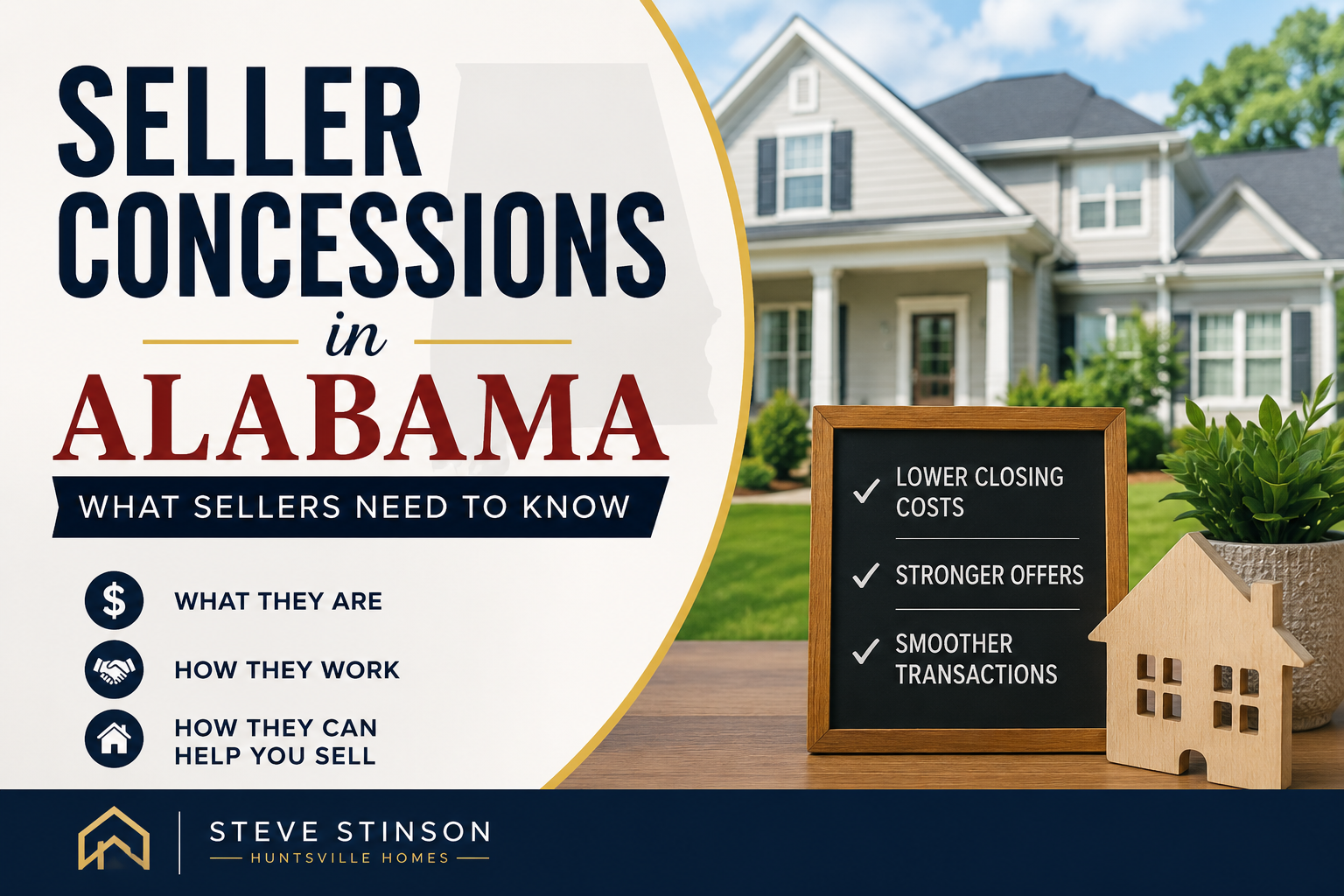
Seller concessions are credits or contributions a seller agrees to pay at closing on the buyer’s behalf, most commonly to cover the buyer’s closing costs, buy down their interest rate, or address a repair credit. In Alabama, where buyer closing costs typically run 2% to 5% of the purchase price, concessions are a common negotiating tool. They reduce your net proceeds but can be the difference between closing a deal and losing it.
Seller concessions come up in almost every negotiation. They’re also one of the most misunderstood parts of the transaction.
Some sellers refuse them on principle. They see it as “giving money away.” Others agree too quickly without understanding what they’re actually netting. Neither approach is right. The right answer depends on your specific deal, your timeline, and what the market is telling you.
Here’s a clear-eyed look at how concessions work in Alabama and how to think about them when they come up at the negotiating table.
What Seller Concessions Actually Are
A seller concession is a dollar amount you agree to credit to the buyer at closing. It comes out of your net proceeds, the same pile of money that would otherwise come to you. The buyer uses the credit to offset their closing costs, reduce their interest rate, cover repairs, or some combination of those.
The most common types:
- Closing Cost CreditThe buyer asks the seller to pay some or all of their closing costs. Buyer closing costs in Alabama typically run 2% to 5% of the purchase price, which on a $350,000 home is $7,000 to $17,500, and can include appraisal fees, title insurance, loan origination fees, inspection fees, and attorney fees. Most sellers don’t pay all of that. The typical ask is 2% to 3%.
- Repair CreditWhen a home inspection reveals issues and the buyer wants a credit instead of completed repairs, the buyer requests a credit in lieu of repairs. Instead of having work done before closing, you give the buyer money to handle it themselves.
- Rate BuydownThe buyer asks you to contribute toward buying down their mortgage interest rate. This became more common as rates rose. A 1-point buydown on a $300,000 loan costs roughly $3,000 and lowers the buyer’s rate by approximately 0.25%.
- Home WarrantyA home warranty policy at closing (typically $500 to $700 in Alabama) is a small concession that can address buyer anxiety, especially in older homes.
Loan Type Limits Matter
This is the piece most sellers don’t know: seller concession limits in Alabama vary by loan type.
| Loan Type | Max Seller Concession |
|---|---|
| Conventional loans (under 10% down) | 3% of purchase price |
| Conventional loans (10 to 25% down) | 6% of purchase price |
| Conventional loans (over 25% down) | 9% of purchase price |
| FHA | 6% of purchase price |
| VA | 4% of purchase price (including all concessions) |
| USDA | 6% of purchase price |
| Mortgage authorities set strict caps on concessions based on the loan programs. For Federal Housing Administration (FHA) loans, sellers can contribute up to 6%. For conventional loans, conventional loans typically range from 3% to 6% in common scenarios, and the limit varies based on the loan to value ratio and down payment. VA loans and USDA loans have their own seller concession limits as well. | |
| If you agree to a concession that exceeds the loan type cap, the excess doesn’t go to the buyer. It simply evaporates. The lender will not allow it. So if a VA buyer asks for a $15,000 concession on a $300,000 sale and the cap is 4% ($12,000), which is generally negotiated in the purchase agreement and can be expressed as a fixed dollar amount, you can’t solve the problem by agreeing to $15,000. The deal has to be restructured. |
Your closing attorney will catch this, but it’s worth knowing before you negotiate, because maximum seller concessions are typically limited to a percentage of the home’s purchase price or home’s sale price.
What Seller Concessions and Closing Costs Actually Cost You
Here’s the math that matters. Concessions reduce your net proceeds dollar for dollar. But they don’t affect your sale price, which means they don’t affect your agent’s commission calculation (which is based on sales price, not net proceeds).
On a $375,000 sale with $8,000 in seller concessions:
- Your sale price is $375,000
- Your net proceeds decrease by $8,000 compared to a no-concession deal
- Commission calculates on $375,000, not $367,000
That sounds straightforward. But there’s a more useful way to think about it.
If you had priced the home at $367,000 with no concessions, your net would be nearly identical. So the question isn’t “do I want to give money away.” It’s “is this concession serving the same function as a price reduction, or is it doing something a price reduction can’t do?”
Concessions are one line item in a larger calculation. Understanding your full net picture and how to price your home correctly in Huntsville before making this decision is worth the time.
When Saying Yes Makes Sense
Concessions are worth offering when they solve a problem the buyer genuinely has, and when that problem would otherwise kill your deal.
The buyer is cash-constrained at closing
A well-qualified buyer can make the monthly payment but doesn’t have enough liquid cash to cover their down payment AND closing costs, so a concession from you reduces their upfront costs and lowers their financial burden at closing. Without it, they can’t close, not because they can’t afford the house, but because of a timing issue with their savings.
The inspection turned up repairs you would rather not manage
A repair credit lets you hand the money to the buyer and skip the project. This is almost always cleaner than being a seller trying to coordinate contractor work before closing, especially if you’re already moved out, and it pairs well with deciding whether to sell your house as-is or make targeted repairs first.
You’re in a slower market and you’ve had no other offers
In a market with 5.9 months of inventory like Huntsville’s current conditions and broader real estate trends, concessions are more common because buyers have negotiating leverage. Offering concessions can attract potential buyers and may lead to faster sales and more interest in the property. Nationally, about 44% of sellers gave concessions in Q1 2026 according to Redfin data. As I reported last month in the Greater Huntsville Q1 ’26 Residential Market Report, in Q1 2026, sellers contributed to closing costs in 63.4% of all transactions in the greater Huntsville market. In a balanced or buyer’s market, a concession request isn’t a signal the buyer is weak. It’s a normal part of the negotiation.
A rate buydown makes the payment work
Some buyers are stretching to qualify at current rates, especially those using VA loan offers in Huntsville. A 1% or 2% temporary buydown, funded by you, can make the monthly payment workable in year one and year two while they refinance when rates drop. This is a legitimate tool that can make a deal happen that wouldn’t otherwise.
When to Push Back
Concessions are not always the right answer. There are situations where saying no, or saying “yes, but at a lower purchase price,” is the better move.
If you already have multiple offers
You have no obligation to offer concessions when you have real competition for your home. In that situation, the market is working in your favor and you don’t need to fund the buyer’s closing.
If the concession request exceeds what the loan type allows
Agreeing to an amount the lender won’t allow wastes everyone’s time. Counter with the actual allowable amount, since it is generally negotiated.
If you’d rather reduce the price than give a credit
A price reduction and a closing cost credit are mathematically similar from your net proceeds standpoint, but not identical. Concessions show up as a credit on the HUD and can affect how your home is perceived in future appraisals. Some agents prefer a clean price reduction for this reason. In Alabama, standard contracts often have the buyer and seller split certain closing fees evenly, so check the contract before deciding how much credit is really needed. Have the conversation with your agent and decide what you prefer.
If the request is padded
Some buyers ask for more than they need, expecting you to counter. Know what comparable homes have sold for with and without concessions in your price range before you respond.
The bottom line is that seller concessions are a tool, not a concession of defeat. The right answer depends on the deal, the buyer, and what you’re ultimately trying to accomplish.
If you have an offer in hand and you’re working through the math, let’s walk through the full picture so you know exactly what you’re netting before you sign.
Schedule a free 20-minute strategy call
Frequently Asked Questions
How much in seller concessions is typical in Huntsville?
In Huntsville, seller concessions typically range from 1% to 3% of the purchase price, though they can go higher depending on loan type. On a $350,000 home, 2% is $7,000. The amount depends on what the buyer asks for, what their loan type allows, and what the market supports. In a buyer’s market with longer days on market, concession requests are more common and often larger.
Do seller concessions come off the sale price?
No. Concessions reduce your net proceeds at closing but don’t change the recorded sale price. Your home still sold at its full price on paper even if you gave a credit. This matters because the gross sale price is what shows up in MLS records and what future appraisers use as a comparable sale.
Can a seller offer concessions in Huntsville without the buyer asking?
Yes. A seller can include concessions proactively as part of a counteroffer or listing pitch. Some sellers in slower markets offer a stated closing cost credit to attract buyers. Just be aware of the loan type caps. You can’t offer more than the lender will allow, and the offer will need to be structured properly in the purchase agreement.
What’s the difference between a seller concession and a price reduction?
Both reduce what you net. A price reduction lowers the recorded sale price, which affects appraisals and comps. A concession keeps the gross price intact but credits money back to the buyer at closing. For most sellers at most price points, the practical difference is small, but your agent can advise on which approach is cleaner given your situation.
Do seller concessions affect the home’s appraisal?
Concessions don’t directly lower the appraised value, but they are disclosed in the transaction and noted by appraisers. If concessions are unusually high, an appraiser may adjust the comparable sale value slightly downward. For most standard concession amounts (2% to 3%), the impact is minimal.
About Steve Stinson
Steve Stinson is a REALTOR® and Broker Associate with Keller Williams Realty in Huntsville, Alabama, serving home buyers and sellers across Madison County since 2005. Learn more about how Steve has helped 500+ families move in Huntsville. He specializes in new construction homes in Huntsville and Madison County, relocation moves to Huntsville, downsizing in the Huntsville area, and investment property guidance in Huntsville and Madison County in addition to seller representation across Huntsville, Madison, Hampton Cove, Owens Cross Roads, and the surrounding North Alabama market. Steve has helped more than 500 families make confident real estate decisions, earned 250+ verified 5-star reviews, received the Best of Zillow award, and consistently ranks in the top 5% of the local MLS as a listing agent. A lifelong Alabamian and 40+ year Huntsville-area resident, Steve brings local market knowledge, pricing strategy, and negotiation experience to every move. Learn more at stevestinsonhuntsvillehomes.com
Ready to make A Wise Move?
If you’re thinking about selling in Huntsville or Madison County, let’s talk through the smartest way to approach it.
Since 2005 · 500+ families helped · 250+ five-star reviews · BBB A+ rated