
Short Term Rentals in Huntsville & Madison, AL: Buyer’s Guide
This guide is for buyers considering short-term rental investments in Huntsville, Madison, or Madison County, Alabama. Understanding local rules is crucial for investment success because short-term rental regulations vary significantly by city, county, and even neighborhood. Failing to comply with zoning, licensing, or HOA restrictions can result in fines, forced closure, or loss of rental income. Whether you’re looking at Huntsville’s vibrant downtown, Madison’s family-friendly neighborhoods, or rural Madison County, knowing the legal landscape is the first step to a profitable and compliant investment.
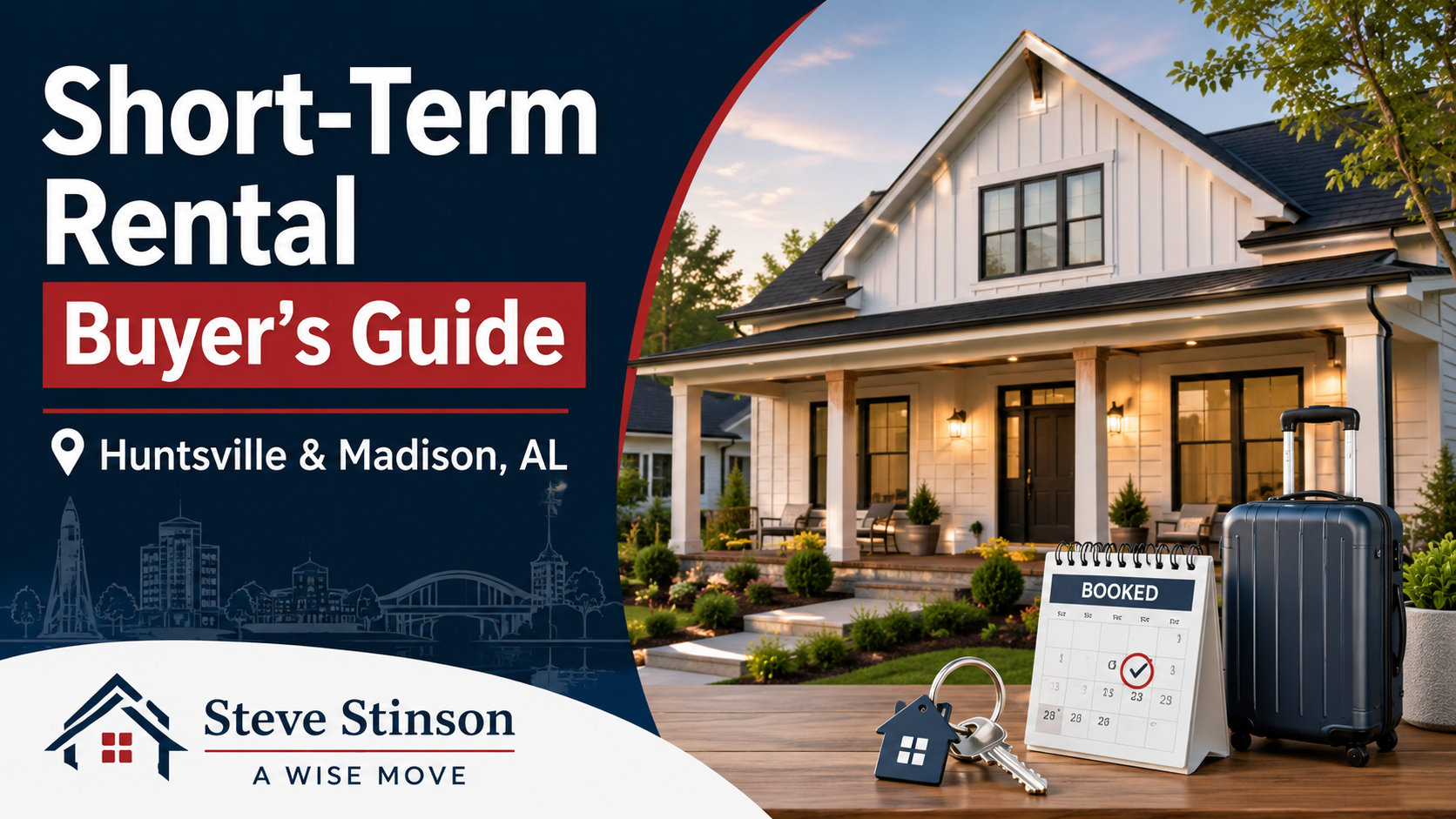
Buying a short-term rental in Huntsville or Madison, Alabama, can be a smart investment, but only if the property can legally operate as an Airbnb or VRBO. Before you buy, confirm the rules for the exact address, including zoning, licensing, taxes, HOA restrictions, and city or county requirements.
Short-term rental rules are not the same across North Alabama. A property near Redstone Arsenal, Research Park, Town Madison, Hampton Cove, Harvest, or rural Madison County may fall under very different rules depending on whether it is inside Huntsville, inside Madison, or in an unincorporated part of the county.
Legal Requirements Overview
In Huntsville, all short-term rentals must have a business license, hosts must adhere to city permits, and zoning approval is required. Short-term rentals are not permitted in most residential zoning districts and are treated as motels under zoning laws. Madison has specific code enforcements regulating short-term rentals.
What Changed for Huntsville and Madison Short-Term Rentals in 2026?
Short-term rental rules changed substantially in the Huntsville-Madison market during 2026. The City of Madison created a new permitting system with a citywide cap, while Huntsville has increased enforcement against STRs operating in prohibited residential zoning districts. For investors, verifying the exact jurisdiction and zoning before buying is now more important than ever.
City of Madison Now Allows STRs, But With Strict Limits
The City of Madison adopted new short-term rental regulations in June 2026 that took effect July 1. This was a significant change because STRs previously were not an approved use under Madison’s zoning rules. The city now has a formal system for approving, permitting and licensing short-term rentals.
According to the City of Madison’s current short-term rental regulations, Madison now allows qualifying short-term rentals subject to zoning approval and a detailed permitting process. The city established a cap of 190 permitted STR units, approximately 0.75% of Madison’s estimated housing supply when the ordinance was proposed. Applications are processed on a first-come, first-served basis.
New operators cannot advertise or operate a short-term rental until required approvals and inspections are complete, applicable fees are paid, and an STR Operational Permit and business license have been issued. Existing operators were required to comply with the new system by September 30, 2026.
Among the requirements:
- STR application and permitting
- Zoning approval
- Building and fire-code inspection
- Certificate of Occupancy
- STR Operational Permit for each rental unit
- City business license
- Required insurance coverage
- Annual permit renewal and inspection
- Notice to adjoining residential property owners and occupants
- A designated local contact available around the clock
- Parking requirements and restrictions on overnight guest street parking
The city’s detailed requirements are contained in Madison’s Short-Term Rental Ordinance No. 2026-201.
The practical takeaway for a buyer is simple: don’t buy a Madison property assuming you’ll be able to use it as an Airbnb or other short-term rental. Verify the property’s zoning and current permit availability with the City of Madison before making projected STR income part of your purchase analysis.
Huntsville Is Taking STR Zoning Enforcement to Court
Huntsville’s underlying rules haven’t changed as dramatically, but enforcement has.
The City of Huntsville’s short-term rental requirements require zoning approval and a business license before an STR can legally operate. Short-term rentals are not permitted as a matter of right throughout Huntsville’s residential neighborhoods, so the property’s zoning matters.
In May 2026, Huntsville filed lawsuits seeking to shut down several short-term rentals that the city alleged were operating in residential areas where the use was prohibited. Properties identified in contemporaneous reporting were located on Oak Glen Terrace, Boswell Drive, Bradley Street and Knox Creek Trail. Axios Huntsville reported on the enforcement lawsuits in May 2026.
That’s an important development for investors. An Airbnb or VRBO listing already operating at a property is not proof that the use is legal. Neither is a seller’s rental history.
Before buying a Huntsville property for short-term rental use, I would verify the specific address with Huntsville Zoning and confirm that the intended use is permitted. I would want that answer before relying on projected STR revenue to justify the purchase price.
Huntsville’s Lodging Tax Increased October 1, 2026
There is also a new operating-cost consideration. Effective October 1, 2026, Huntsville increased its city lodging tax from 9% to 10%. The city’s $2 per-room, per-night lodging tax surcharge remains in place.
The change is documented on the City of Huntsville lodging tax page.
Short-term rental owners should also determine what state and other applicable lodging taxes apply to their specific property and operation. Tax collection by a booking platform does not replace the need to verify zoning, licensing, permitting and other local requirements.
What This Means If You’re Buying an STR Investment
The regulatory direction in Huntsville and Madison is becoming clearer, but not necessarily simpler.
Madison has created a legal path for qualifying STRs, but it comes with a permit cap, inspections, licensing and ongoing operating requirements. Huntsville permits STRs only where the zoning allows them and has demonstrated that it is willing to use the courts against operators the city believes are violating its zoning rules.
For me, that makes short-term rental due diligence a property-level question, not simply a Huntsville-versus-Madison question.
Before you buy, verify the property’s jurisdiction, zoning, HOA restrictions, STR permit eligibility, licensing requirements, lodging taxes and insurance. Then run the numbers. If the investment only works as a short-term rental, I would not close until I was comfortable that the intended use is actually allowed.
What Counts as a Short-Term Rental?
A short-term rental is a furnished home, condo, townhome, guest suite, or room rented for temporary stays. Most owners advertise these properties on platforms like Airbnb, VRBO, Booking.com, or direct booking websites. Most owners advertise these properties on platforms like Airbnb and Vrbo, which dominate the short-term rental market in Huntsville and Madison.
For buyers, the key issue is not just whether the property could attract guests. The first question is whether the property can legally be used that way.
Key Market Facts: Huntsville & Madison
Short-Term Rentals
- Huntsville has over 1,060 vacation rentals available, with an average guest rating of 4.8 out of 5.
- Rentals start at $99 per night.
- 390 pet-friendly rentals are available in Huntsville.
- 180 properties in Huntsville feature swimming pools.
- Huntsville has 560 family-friendly vacation rentals available, often with kid-friendly amenities.
- Top family activities include the U.S. Space & Rocket Center and Huntsville Botanical Garden.
- Five Points and Blossomwood are popular family-friendly neighborhoods.
- Stovehouse neighborhood is a trendy area for rentals.
- Downtown Huntsville offers easy access to restaurants and events Sources.
- The Medical District is ideal for proximity to hospitals and amenities.
- Madison’s rental market leans toward large family-friendly single-family homes, with 87.8% of rentals being entire home/apartments and over 76% of the market comprising entire home/apartment listings.
- Abby Glenn is known for quiet and safe month-to-month options.
- Platforms like Airbnb and Vrbo dominate the short-term rental market in both cities.
Before making an offer, verify:
- The property’s exact jurisdiction
- Zoning rules
- City or county business license requirements
- Lodging tax obligations
- HOA or condo restrictions
- Insurance requirements
- Parking rules
- Noise and nuisance standards
- Any pending short-term rental rule changes
Why Jurisdiction Matters in Madison County
Madison County includes several cities, towns, and unincorporated areas. A listing may say “Huntsville,” “Madison,” or “Madison County,” but that does not always tell you which local government controls short-term rental rules.
A property can have a Madison mailing address while sitting outside Madison city limits. A Huntsville-area property could be inside the city, outside the city, or near another municipal boundary. That difference matters because zoning, business licensing, tax collection, and enforcement can vary by location.
The first step is to identify the property’s jurisdiction using the parcel number, address, and local mapping tools. Then confirm the answer directly with the appropriate city or county office.
Short-Term Rental Rule Comparison for Madison County Buyers
| Area | What to Check First | Key Concern |
|---|---|---|
| Huntsville | Zoning and business license requirements | Huntsville generally has a more formal review and approval process |
| Madison City | Confirm the property’s zoning and whether an STR permit is currently available under Madison’s 2026 permitting system. | Madison caps the number of STR permits and requires inspections, licensing, and ongoing compliance, so prior STR use does not guarantee a buyer can continue operating it. |
| Unincorporated Madison County | County tax, business, and property-use requirements | There may be fewer city-level rules, but taxes and compliance still apply |
| HOA or Condo Community | Covenants, rental restrictions, and minimum lease terms | Private rules may prohibit short-term rentals even when local rules allow them |
Short-Term Rentals in Huntsville, AL
Huntsville is one of the most active areas for short-term rental interest in North Alabama. Properties near downtown Huntsville, Five Points, Research Park, Bridge Street, Redstone Arsenal, the Medical District, and Hampton Cove may appeal to visitors, contractors, relocating families, and business travelers.
Key Locations for Short-Term Rentals
- Downtown Huntsville: Easy access to restaurants and events.
- Five Points & Blossomwood: Popular with families.
- Stovehouse: Trendy area for rentals.
- Medical District: Ideal for proximity to hospitals and amenities.
- Near Redstone Arsenal and Research Park: High demand from professionals.
Approval and Licensing Process
However, demand does not guarantee approval.
If you are considering a short-term rental in Huntsville, start with zoning. The property’s zoning classification will help determine whether short-term rental use is allowed, restricted, or subject to additional approval. Short-term rentals are treated as motels under zoning laws in Huntsville.
You should also expect to review business license requirements. A short-term rental is an income-producing operation, not just a residential property. That means local licensing, tax registration, and operational rules may apply.
Before buying in Huntsville, verify:
- Whether the property’s zoning allows short-term rental use
- Whether a special approval, permit, or exception is needed
- Whether a city business license is required
- Which lodging taxes apply
- Whether the property has adequate parking
- Whether the neighborhood or HOA has additional restrictions
- Whether the home meets practical guest-use standards
A home that works well as a long-term rental may not automatically work as a short-term rental.
Neighborhood Considerations
Consider guest expectations for amenities, parking, and neighborhood character. Some neighborhoods may have additional restrictions or concerns about guest turnover and noise.
Summary: Huntsville offers strong demand for short-term rentals, but strict zoning and licensing requirements mean not every property is eligible. Next, let’s look at how Madison City approaches short-term rentals.
Short-Term Rentals in Madison City
Madison changed its short-term rental rules in 2026. The city now allows qualifying STRs through a formal permitting and licensing process, but approval is not automatic.
Under Madison’s current short-term rental regulations, owners must satisfy zoning requirements, complete required inspections, obtain an STR Operational Permit and business license, and comply with ongoing operating standards. The city also established a cap on the number of STR permits that can be issued.
That makes due diligence especially important. Before buying a property in Madison for Airbnb, VRBO, or another short-term rental strategy, verify the specific property’s zoning and confirm that a permit is available. An existing rental listing or prior STR use does not by itself guarantee that a new owner can continue operating the property as a short-term rental.
The full requirements are contained in Madison Short-Term Rental Ordinance No. 2026-201.
Key Locations for Short-Term Rentals
- Town Madison and Toyota Field: Popular for event visitors.
- Family-friendly neighborhoods: High demand for larger homes.
- Abby Glenn: Known for quiet and safe month-to-month options.
Most Madison listings are entire home or apartment-style rentals, with 87.8% falling into that category.
Approval and Licensing Process
Still, Madison buyers need to be especially careful.
The city has reviewed and discussed short-term rental rules, and Madison also has specific code enforcement considerations, so buyers should not assume Airbnb-style use is freely allowed in every residential area. Before purchasing, confirm the current rules directly with Madison city staff for the exact property address.
Neighborhood Considerations
This is especially important in established residential neighborhoods, where short-term rental activity can raise concerns about parking, traffic, guest turnover, and neighborhood character. Neighborhoods such as Abby Glenn are often viewed as quiet, safe choices for longer month-to-month stays, but that does not automatically mean short-term use is allowed.
Before buying in Madison City, check:
- Whether short-term rentals are allowed under current city rules
- Whether the property’s zoning permits the intended use
- Whether a business license is required
- Whether new or revised regulations are pending
- Whether the HOA restricts rentals under 30 days
- Whether the property has enough parking for guests
- Whether nearby owners have raised code or nuisance concerns
Madison can be a strong location, but only if the property is legally usable for short-term stays.
Summary: Madison’s market is ideal for family-friendly rentals, but city code enforcement and zoning must be checked for each property. Next, let’s review the rules for unincorporated Madison County.
Short-Term Rentals in Unincorporated Madison County
Properties outside Huntsville and Madison city limits may appear simpler, but they are not rule-free.
Key Locations for Short-Term Rentals
- Harvest, Monrovia, Meridianville, New Market, and other rural areas: Appeal to guests seeking space and privacy.
Approval and Licensing Process
If the property is in unincorporated Madison County, confirm that it is truly outside municipal limits. Then review county tax requirements, state lodging tax obligations, business registration needs, and any private restrictions affecting the property.
Neighborhood Considerations
A larger lot or quieter setting may appeal to certain guests, but the property still needs to work legally, financially, and operationally.
For unincorporated Madison County properties, review:
- State lodging tax requirements
- County lodging tax requirements
- Business registration or licensing requirements
- Septic capacity if the home is not on sewer
- Driveway and parking access
- Road conditions
- Fire and safety considerations
- Insurance coverage
- Deed restrictions or private covenants
Rural or county properties can offer more space and privacy, but buyers should confirm the details before relying on short-term rental income.
Summary: Unincorporated Madison County offers flexibility, but buyers must still comply with county and state rules. Next, let’s discuss how HOA and condo rules can impact your investment.
HOA and Condo Rules Can Override Your Plans
Even if a city or county allows short-term rentals, an HOA may not.
This is one of the most common issues buyers miss. They check the city rules but fail to read the neighborhood covenants. Then, after closing, they discover the HOA bans rentals under 30 days, restricts commercial activity, or prohibits transient occupancy.
Ask for and review:
- HOA covenants and restrictions
- Condo association rules
- Minimum lease term requirements
- Parking rules
- Guest occupancy limits
- Noise and nuisance policies
- Fine schedules
- Pending amendments to rental rules
Look for language related to short-term rentals, transient guests, hotel-like use, business activity, leasing restrictions, and rental advertising.
Summary: HOA and condo rules can be stricter than city or county laws. Always review governing documents before buying. Next, let’s look at tax obligations for short-term rental owners.
Taxes: Do Not Assume the Platform Handles Everything
Short-term rental income is usually subject to lodging taxes. Depending on the property’s location, taxes may include state, county, and municipal lodging taxes.
Some booking platforms may collect and remit certain taxes, but owners should not assume every tax is handled automatically. The owner is still responsible for understanding what applies, where to register, and how filings must be completed.
Before operating a short-term rental, confirm:
- Which lodging taxes apply to the property
- Whether state, county, and city taxes are all required
- Who collects each tax
- Whether the owner must register with tax authorities
- Whether platform-collected taxes cover the full obligation
- Whether cleaning fees or other guest charges are taxable
- Filing deadlines and reporting requirements
A CPA or tax professional familiar with Alabama lodging taxes can help you avoid expensive mistakes.
Summary: Tax compliance is your responsibility as an owner, even if platforms collect some taxes. Next, let’s review what to research before making an offer.
What to Research Before Buying an Airbnb in Madison County
A short-term rental purchase requires more research than a standard home purchase. You are not just buying a house. You are buying a property that must operate like a small hospitality business, and staying current on Huntsville real estate market trends and expert tips can help you make better investment decisions.
Before you make an offer, work through this checklist, and remember that any information you share with a local agent should be covered by a clear real estate privacy policy that explains how your data is handled:
- Confirm local rules: Verify zoning, licensing, HOA restrictions, and any neighborhood covenants that could limit rental use.
- Study local demand: Look beyond tourists and event traffic; many rentals also serve aerospace, engineering, and medical professionals who need remote-work-friendly accommodations for extended stays.
- Run the numbers carefully: Estimate income, expenses, vacancy, cleaning costs, furnishing costs, taxes, insurance, and management fees before you commit.
- Plan for management: Decide whether you will self-manage or hire help, and remember that business travelers often expect a dedicated workspace.
- Review the guest experience: Small details matter, and reliable Wi-Fi can make a property more competitive for longer stays.
Use this checklist before making an offer:
- Confirm the exact jurisdiction: Find out whether the property is in Huntsville, Madison, another municipality, or unincorporated Madison County.
- Verify zoning: Contact the appropriate planning or zoning office and ask whether short-term rental use is allowed for the exact address.
- Review business license requirements: Ask whether a city or county business license is required before operating.
- Confirm lodging taxes: Identify every tax that applies and how each one is collected, reported, and paid.
- Read the HOA documents: Do not rely on assumptions. Review the actual covenants, restrictions, and rental rules.
- Check insurance options: Standard homeowner insurance may not cover short-term rental activity. Look for coverage designed for STR use.
- Build a realistic income estimate: Include vacancy, cleaning, repairs, platform fees, utilities, supplies, taxes, insurance, furnishings, and management costs.
- Study local demand: Guest demand may be stronger near Redstone Arsenal, Research Park, downtown Huntsville, Bridge Street, Town Madison, I-565, hospitals, event venues, and major employers.
- Plan for management: Short-term rentals require guest communication, cleaning coordination, maintenance, reviews, pricing adjustments, and quick response times.
- Watch for rule changes: Short-term rental regulations can change. Build flexibility into your investment plan in case local rules become stricter.
Summary: Careful research and due diligence are essential before making an offer. Next, let’s explore what makes a property stand out in the North Alabama short-term rental market.
What Makes a Good Short-Term Rental Property in North Alabama?
The best short-term rental properties are not always the cheapest homes or the ones with the highest projected nightly rate. In Huntsville, there are more than 1,060 vacation rentals available, and average guest ratings run 4.8 out of 5. The strongest properties usually combine legal usability, convenient location, guest demand, easy maintenance, and low operational friction.
Property Features
- A practical floor plan, with three-bedroom layouts often working well for families and kids
- Off-street parking
- Strong internet access and other amenities that support comfort for longer stays, especially for guests working remotely
- A clean, updated interior
- A location near major employers, research facilities, hospitals, or downtown
- Durable finishes
- Low-maintenance landscaping
- Good guest privacy
- Easy cleaning and turnover
- Clear HOA or deed restrictions
- Safe entry, lighting, and access
Pet-Friendly Options
- Fenced yards
- Access to local parks or dog-park-style conveniences
- 390 rentals in Huntsville are pet-friendly
Amenities That Attract Guests
- Swimming pools (180 properties in Huntsville)
- Family-friendly features (560 family-friendly vacation rentals)
- Kid-friendly amenities
- Proximity to top attractions like the U.S. Space & Rocket Center and Huntsville Botanical Garden
For many investors, the safest approach is to buy a property that could also work as a long-term rental if short-term rental rules or market conditions change, similar to how local owners weigh whether they should sell or rent their Huntsville home.
Summary: The most successful short-term rentals combine legal eligibility, strong amenities, and a location that matches guest demand. Next, let’s wrap up with key takeaways and frequently asked questions.
The Bottom Line
Before buying a short-term rental in Madison County, confirm the rules for the exact property. Huntsville, Madison, and unincorporated Madison County may have different requirements, and HOA rules may be stricter than local government rules.
A short-term rental can be a strong investment in North Alabama, especially near major job centers, travel corridors, and event areas. Demand also benefits from local attractions, with the rocket center remaining one of the top family activities for visitors and Huntsville Botanical Garden serving as another popular nearby destination. But the best results come from doing the compliance work before closing, not after.
Thinking about buying a short-term rental in Huntsville, Madison, or Madison County? If you’re relocating to the area, a dedicated local relocation guide for moving to Huntsville can help you understand neighborhoods, commutes, and housing options as you review the property, location, rules, and numbers before you make your move.
FAQ
Do I need a business license to operate an Airbnb in Madison County, AL?
For context on the broader housing landscape, you may want to understand the latest Q1 2026 Huntsville housing market report before making long-term investment decisions.
- It depends on where the property is located.
- Huntsville and Madison may have different requirements than unincorporated Madison County.
- Verify business license requirements with the city or county before operating.
- In Huntsville, confirm any permit steps and allow time for approval before offering the property as accommodation.
Are short-term rentals allowed in Madison, Alabama?
Yes, short-term rentals are allowed in Madison, Alabama, but they are regulated and require city approval. Madison adopted a formal STR permitting system in 2026 that includes zoning review, inspections, licensing, operating requirements, and a citywide permit cap. Buyers should verify the specific property’s eligibility and current permit availability with the City of Madison before purchasing.
Are short-term rentals allowed in Huntsville, Alabama?
If you’re also thinking about an eventual exit, it can help to know when is the best time to sell a house in Huntsville so you can align your investment timeline with peak buyer demand.
- Some Huntsville properties may be eligible, but zoning and licensing must be confirmed first.
- Legal eligibility matters more than low advertised starting rates even though some Huntsville vacation rentals are listed from about $99 per night.
- Always check with Huntsville zoning before buying a property for short-term rental use.
Do Airbnb owners have to pay lodging taxes in Alabama?
Understanding tax obligations goes hand-in-hand with knowing your property’s value; many owners start by asking, what is my home worth in Huntsville before deciding how much to invest in a short-term rental setup.
- Yes. Short-term rental owners generally need to collect and remit applicable lodging taxes, which may include state, county, and municipal taxes depending on the location.
Can an HOA ban short-term rentals?
- Yes. An HOA or condo association can restrict or prohibit short-term rentals even if local government rules allow them.
- Always review the governing documents before buying.
What is the biggest mistake Airbnb buyers make?
- The biggest mistake is buying based on projected income without confirming whether the property can legally operate as a short-term rental.
Ready to make A Wise Move?
If you’re thinking about selling in Huntsville or Madison County, let’s talk through the smartest way to approach it.
Since 2005 · 500+ families helped · 250+ five-star reviews · BBB A+ rated
About Steve Stinson
Steve Stinson is a REALTOR® and Broker Associate with Keller Williams Realty in Huntsville, Alabama. He has served buyers and sellers across Madison County since 2005.
Steve specializes in getting sellers the best result, with particular strength in new construction homes, relocation, downsizing, and buying or selling investment properties. He works with clients in Huntsville, Madison, Hampton Cove, Owens Cross Roads, and the surrounding North Alabama area, and helps owners weigh open-market sales against local cash-buyer offers so they can compare speed, price, and terms with confidence.
He has helped more than 500 families make A Wise Move and earned 250+ five-star reviews. Steve is a Best of Zillow award recipient and consistently ranks in the top 5% of the local MLS as a listing agent. A lifelong Alabamian and 40-plus-year resident of the area, he brings deep local knowledge and pricing strategy to every move, whether you’re navigating a seller’s market or deciding how to compete for a home in a hot one.
Disclaimer
To keep this information accurate and useful, the statistics in this post were pulled from several trusted data sources. Below are the primary sources referenced. This information is for general informational purposes only and should not be considered tax, legal, or financial advice. Please consult the appropriate licensed professionals before making any investment decision.
- City of Huntsville Licensing & Permits – Short-Term Rentals: https://www.huntsvilleal.gov/business/licensing-permits/short-term-rentals
- Airbnb Huntsville Vacation Rentals Market Data: https://www.airbnb.com/huntsville-al/stays
- Madison, AL Official Website – Short-Term Rentals: https://www.madisonal.gov/1223/Short-Term-Rentals
- Madison County Government Website: https://www.madisoncountyal.gov/
- Huntsville Tourism & Visitor Information: https://www.huntsville.org/