
The Appraisal Came in Low: What Huntsville Sellers Need to Do Next
A low appraisal does not always kill the deal. Huntsville sellers still have options.
This guide is for Huntsville home sellers facing a low appraisal. It covers your options, explains the process, and helps you decide your next steps to protect your sale. Understanding what to do after a low appraisal is crucial, as it can impact your sale price, your timeline, and your ability to move forward with your plans.
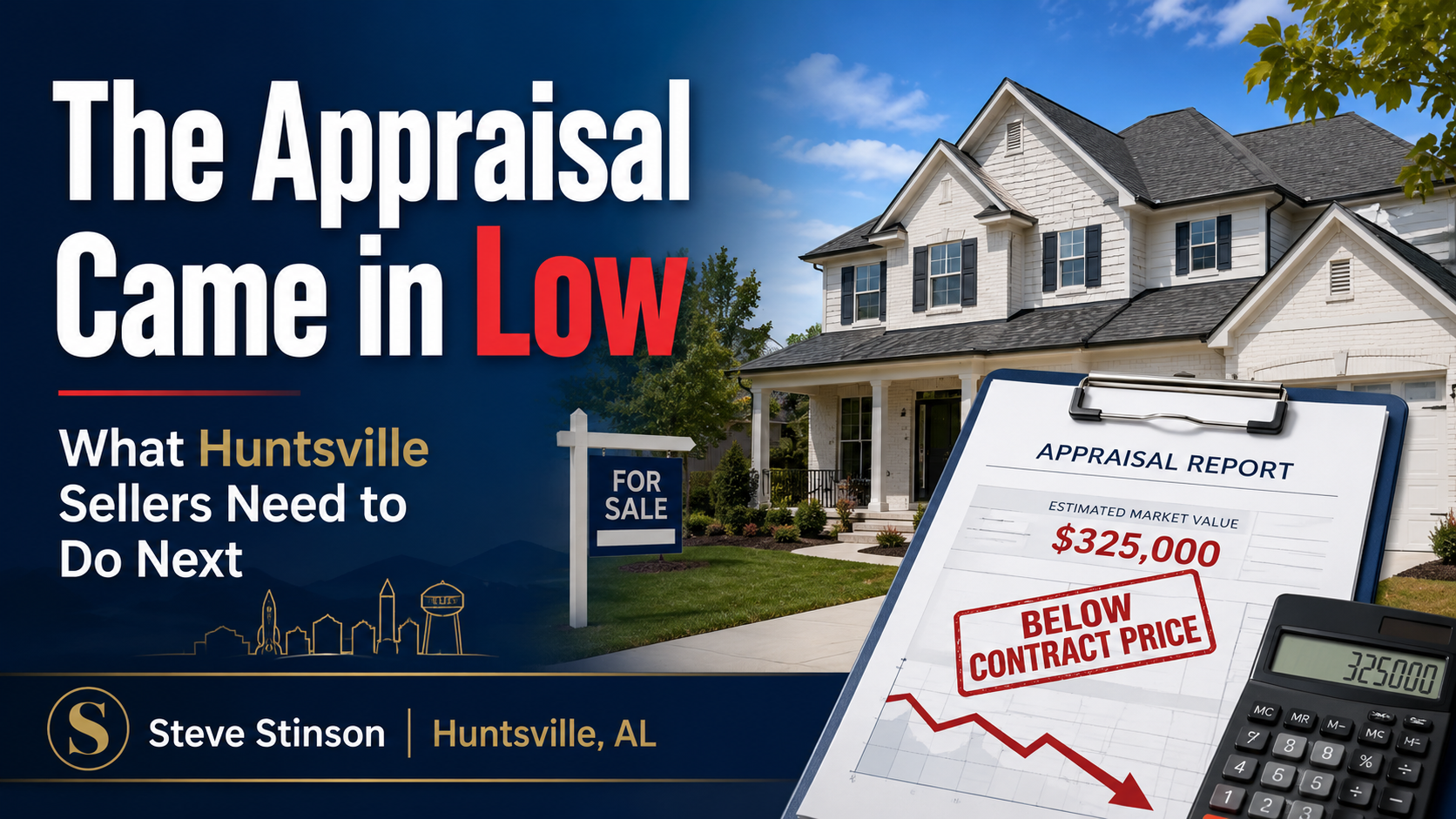
What a Low Appraisal Actually Means
What Is a Home Appraisal?
An appraisal is ordered by the lender and paid for by the buyer. Appraisers assess the home’s condition and comparable sales. The appraiser visits the home, reviews comparable sales, and delivers a report to the lender that establishes the property’s market value. Lenders require appraisals to ensure homes are worth the loan amount. Lenders finance based on the lower of appraised value or purchase price.
How Lenders Use Appraisals
A home appraisal is typically ordered by the buyer’s lender 1 to 2 weeks after the offer is accepted. The lender uses the appraisal to determine how much they are willing to finance. If you accepted an offer of $385,000 and the appraisal comes in at $365,000, the lender will only lend against $365,000. The buyer must cover the $20,000 gap somehow, or the deal has a problem.
Impact on the Sale Process
The appraiser is not working for you or the buyer. They work through a third-party management company and have no stake in whether your deal closes. Their job is to produce a defensible, objective opinion of value. That does not always mean they get it right.
Now that you understand what a low appraisal means, let’s look at your options as a seller.
Your Four Options When the Appraisal Comes in Low
Option 1: Lower the Price to the Appraised Value
The cleanest path is to drop your sale price to match what the appraisal shows. The deal proceeds on the same terms, the financing works, and you close on schedule.
The trade-off is obvious: you net less than you agreed to. Whether that is acceptable depends on how much equity you have, how motivated you are to close, and whether you believe you can get a better outcome from a different buyer.
In the current Huntsville market, with homes selling at roughly 98% of list price, a gap of a few thousand dollars is often worth closing to protect the transaction. A gap of $20,000 or more is a different conversation.
Transition: If lowering the price isn’t ideal, there are other ways to bridge the gap.
Option 2: Negotiate to Split the Gap
You do not have to choose between accepting the full reduction or letting the deal die; sellers still have a few options, and many deals survive a low appraisal because the parties meet in the middle.
For example: the purchase price is $385,000, the appraisal is $365,000. You lower to $375,000. The buyer brings an extra $10,000 cash to closing beyond what their lender covers to cover the difference between the appraised value and the agreed-upon sale price. Both sides absorb part of the difference.
This works when the buyer wants the home enough to bring additional funds, has enough cash reserves, and is comfortable using more cash or a larger down payment to keep the deal alive. The buyer’s financial situation and monthly payment may limit how much gap they can absorb. It requires honest communication, which your agent facilitates.
Transition: If you believe the appraisal is inaccurate, you may be able to challenge it.
Option 3: Challenge the Appraisal
A low home appraisal can contain errors. Square footage may be recorded incorrectly, and human error can also affect the valuation. Recent comparable sales that support a higher value may not have been included. Upgrades in your home may not have been accounted for. If the evidence is strong, the seller and agent can dispute the valuation through the buyer’s lender.
If you believe the appraisal missed something material, your agent can prepare a reconsideration of value (ROV) and submit it through the buyer’s lender. The ROV typically includes:
- Comparable sales the original appraisal did not use, with notes on why they are relevant
- Documentation of any errors (incorrect square footage, missing upgrades, wrong bedroom count)
- A written explanation of why those comps or corrections support a higher value
The lender sends the ROV back to the appraiser for review. The appraiser may revise the report, stand by the original number, or note the disputed items without changing the conclusion.
This process takes additional time, typically 1 to 2 weeks. It is worth pursuing when there is a legitimate, documentable issue with the original report and you need to correct the first appraisal. It is not worth pursuing as a delay tactic if the appraisal is defensible.
Transition: If none of these options work, you may need to consider letting the buyer walk away.
Option 4: Allow the Buyer to Walk Away and Relist
If the buyer has an appraisal contingency in their offer, they can walk away from the deal and receive their earnest money back. If the appraisal is lower than the contract amount, the buyer may choose to exit under that contingency. You are not obligated to lower your price, and the buyer is not obligated to proceed.
This path makes sense if you believe the appraised value is wrong and you would rather relist than accept a reduced price when the house does not appraise at the original offer price. The risk is that you go back on the market with additional days on market history, which buyers notice. In Huntsville, homes listed for more than 30 days start to carry a stigma, and buyers begin asking what is wrong with the property.
Relisting works best when you price the new listing correctly and address whatever may have contributed to the low appraisal, including resetting the appraisal price.
Transition: It’s important to know what you cannot do as a seller in this situation.
One Thing Sellers Cannot Do
A seller cannot cancel the contract because of a low appraisal. Only a buyer with an appraisal contingency has the right to exit. If you accepted an offer that included an appraisal contingency, your options are the four above. You do not have the unilateral right to walk away from the deal simply because the appraisal disappointed you.
If the buyer waived their appraisal contingency, they are bound by the contract regardless of what the appraisal shows. That is a stronger offer structure for sellers, and one reason cash offers and contingency waivers have real value in competitive situations. Some buyers address that risk upfront with an appraisal gap clause if the home appraises low.
Transition: Understanding why appraisals come in low can help you prepare for or avoid this situation.
Why Appraisals Sometimes Come in Low in the Huntsville Market
Huntsville has seen steady appreciation over the past several years, driven by defense and aerospace job growth, the FBI, Space Command’s arrival at Redstone Arsenal, and strong in-migration from other parts of the country. In a seller’s market, bidding wars can also push accepted prices above what closed comparable sales support.
Appraisers rely on closed sales, which may be 3 to 6 months old in a rising market. If your neighborhood has seen rapid appreciation, the comparable sales data available to the appraiser may not reflect what buyers are currently paying. In practice, home appraisers often have to lean on older closed sales while weighing recent market evidence.
Additionally, Madison County has a known data gap: the county assessor’s records historically have not included bedroom count for many properties. Automated tools and some appraisers working from public records may miss this detail, which affects valuation comparisons. A good agent knows this and can document the correct information upfront.
Transition: The best way to avoid appraisal surprises is to prepare before the appraiser visits.
What to Do Before the Appraisal to Protect Your Sale
Prepare Documentation
- Provide a list of all significant improvements made to the home (HVAC replacement, roof, kitchen updates, etc.) with approximate costs
Ensure Access
- Ensure the appraiser can access every area of the home, including attic, crawlspace, and any outbuildings
Address Maintenance Issues
- Address obvious deferred maintenance before the visit that could affect condition ratings
For context on what your net proceeds look like after all costs, this breakdown of seller costs in Huntsville is a useful reference when evaluating whether to absorb a price reduction.
Transition: Understanding the financial impact of a low appraisal is also important for your bottom line.
How a Low Appraisal Affects Your Mortgage and Loan Terms
A low appraisal can reduce your loan amount, increase your loan-to-value (LTV) ratio, and may require you to pay private mortgage insurance if LTV exceeds 80%. Your lender calculates your loan amount based on the appraised value. You may need to cover the appraisal gap in cash. If the LTV increases due to a low appraisal, it can push you into a higher risk tier, potentially affecting your mortgage rate and monthly payment.
Current Mortgage Rates and Forecasts
- The current average 30-year fixed-rate mortgage is 6.47%.
- Mortgage rates have ticked slightly higher due to inflation concerns.
- Current mortgage rates closely track the 10-year Treasury yield.
- Mortgage rates do not directly mirror the Federal Reserve’s benchmark rate.
- Experts from various institutions project rates will stabilize or see a modest decline.
- Experts project mortgage rates to remain within the 6% to 6.4% range for 2026.
Frequently Asked Questions
How often do appraisals come in low?
Studies suggest roughly 8 to 10% of appraisals come in below the contract price nationally. In a rising market, low appraisals are more common because recent comparable sales may not fully capture current buyer demand.
Can I get a second appraisal if I think the first one is wrong?
Generally, the buyer’s lender controls the appraisal process. You cannot independently order a second appraisal and submit it. A home inspection is different because it evaluates the property’s systems and condition, while the appraisal estimates market value for the lender. However, the lender may allow a reconsideration of value request, or in some cases the bank may order another review only in limited circumstances if the ROV process reveals significant documented concerns.
What if the buyer does not have an appraisal contingency?
If the buyer waived their appraisal contingency, they are bound to proceed with the purchase regardless of what the appraisal shows. They must either bring the additional cash to close or risk losing their earnest money if they back out without contractual grounds. Consult a real estate attorney if you have questions on this
How long does the appraisal process take in Alabama?
After the appraiser visits, the written report typically comes back to the lender within 7 to 10 business days. If there is a reconsideration of value, add another 1 to 2 weeks. Plan on the full appraisal process taking 2 to 4 weeks from when the lender orders it.
Should I lower my asking price proactively to avoid a low appraisal?
If your list price is above what comparable sales can support, addressing that before you list is smarter than dealing with it mid-transaction. A well-priced home is less likely to face an appraisal problem, and more likely to attract strong offers even in a balanced market. Even for sellers, a clear understanding of these pricing and appraisal risks matters throughout the home buying process.
A low appraisal is not necessarily a deal-killer. In most cases, it is a negotiation point, and the right move depends on the specifics of your situation. In many transactions, the home appraises at or above the agreed price, but if the appraisal value comes in short, the next steps depend on the numbers and leverage of both sides.
If you are dealing with an appraisal issue and want to think through your options, I am glad to help you evaluate the numbers. The goal is to reach a decision you can feel confident about, whatever that looks like.
Ready to make A Wise Move?
If you’re thinking about selling in Huntsville or Madison County, let’s talk through the smartest way to approach it.
Since 2005 · 500+ families helped · 250+ five-star reviews · BBB A+ rated
About Steve Stinson
Steve Stinson is a REALTOR® and Broker Associate with Keller Williams Realty in Huntsville, Alabama. He has served buyers and sellers across Madison County since 2005.
Steve specializes in getting sellers the best result, with particular strength in new construction homes, relocation, downsizing, and buying or selling investment properties. He works with clients in Huntsville, Madison, Hampton Cove, Owens Cross Roads, and the surrounding North Alabama area, and helps owners weigh open-market sales against local cash-buyer offers so they can compare speed, price, and terms with confidence.
He has helped more than 500 families make A Wise Move and earned 250+ five-star reviews. Steve is a Best of Zillow award recipient and consistently ranks in the top 5% of the local MLS as a listing agent. A lifelong Alabamian and 40-plus-year resident of the area, he brings deep local knowledge and pricing strategy to every move, whether you’re navigating a seller’s market or deciding how to compete for a home in a hot one.