
Should I Sell Now or Wait?
What Huntsville
Move-Up Sellers Need to Know
Answer: For most Huntsville homeowners sitting on a mortgage rate below 4%, the instinct to wait for rates to fall makes emotional sense. But the math often doesn’t support it. When rates drop, buyer demand increases, home prices tend to rise, and the gap between what you sell for and what you pay for your next home stays roughly the same. Huntsville’s sustained job growth from Redstone Arsenal, Space Command, FBI, Blue Origin, and other defense and aerospace employers creates consistent buyer demand that doesn’t disappear when rates stay elevated. If your reason for moving is tied to your life, your family, or your finances, waiting is rarely the strategic play.
By Steve Stinson | May 23, 2026
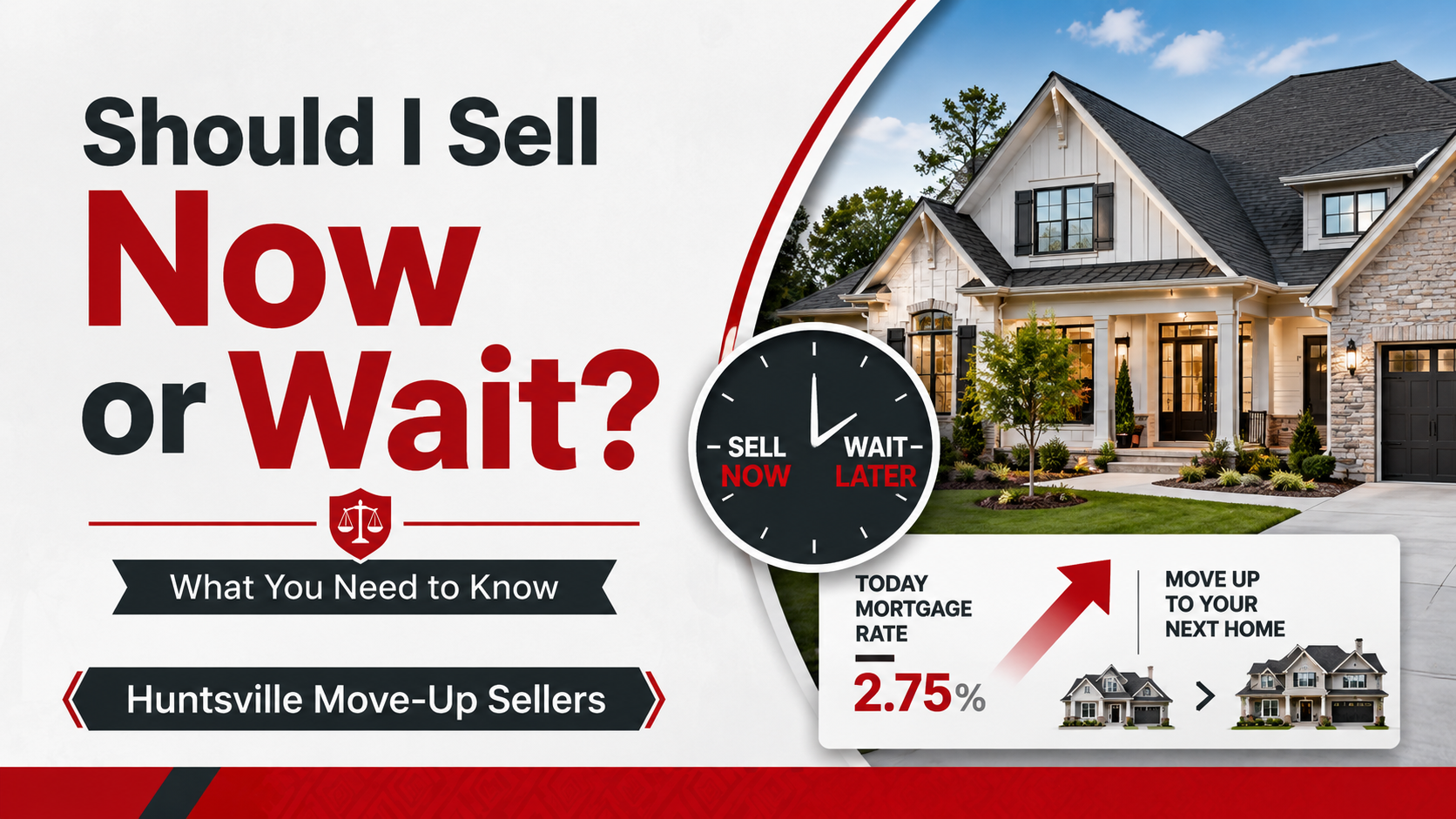
Should I sell my house now or wait in Huntsville, Alabama?
The most common version of this question sounds like this: “We’d love to move, but we have a 3.2% rate. It just doesn’t make sense to trade that for a 6.5%.”
I hear it constantly. It’s a real concern, and it deserves a straight answer rather than a dismissal. But I’ve watched a lot of sellers wait for conditions that never arrived. Here’s how I actually think through it.
Why the Rate Lock-In Feels Like a Trap
About four out of five homeowners in the country still carry a mortgage rate below 6%. In the Huntsville and Madison County area, that number is consistent with national data. A lot of sellers bought or refinanced between 2019 and 2022, when rates were historically low.
Trading a 3% rate for a 6.5% rate on a larger loan is a real cost. On a $450,000 purchase, the difference in monthly payment between those two rates is often $800 to $1,200 per month depending on loan size. That’s not imaginary. It deserves to be part of your decision.
But here’s where the logic breaks down.
When mortgage rates fall, buyers who have been sitting on the sideline come back into the market. Demand increases. Prices rise.
This is what happened in 2020 and 2021. Rates dropped to historic lows. Buyers flooded in. Home prices in Huntsville rose 20% to 30% in two years. Sellers who waited for lower rates to buy their next home found that prices on the homes they wanted had risen just as fast.
The spread stays roughly the same. You sell for more. You pay more for what you buy. Your monthly payment may tick down slightly, but you’ve often borrowed more principal to make up the difference in price.
If you’re a move-up buyer, waiting for rates to drop is not a guaranteed win. It can easily be a wash, or worse, if prices rise faster than rates fall.
What the Huntsville Market Actually Looks Like in 2026
In 2026, Huntsville is in a more balanced position than it was during the peak years. There are roughly five to six months of supply on the market, which gives buyers more options and more negotiating room than they had in 2021.
That balance means sellers need to price and present their homes correctly. The days of listing at a premium and expecting to accept the first offer are behind us. But demand is real and steady.
The reasons are local and structural. Redstone Arsenal employs tens of thousands of civilians and military personnel. Blue Origin has more than 1,600 employees in the area and is adding more. Boeing, Dynetics, and hundreds of defense contractors operate out of Cummings Research Park. The FBI and Space Command, whose headquarters is relocating to Redstone Arsenal, is expected to bring more than three thousand additional jobs, with many more projected to follow over the coming decade.
These aren’t speculative buyers. They’re people relocating for real jobs with steady incomes. They’re in the market whether rates are 5.5% or 7%.
The Actual Math on a Move-Up Purchase
Here’s a simple way to think through it.
If your current home is worth $350,000 and you have a $200,000 balance at 3.2%, your monthly principal and interest payment is roughly $863.
If you sell today and buy a $550,000 home at 6.5% with a $440,000 loan (putting 20% down from your equity), your new payment is roughly $2,782 per month.
If you wait two years and rates drop to 5.5%, but your next home is now worth $590,000 because prices appreciated modestly, your payment on a $472,000 loan is roughly $2,682 per month.
The difference is about $100 a month. And you gave up two years in the home you want.
Every situation is different. Your equity position, your income, your target home’s price, and your timeline all change the calculation. But this is the kind of analysis worth doing before deciding to sit and wait.
When Waiting Actually Makes Sense
There are real situations where waiting is the right call.
If your reason for moving is optional and you’re not financially ready for the payment increase, waiting is smart. If you’re 18 to 24 months from paying off significant debt that will meaningfully change your debt-to-income ratio, waiting may make the next purchase more comfortable. And if your current home is in a neighborhood where demand is softening and prices are drifting down, waiting costs you equity.
The honest version of this conversation is: waiting makes sense when your life and finances aren’t ready. It rarely makes sense as a pure rate-timing strategy.
The Bottom Line
If something in your life is telling you it’s time to move; a growing family, a job change, a commute that’s wearing you out, a home that no longer fits, that signal is usually the right one to act on. The rate you give up matters less than most people assume once you run the actual numbers.
Huntsville’s job market and population growth aren’t slowing down. Demand from new arrivals isn’t waiting for rates to drop either.
Frequently Asked Questions
What is the rate lock-in effect in real estate?
The rate lock-in effect describes what happens when homeowners are reluctant to sell because they would lose a low mortgage rate locked in during a period of cheaper borrowing. Nationally, many homeowners who bought or refinanced between 2019 and 2022 carry rates under 4%, making the prospect of a higher rate on their next purchase feel financially unappealing. Analysts estimate this effect has kept approximately 2.5 million potential sellers from listing their homes.
Will Huntsville home prices go down if I wait?
Most forecasts for the Huntsville area project modest, steady appreciation of 2 to 3% annually, driven by ongoing job growth and population increases. A significant price drop is not expected by most local analysts, partly because the demand drivers; Redstone Arsenal, FBI, Space Command, defense and aerospace employment, are structural and not tied to low mortgage rates. When rates eventually fall and bring more buyers back into the market, prices tend to rise further, not fall.
Is it a buyer’s or seller’s market in Huntsville right now?
As of spring/summer 2026, Huntsville is in a roughly balanced market with about five to six months of supply. That’s more inventory than during the peak years of 2021 and 2022, which gives buyers more negotiating leverage. Well-priced and well-presented homes still sell. Overpriced or poorly prepared homes sit longer and typically require price reductions.
What’s the best time of year to list a home in Huntsville?
Late spring, particularly May and June, historically produces the fastest sales and the closest-to-asking-price results in the Huntsville and Madison County area. Homes listed in May tend to spend fewer days on market than the annual average. That said, consistently strong relocation demand from defense, aerospace, and government employers means well-priced homes move in any season.
How do I decide if a move-up purchase makes financial sense right now?
The key variables are your current equity, your target home’s price range, the rate you’d qualify for today, and whether the new monthly payment fits your income comfortably. A side-by-side comparison of your current home and your target home, factoring in realistic appreciation on both sides, gives you a clearer picture than waiting and hoping rates improve. Running this with an agent who knows the Huntsville market and a lender who can give you accurate current numbers is the fastest way to an honest answer. I help clients evaluate this exact scenario every week. Reach out to get the personalized picture for your specific situation.
The rate lock-in question is one of the most common conversations I have with sellers right now. The answer isn’t the same for everyone, but it almost never comes down to pure rate timing.
If you want to run the numbers on your specific situation, schedule a free 20-minute strategy call. We’ll work through what your home would sell for today, what your next move would cost, and whether the math supports acting now or waiting. No pressure, just the actual numbers.
About Steve Stinson
Steve Stinson is a REALTOR® and Broker Associate with Keller Williams Realty, serving Madison County and the Huntsville, Alabama area since 2005. He specializes in seller representation, new construction buyers, relocations, downsizing, and investment guidance. Steve has helped 500+ families navigate their real estate decisions, holds 250+ verified 5-star reviews, earned the Best of Zillow award, and consistently ranks in the top 5% of the local MLS as a listing agent. He’s a lifelong Alabamian and 40+ year resident of the Huntsville area. Learn more at stevestinsonhuntsvillehomes.com.