
Do you need a storm shelter when you buy a house in Huntsville?
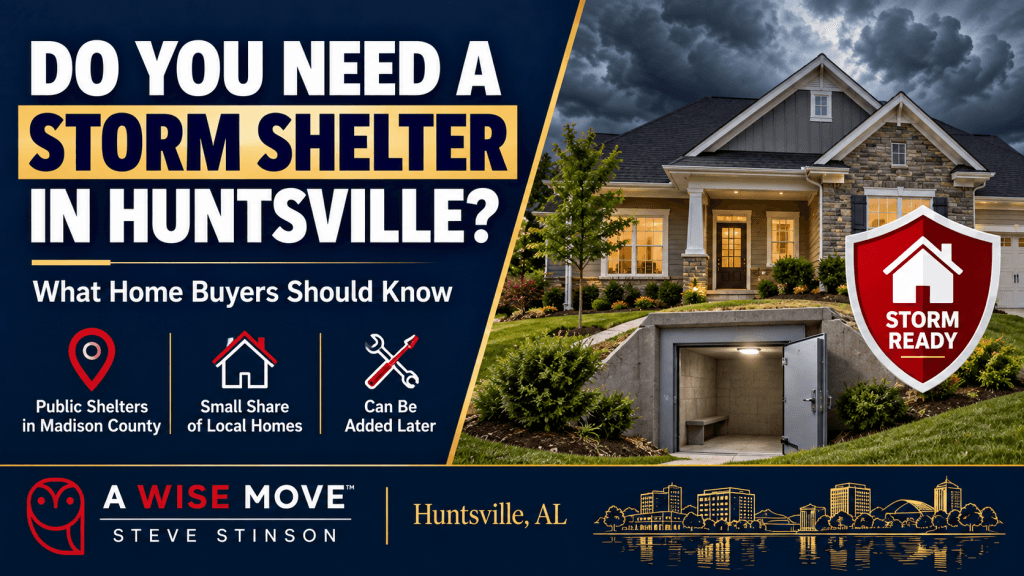
You do not need a storm shelter to buy a house in Huntsville, but you should decide on purpose rather than by accident. Huntsville and Madison do not operate public safe rooms, so in most of the metro your shelter plan is whatever you build at your own address. A home shelter runs roughly $4,000 to $8,000 installed depending on type and site, and homes that already have one are a small share of the market. Budget for it during your search rather than discovering the gap in April.
If you are moving to Huntsville from a part of the country that does not get tornadoes, this is usually the question that catches you off guard. You have toured homes online, compared commutes, and narrowed down to two or three areas. Then someone mentions April 27, 2011, and you start wondering what you are actually walking into.
Here is the short version. North Alabama sits in a genuinely active severe weather corridor, and it has two seasons, not one. The spring season runs roughly March through May. There is a second, smaller season in late fall, usually November, that surprises people who assume tornado risk ends with summer. Warning lead times are typically ten to fifteen minutes, which is enough to get to a shelter you already have and not enough to drive somewhere.
That last point is the one that matters for your home search.
The Part Most Relocation Content Leaves Out
Huntsville and Madison do not have public safe rooms. The Huntsville-Madison County Emergency Management Agency maintains a list of community storm shelters, and those shelters are concentrated in the smaller communities across Madison County, not in the two largest cities. Each one is managed independently by the community it serves, sets its own criteria for opening, and may not be available when you need it. That is EMA’s own language, not my read on it.
In Huntsville and Madison proper, some churches and other buildings announce they are opening as public shelters during severe weather. That is helpful, but it is not a plan you can count on at 2 a.m. with ten minutes of warning.
So if you are relocating here and you are used to a city with municipal shelters, adjust the mental model. In this metro, sheltering is handled at the household level.
Here’s what that means for your search. A home with a shelter already installed solves the problem on day one. A home without one means you either build one, identify a genuinely reinforced interior space, or accept the risk knowingly. All three are legitimate choices. Making no choice is the one that goes badly.
Registration is a real step, and it is free
Once you own a shelter, register it. Huntsville-Madison County EMA maintains a shelter database so first responders know where people may be after a storm. That database is what search crews work from when a neighborhood is damaged and someone is unaccounted for.
- City of Huntsville residents register through the Huntsville Fire Department’s storm shelter registration page
- City of Madison residents register through the City of Madison
- Unincorporated Madison County residents register through Madison County
- Limestone County residents (including parts of Athens and the Greenbrier corridor) register through Limestone County EMA
The county database updates on about a thirty-day cycle, so register when you close rather than when the first watch goes up. If you are buying a home that already has a shelter, the previous owner’s registration does not carry over to you. Re-register it in your name.
What a Shelter Costs and What It Adds Back
Pricing depends on type, size, and how difficult your lot is. Local installers in the Huntsville area work across a wide radius and price differently for ridge lots, flat suburban lots, and the heavy clay that needs drainage engineered into the install.
| Shelter type | Typical installed cost | Notes |
| Small in-garage safe room (about 4×4) | $4,000 and up | Fits in an existing garage slab, smallest footprint |
| Above-ground steel or concrete safe room | $5,800 and up | Can go in a garage or interior room, easiest for mobility needs |
| Underground in-yard shelter | $5,800 and up | Requires excavation, drainage matters on clay and slope lots |
Two things to know about the money side, and I want to be straight about how solid each one is.
Insurance discounts are real but modest and carrier-specific. Some carriers offer a premium credit for a FEMA-compliant shelter. Industry sources put the range around 5% to 20%, but that is a wide band and it depends entirely on your carrier. Ask your insurance agent for the actual number on your policy before you count on it. Do not assume a shelter pays for itself through premium savings, because in most cases it does not.
Resale value is positive but not dollar-for-dollar. Industry estimates commonly put the added value around $3,000 to $5,000, and those estimates come from shelter manufacturers, so treat them as directional rather than appraised. What I see more consistently in this market is not a price premium but a shorter list of objections. A buyer relocating from Texas, Oklahoma, or Kansas frequently treats a shelter as a requirement, and in a market where buyers have choices, removing a reason to say no has real value.
Also worth knowing: Alabama runs a grant program called Strengthen Alabama Homes that puts up to $10,000 toward FORTIFIED roof upgrades. It is funded by the insurance industry, not taxpayers. As of 2026, Madison County is not an eligible county. The program has been running in Mobile, Baldwin, Jefferson, Tuscaloosa, and Escambia. I mention it because relocating buyers read about it and assume it applies here. It does not, at least not yet. The statewide FORTIFIED wind premium discount is a separate thing and does apply.
How to Evaluate a Shelter on a Home You Are Touring
If a listing advertises a storm shelter, that word covers a wide range of quality. Ask these before you get attached to the house:
- Is it built to a recognized standard? FEMA P-361 and ICC 500 are the two that matter. Ask for documentation. A poured concrete room that someone’s brother-in-law built is not the same product as a certified shelter.
- How many people does it hold, and does that match your household? Capacity is rated. A 4×4 safe room is for three or four adults standing, not a family of five plus two dogs.
- Can everyone in your household get into it quickly? Underground shelters with ladder access are a problem for anyone with mobility limits, small children, or a pet that will not cooperate. Above-ground garage units solve this and are worth the trade-off for a lot of households.
- Where does the water go? On a clay lot or a hillside in an area like Hampton Cove or along the Monte Sano slopes, a below-grade shelter that was not drained properly will hold water. Look inside. Look for staining and for a sump or drain.
- Is it registered, and will the seller give you the paperwork? Ask for the registration record, any manufacturer documentation, and the install date.
Worth remembering here: Alabama is a buyer beware state. There is no required seller disclosure form, and a seller is generally not obligated to volunteer what they know about a shelter’s condition. That puts the burden on you and your inspector to actually look. This is the same standard that governs what Alabama sellers are and are not required to disclose, and it catches relocating buyers more than almost anything else about the process here.
A general home inspector will note that a shelter exists. Most will not certify it. If the shelter is a material part of why you want the house, ask the manufacturer or a local installer to look at it during your inspection period.
If the house you want does not have one
That is a normal outcome, and it is not a reason to walk. Most homes in this metro do not have shelters. A search on Redfin for Huntsville listings with a storm shelter typically returns a couple dozen homes at any given time out of a market many times that size, at a median list price in the mid $300,000s. If you filter your entire search to shelter-equipped homes, you will cut yourself off from most of the inventory and probably from the areas that actually fit your commute.
The better sequence is to choose the home and the location first, then budget the shelter as a first-year improvement. Use your inspection period to identify where one could go and get a quote, so the number is real before you close rather than a guess.
New construction is a separate conversation. Some builders in this market will add a garage safe room as an option during construction, which is almost always cheaper than retrofitting later. If you are going the new construction route, ask early, because it is easier to include before the slab is poured. It is also a line item worth raising when you are negotiating, alongside the other builder incentives available in Huntsville right now.
Have a question about the Huntsville housing market?
Get straight, local answers about selling, buying, relocating, investing, or building in the Huntsville area. No pressure.
Since 2005 · 500+ Families Served · 250+ Five-Star Reviews · BBB A+ Rated
Frequently Asked Questions
Do Huntsville and Madison have public tornado shelters?
No. Neither city operates public safe rooms. The community storm shelters listed by Huntsville-Madison County EMA are located in smaller communities across the county, each managed independently with its own opening criteria. Some churches and other buildings in the cities announce they are opening during severe weather, but that is not a reliable plan. In most of this metro, sheltering happens at your own address.
Is a basement good enough in North Alabama?
Most Huntsville-area homes are built on slab or crawl space, so basements are less common here than in the Midwest. Where a basement does exist, it is better than an upper floor but it is not equivalent to a rated shelter, because the structure above it can still fail. An interior room on the lowest floor with no exterior walls is the standard fallback if you do not have a shelter, and it is a real improvement over nothing.
Does a storm shelter lower my homeowners insurance in Alabama?
Some carriers offer a discount for a FEMA-compliant shelter, but the amount varies widely by carrier and policy. Ask your insurance agent for the specific credit on your quote rather than relying on a general range. Separately, Alabama law requires admitted insurers to discount the wind portion of the premium for homes with a FORTIFIED designation, which is a different program focused on the roof and structure rather than a shelter.
When is tornado season in Huntsville?
North Alabama has two severe weather seasons. The primary one runs roughly March through May, and there is a smaller secondary season in late fall, typically November. Tornadoes here can and do occur outside both windows, including at night, which is part of why an on-site shelter matters more here than in regions where storms are more predictable.
Should I make a storm shelter a requirement in my home search?
For most relocating buyers, no. Shelter-equipped homes are a small fraction of Huntsville inventory, and filtering to them will eliminate most of the market and probably the areas that fit your commute. Choose the location and the home first, then plan the shelter as a first-year project with a real quote in hand before you close.
Deciding Before You Land, Not After
The honest answer is that a storm shelter is not a gate on buying a home in Huntsville. It is a line item you should price on purpose, early, while you still have room in the conversation to do something about it. The buyers who end up unhappy are almost never the ones who decided against a shelter. They are the ones who never thought about it until the first watch box went up over Madison County.
If you are relocating here, this fits into the same set of questions as where to live based on your actual commute and what people wish they knew before moving to Huntsville. They are all easier to sort out before you are on a plane with a three-day house hunting trip and a rental car.
If you are planning a move to the Huntsville area and want to talk through which areas fit your commute, your budget, and the things you cannot evaluate from a listing photo, let’s talk it through before your house hunting trip. Schedule your strategy call.
About Steve Stinson
Steve Stinson is a REALTOR® and Broker Associate with Keller Williams Realty in Huntsville, Alabama. He has served sellers and buyers across Madison County since 2005.
Steve’s practice centers on four areas: listing and selling homes, relocation to the Huntsville market, investment property, and new construction. He also handles expired listings and downsizing. He works with clients in Huntsville, Madison, Hampton Cove, Owens Cross Roads, and surrounding Madison County communities, and helps owners weigh open-market sales against local cash-buyer offers so they can compare speed, price, and terms with confidence.
He has served 500+ families making A Wise Move and earned 250+ verified 5-Star reviews, most of them on Google. Steve is a Best of Zillow award recipient and consistently ranks in the top 5% of the local MLS as a listing agent. A Madison County resident since 1980, he brings deep local knowledge and pricing strategy to every move.
Equal Housing Opportunity. This content is general information only. It is not legal, tax, or financial advice. Confirm your specific costs, tax obligations, and transaction details with your closing attorney, tax advisor, lender, or escrow officer. Broker compensation is fully negotiable and not set by law; no standard or typical rate exists.
Sources
- Huntsville-Madison County Emergency Management Agency, Safe Room Locations
- City of Huntsville, Storm Shelter Registration
- Madison County, Register Storm Shelter
- Limestone County EMA, Register Your Shelter
- Strengthen Alabama Homes, program site
- Smart Home America, Strengthen Alabama Homes grant program and eligible counties
Shelter pricing, insurance discount ranges, and resale value estimates in this post come from shelter manufacturers and installers rather than from a government or appraisal source. They are presented as ranges for that reason. Confirm pricing with a local installer and confirm any premium credit with your own insurance agent.