
Should You Get Radon Testing When Buying a House in Huntsville?
Yes. Radon testing Huntsville AL buyers should usually include during the inspection period because Madison County is one of Alabama’s highest-potential radon counties. North Alabama’s karst geology can also cause major seasonal swings. A result of 4 pCi/L or higher is generally treated as a correctable safety issue and should be addressed.
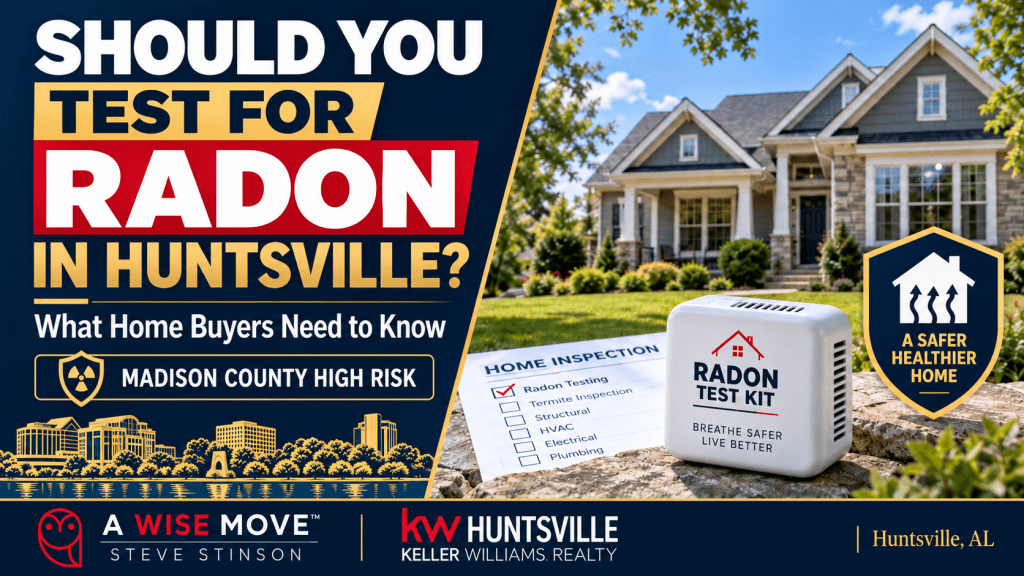
In my Huntsville-area transactions, I make sure buyers understand radon before the inspection decision is due. Most buyers choose to add a radon test because the risk here is real, but the results can be inconsistent from one house to the next and from one season to another. That inconsistency is exactly why testing matters.
Radon Testing in Huntsville: At a Glance
| Question | Practical answer |
| Is Madison County high risk? | Yes. Madison County is one of 15 Alabama counties identified by ADPH as having the highest potential for elevated radon. |
| What level triggers action? | EPA and ADPH recommend fixing a home when the radon level is 4 pCi/L or higher. |
| How long is a transaction test? | ADPH allows short-term real estate testing for at least 48 hours, with specific closed-house and placement requirements. |
| Does weather matter? | Yes. In karst areas, weather and season can create meaningful spikes and dips in measured radon. |
| What about new construction? | Passive radon systems are now commonly included in the new construction I see locally. If testing is elevated, a fan can be added to activate the system. |
Why Is Radon a Bigger Concern in Huntsville and Madison County?
Madison County has elevated radon potential, and North Alabama has extensive karst geology. Karst is limestone and other carbonate rock that has been dissolved by groundwater, creating fissures, caves, sinkholes, and underground drainage. Those openings can give radon gas pathways toward buildings, and the resulting indoor levels can vary significantly.
The Alabama Department of Public Health identifies Madison County as one of 15 Alabama counties with the highest potential for elevated radon. Radon itself is colorless, odorless, and radioactive. You cannot judge the risk from the age, price, appearance, or condition of a home. Testing is the only way to know the measured level in that house at that time.
That last phrase matters: at that time. ADPH says seasonal variation is greater in karst areas than in non-karst areas. Its Alabama karst variability study found that about one-third of homes that produced a negative short-term result in summer later showed a radon problem when tested in winter. A clean summer test is useful, but it should not be treated as a lifetime guarantee.
How Should a Buyer Test for Radon During an Alabama Home Purchase?
For a real estate transaction in a karst area, ADPH recognizes three short-term approaches: two simultaneous tests, two sequential tests, or one continuous monitor operated by a certified radon tester. Each approach uses at least 48 hours of testing, and ADPH recommends corrective action when the average result is 4 pCi/L or higher.
For most buyers, the continuous monitor is the practical choice because it fits into the inspection period and produces a professional report. The test still has to be run correctly. ADPH calls for closed-house conditions for at least 12 hours before testing, no severe storms or high winds, proper device placement, and testing on the lowest level suitable for occupancy.
I also tell buyers not to overread one number. If you buy based on a short-term test in a karst area, ADPH recommends a 12-month confirmatory test after you move in. That longer test gives you a better picture across changing weather and seasons.
What Happens If the Radon Test Is 4 pCi/L or Higher?
A result of 4 pCi/L or higher is a correctable safety issue, not automatically a reason to walk away from the house. EPA and ADPH recommend reducing radon at that level. In Huntsville transactions, I normally treat the result as a repair item and expect the seller to address remediation as part of the inspection negotiations, subject to the contract and the parties’ agreement.
Alabama sellers are not automatically required to make every repair a buyer requests, so the contract still matters. I explain that distinction in my guide to seller repairs after an Alabama home inspection. Radon is different from a cosmetic request because there is a recognized action level and a well-established mitigation method.
ADPH says the average house costs about $1,200 to mitigate, with a general range of about $500 to $2,500 depending on the home and the system needed. That is one reason I would not automatically abandon an otherwise good house over an elevated test. Get the system designed by a qualified radon professional, negotiate who will pay, and verify the result after the work is complete.
Do Alabama Sellers Have to Disclose a Known Radon Problem?
Alabama follows caveat emptor, or buyer beware, for the resale of existing homes, but that does not mean a seller can say anything or hide everything. The Alabama Real Estate Commission says sellers and their agents must answer direct questions truthfully and recognizes an exception for known defects that may pose an immediate health or safety risk.
That is why I recommend asking in writing whether the property has ever been tested for radon, whether elevated results were found, and whether a mitigation system has been installed. For the broader Alabama rules, see what Alabama home sellers are required to disclose.
If a mitigation system is already installed, I do not automatically see that as a negative. A documented system can mean a known problem was addressed. Ask for the installation information, prior test results, any post-mitigation testing, and confirmation that an active fan is operating if the system uses one.
What About Radon in New Construction Homes in Huntsville?
New construction deserves its own conversation. In the Huntsville and Madison County new homes I am seeing now, builders are automatically including passive radon mitigation systems. A passive system vents soil gas without a fan. If testing later shows an elevated radon level, a fan can be added to the existing vent system to turn it into an active system and typically reduce the radon level.
That local practice lines up with EPA guidance. EPA describes radon-resistant new construction as a passive system that can be upgraded by adding a fan if testing shows 4 pCi/L or higher. Even with a passive system in place, the home should still be tested. The pipe is preparation. The test tells you whether the system is doing enough.
If you are comparing builders or touring model homes, radon is one of several details worth asking about before you sign. My Huntsville new construction guide covers the broader process, builder contracts, inspections, representation, and questions buyers should raise early.
Can You Trust a Summer Radon Test in North Alabama?
Yes, but treat it as a transaction snapshot rather than the final word. ADPH specifically warns that karst geology can produce larger seasonal swings. Its guidance says short-term results may run higher in colder months, although some homes test higher in warmer months. The point is not that one season always wins. The point is that the level can move.
If I were buying a Huntsville home in July and the short-term result came back below 4 pCi/L, I would still use that result for the transaction decision. I would also plan a long-term follow-up after closing because ADPH recommends it for karst areas. That is a reasonable way to respect both the inspection deadline and the geology.
Should Radon Be a Deal Breaker When Buying a Huntsville Home?
Usually, no. Elevated radon is a real health concern, but it is also one of the more defined problems a home inspection can uncover. There is a recognized action level, established mitigation systems, and a way to retest after correction. The better question is whether the problem can be corrected properly and on terms you are comfortable accepting.
I would be much more cautious about a condition that cannot be priced, verified, or corrected as cleanly. That is the same framework I use when discussing the biggest Huntsville home buying deal breakers. Radon deserves attention, but an elevated number by itself does not mean the house is a bad purchase.
Have a question about the Huntsville housing market?
Get straight, local answers about selling, buying, relocating, investing, or building in the Huntsville area. No pressure.
Since 2005 · 500+ Families Served · 250+ Five-Star Reviews · BBB A+ Rated
Frequently Asked Questions
Is radon a problem in Huntsville, Alabama?
Yes. Madison County is one of 15 Alabama counties that ADPH identifies as having the highest potential for elevated radon. North Alabama also has karst geology, which can make indoor radon readings more variable from one house to another and across seasons.
What radon level should concern a home buyer?
A radon result of 4 pCi/L or higher should be addressed. EPA and ADPH use 4 pCi/L as the action level for reducing radon, and ADPH also notes that risk is not zero below that level.
How long does a radon test take during a home inspection?
A real estate transaction test generally takes at least 48 hours. ADPH allows simultaneous tests, sequential tests, or a continuous monitor operated by a certified tester, with specific requirements for closed-house conditions and device placement.
Who normally pays for radon mitigation in a Huntsville transaction?
In my Huntsville-area experience, sellers normally handle remediation when the transaction test is 4 pCi/L or higher, although the repair request is still negotiated under the purchase contract. Buyers should not assume payment is automatic until the parties agree in writing.
Do new Huntsville homes still need radon testing if they have a passive system?
Yes. A passive radon system makes mitigation easier, but testing is still necessary. If the result is elevated, a fan can be added to activate the system and pull radon from beneath the home more effectively.
Should I retest after I buy the house?
Yes, especially in North Alabama karst areas. ADPH recommends a 12-month confirmatory test after a purchase decision based on a short-term transaction test so you can see how the home performs through different seasons.
The Simple Version
Test the house. In Madison County, the radon risk is high enough and the readings are inconsistent enough that skipping the test does not make much sense. If the result is elevated, treat it as a correctable safety issue, negotiate the remediation, and retest. If the short-term result is low, remember that North Alabama karst conditions can still justify a longer follow-up test after closing.
If you are buying in Huntsville, Madison, Hampton Cove, Owens Cross Roads, or elsewhere in Madison County and want to think through inspections before you are working against a contract deadline, I am glad to help you plan the questions that matter for the house you are considering. Schedule your 20-minute strategy call and we can talk through the situation before you decide what to do next.
About Steve Stinson
Steve Stinson is a REALTOR® and Broker Associate with Keller Williams Realty in Huntsville, Alabama. He has served sellers and buyers across Madison County since 2005.
Steve’s practice centers on four areas: listing and selling homes, relocation to the Huntsville market, investment property, and new construction. He also handles expired listings and downsizing. He works with clients in Huntsville, Madison, Hampton Cove, Owens Cross Roads, and surrounding Madison County communities, and helps owners weigh open-market sales against local cash-buyer offers so they can compare speed, price, and terms with confidence.
He has served 500+ families making A Wise Move and earned 250+ verified 5-Star reviews, most of them on Google. Steve is a Best of Zillow award recipient and consistently ranks in the top 5% of the local MLS as a listing agent. A Madison County resident since 1980, he brings deep local knowledge and pricing strategy to every move.
Equal Housing Opportunity. This content is general information only. It is not legal, tax, or financial advice. Confirm your specific costs, tax obligations, and transaction details with your closing attorney, tax advisor, lender, or escrow officer. Broker compensation is fully negotiable and not set by law; no standard or typical rate exists.
Sources
Alabama Department of Public Health: Madison County radon risk, Alabama high-potential counties, and the 4 pCi/L action level. https://www.alabamapublichealth.gov/radon/radon-in-alabama.html
Alabama Department of Public Health: Karst geology, seasonal variability, and the Alabama summer false-negative finding. https://www.alabamapublichealth.gov/radon/testing-recommendations.html
Alabama Department of Public Health: Karst-area real estate transaction testing procedures and 12-month follow-up guidance. https://www.alabamapublichealth.gov/radon/karst-real-estate.html
Alabama Department of Public Health: Radon mitigation methods and typical mitigation cost range. https://www.alabamapublichealth.gov/radon/fixing-problems.html
U.S. Environmental Protection Agency: Radon-resistant new construction, passive systems, and adding a fan to create an active system. https://www.epa.gov/radon/how-address-radon-when-building-new-home
Alabama Real Estate Commission: Alabama caveat emptor consumer guidance and disclosure exceptions. https://arec.alabama.gov/pages/consumer/information/consumerinformation.aspx