
Earnest Money in Alabama: Rules, Refunds, and Who Keeps It
By Steve Stinson | July 5, 2026
In Alabama, earnest money goes to the buyer or seller based on the contract, contingencies, and deadlines. If a buyer cancels under a valid contingency, they usually get it back. If they walk without protection, the seller may have a claim, but release usually requires written agreement by both parties or a court order.

What is earnest money?
Earnest money is a good-faith deposit in real estate transactions. In Alabama, earnest money is not legally required but is standard. The purchase contract dictates the terms for earnest money handling, and it is typically held in an escrow account during the transaction. This article covers the essential rules for earnest money in Alabama, including how refunds work, who keeps the deposit if a buyer backs out, and what both buyers and sellers need to know to protect their interests. Whether you are a buyer, seller, or real estate agent, understanding these rules is crucial because earnest money can have a significant financial impact and plays a key role in protecting your deal.
Why does this matter? Earnest money in Alabama can represent thousands of dollars at stake in a home sale. Knowing the rules helps buyers avoid losing their deposit and helps sellers understand when they can claim it. For agents, it’s vital to guide clients through these details to ensure a smooth transaction and avoid disputes.
Who gets the earnest money if a buyer backs out in Alabama?
If a buyer backs out of an Alabama home sale, who keeps the earnest money depends on the purchase agreement, the contract language, and the contingencies in the deal. In Alabama, the earnest money deposit is usually held by a closing attorney or broker, and if a buyer cancels under a valid contingency by the deadline, they can usually recover it with the required written notice. If they walk away for no protected reason, the seller may be entitled to keep it. The exact outcome depends on the terms of the contract, and the money cannot be released until both sides agree in writing or a court orders it.
The question I hear from nervous sellers is simple: “If my buyer walks, do I get to keep it?” That question matters to buyers and sellers across Huntsville and Madison County, including first-time buyers, investors, and relocating clients, because the answer affects real money and how safely a deal is structured. Below, I’ll walk through what earnest money is, how Alabama handles it, when a seller can keep it, when a buyer gets it back, and what sellers can do to protect themselves.
What earnest money is actually for
Think of earnest money as the buyer’s skin in the game. It tells you they are committed enough to risk real cash. Most contracts require delivery within 1 to 3 business days. If the sale closes, the deposit applies to the buyer’s costs at closing, is credited toward closing costs as shown on the settlement statement at settlement, and does not change what you net as the seller. If the sale falls apart, the deposit is the thing both sides fight over.
The key word is contingencies. In many contracts, these common contingencies create specific contingency periods that give the buyer a few protected exits:
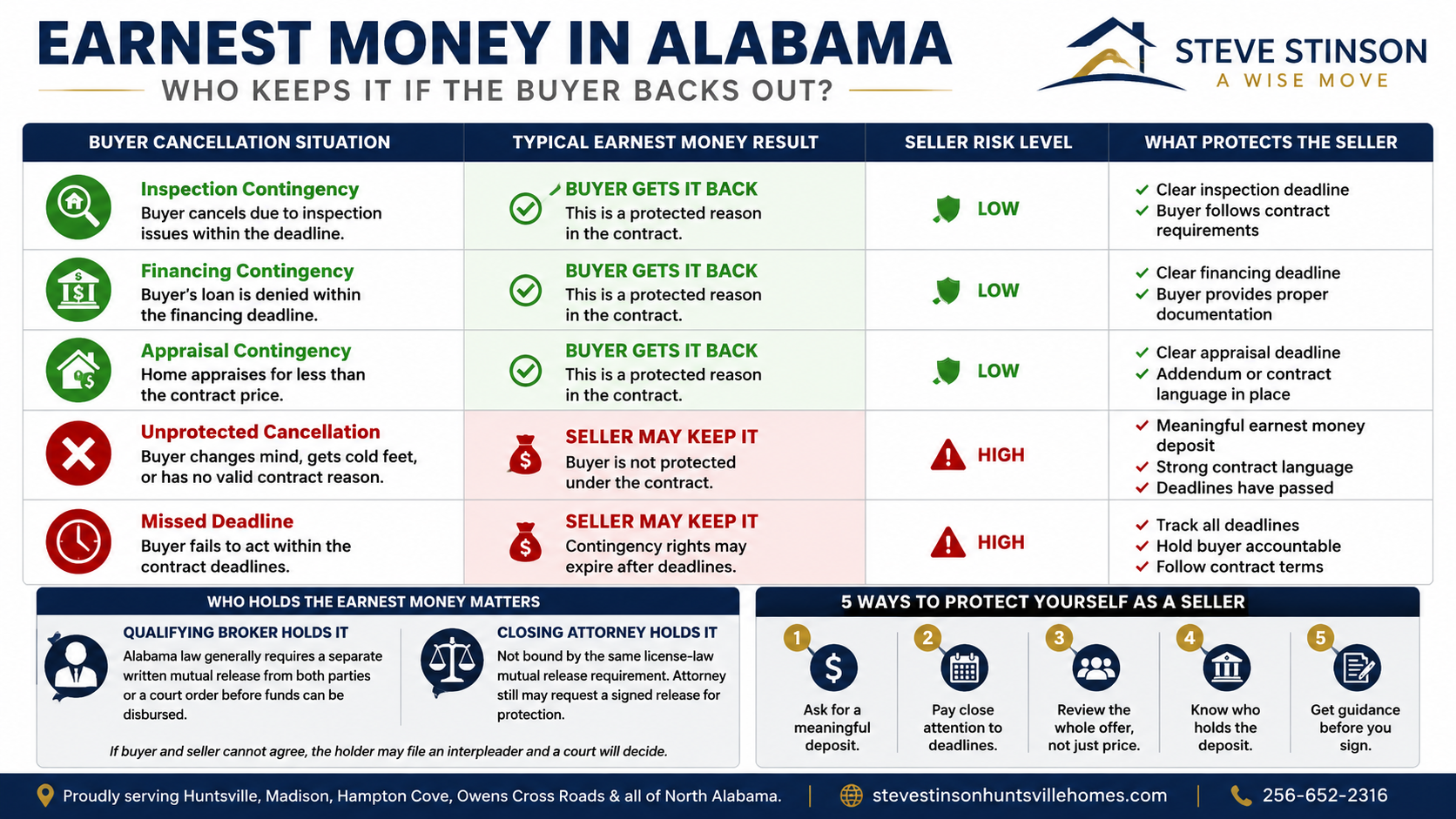
- Inspection contingency: The buyer can cancel after the inspection within the agreed period.
- Financing contingency: The buyer can cancel if their loan is denied before the financing deadline.
- Appraisal contingency: The buyer can cancel if the home appraises below the contract price.
If a buyer cancels using one of these exits, they typically get their earnest money back. However, cancellation usually must happen within the contingency periods and under the contract’s notice rules, with timely notice and any required written notice needed to protect the deposit. That is what the contingency is for.
Now that you know what earnest money is for, let’s look at when the seller can keep it.
When the seller can keep it
Here is the part sellers want to hear. If the buyer walks for a reason the contract does not protect, that is a case where the buyer defaults, and you may be entitled to keep the deposit as liquidated damages. Still, the contract controls, and other remedies can depend on the exact wording.
The reality is that timing decides a lot. Contingencies expire. If a buyer fails to secure financing before the financing deadline, or cancels after the inspection period or before loan approval without protection, the buyer is in a weaker position. The same logic applies if buyers miss deadlines tied to inspection or appraisal. A buyer who blows past a deadline and then tries to walk is on much weaker ground.
This is one reason a well-structured contract matters so much. A larger earnest deposit and clean deadlines give you more protection if the deal falls apart. It is also why I tell sellers that the highest offer is not always the strongest. In competitive markets, earnest money strategy and avoiding unnecessary risk both matter when you evaluate offer strength. A buyer’s deposit size, financing type, and lender reputation all tell you how likely they are to actually close.
If you understand when the seller can keep the deposit, it’s important to know how Alabama law affects the release of earnest money.
The Alabama rule that surprises people
This is where Alabama is different, and it surprises sellers who assume the money just comes to them.
Earnest money cannot be disbursed on demand. Under Alabama law, the purchase agreement usually identifies the escrow holder and governs how the funds are handled:
- If a qualifying broker holds the earnest money: Alabama license law says a licensed broker must place the deposit in a federally insured escrow account, promptly deliver it to the qualifying broker, and maintain detailed accounting records. The broker can only release it when both parties agree in writing how to split it, or when a court orders it. The broker cannot simply hand it to you because you believe you are owed it. If named in the contract, the listing broker or buyer’s broker may be the one holding the deposit.
- If a closing attorney or other non-licensee holds it: They are not bound by that same license-law requirement for a mutual release. They have more flexibility, though they may still ask for a signed release to protect themselves. In some real estate transactions, a title company is also involved in handling escrow and closing.
So even in a case where you are clearly entitled to the deposit, a buyer who refuses to sign a release can hold things up. A signed mutual release is often needed before the holder can disburse or refund the money, and the holder may hold funds until the dispute is resolved. When the two sides cannot agree, the dispute usually gets resolved through a legal step called an interpleader, where the holder asks a court to decide who gets the funds.
Here’s what that means: Earnest money is rarely the thing you should plan your finances around. It is a deterrent and a partial cushion, not a guaranteed payday if a buyer walks.
Understanding the legal process for releasing earnest money, let’s move on to how sellers can protect themselves from potential issues.
Schedule Your 20-Minute Strategy Call
How to protect yourself as a seller
You cannot stop a buyer from getting cold feet. You can put yourself in a stronger position before you ever sign.
Ask for a meaningful deposit
The right earnest money strategy includes setting a meaningful but negotiable deposit amount for the market and property, because a larger earnest amount raises the cost of walking away and signals a serious buyer.
Pay attention to deadlines
The earnest money deadline, along with inspection, financing, and appraisal deadlines, is part of your protection, so make sure those contingency dates are clear, reasonable, and tracked.
Weigh the whole offer, not just price
Financing type, down payment, and lender strength predict whether a buyer can close.
Know who holds the deposit
Whether it is a broker or the closing attorney affects how a dispute would play out, and clear deposit instructions plus a written receipt help confirm who received the funds and when.
Get guidance before you sign
A local agent can give you local guidance on drafting deadlines and contingency terms that protect you, because the terms that matter most are written into the contract on the front end, not negotiated after a buyer walks.
This is exactly the kind of thing I walk my clients through before we accept an offer, just like deciding whether to sell your house as-is or make repairs first in Alabama. The goal is not to plan for failure. It is to make sure that if a buyer does walk, you are protected and the deal you accepted was the strongest one on the table.
Now that you know how to protect yourself as a seller, let’s summarize the key takeaways about earnest money in Alabama.
The bottom line
In Alabama, the exact outcome depends on the purchase agreement, the contract language, and whether notice and contingency deadlines were met. A protected, on-time cancellation usually returns the deposit to the buyer. An unprotected walk-away can leave it with you, but if seller defaults, a buyer refund may be required, and most buyers prefer a quick resolution over a prolonged dispute; the funds cannot be released until both sides agree in writing or a court decides. Structure the contract well on the front end and the earnest money does its job.
Every contract is different, and the right deposit and deadlines depend on your situation and your buyer, especially in more complex situations like selling a house during divorce in Alabama. That is what I help sellers think through before we sign anything.
Frequently Asked Questions
How much is earnest money in Alabama?
There is no fixed amount. In the Huntsville area, this good faith deposit is negotiable and commonly falls around 1% to 3% of the purchase price, though local conditions can affect it. In places like Auburn, many buyers may see earnest money vary with seasonal demand, and the deposit is often due within 1 to 3 business days after contract acceptance. A larger deposit signals a more committed buyer and gives the seller more protection.
Who holds the earnest money in an Alabama home sale?
It is held in escrow by the closing attorney or a real estate broker, never paid directly to the seller. The escrow holder is named in the purchase agreement and may be the closing attorney, a broker, or in some transactions a title company. Who holds it matters, because brokers are bound by Alabama license-law rules on releasing the funds and non-licensee attorneys are not, and a wire transfer is a common funding method for the deposit.
Can a seller keep earnest money if the buyer just changes their mind?
Possibly. If the buyer defaults by cancelling without a valid contingency, the seller may have a claim to the earnest money as liquidated damages depending on the contract language, while if the seller fails to perform, the buyer may instead be entitled to a refund. But it cannot be released until both parties sign a written agreement or a court orders it.
What is an interpleader in a real estate dispute?
An interpleader is a legal action where the party holding disputed earnest money asks a court to decide who should receive it. It is used when the buyer and seller cannot agree on how to disburse the deposit.
Does the buyer always get earnest money back if the inspection finds problems?
Usually, yes, if the buyer cancels during the inspection period. In many cases, the buyer can also negotiate repairs if the contract allows, but to cancel and receive a refund they generally must send written notice before the deadline. If that window has passed or the contingency was waived, the buyer’s right to a refund weakens and the seller’s claim to the deposit strengthens, and the exact outcome depends on the contract language.
If you want to talk it through for your specific situation, I’d be glad to help. Schedule a free 20-minute strategy call. No pressure, just straight answers.
Have a question about the Huntsville housing market?
Get straight, local answers about selling, buying, relocating, investing, or building in the Huntsville area. No pressure.
Since 2005 · 500+ Families Served · 250+ Five-Star Reviews · BBB A+ Rated
About Steve Stinson
Steve Stinson is a REALTOR® and Broker Associate with Keller Williams Realty in Huntsville, Alabama. He has served buyers and sellers across Madison County since 2005.
Steve specializes in getting sellers the best result, with particular strength in new construction homes, relocation, downsizing, and buying or selling investment properties. He works with clients in Huntsville, Madison, Hampton Cove, Owens Cross Roads, and the surrounding North Alabama area, and helps owners weigh open-market sales against local cash-buyer offers so they can compare speed, price, and terms with confidence.
He has helped more than 500 families make A Wise Move and earned 250+ five-star reviews. Steve is a Best of Zillow award recipient and consistently ranks in the top 5% of the local MLS as a listing agent. A lifelong Alabamian and 40-plus-year resident of the area, he brings deep local knowledge and pricing strategy to every move, whether you’re navigating a seller’s market or deciding how to compete for a home in a hot one.
Disclaimer:
This article is for general informational purposes only and should not be considered tax, legal, financial, or investment advice. Real estate decisions can have important tax, legal, and financial consequences, and every situation is different. Before making decisions about selling a home, calculating proceeds, capital gains, investments, or legal obligations, consult with a qualified CPA, attorney, financial advisor, or other licensed professional familiar with your specific situation.