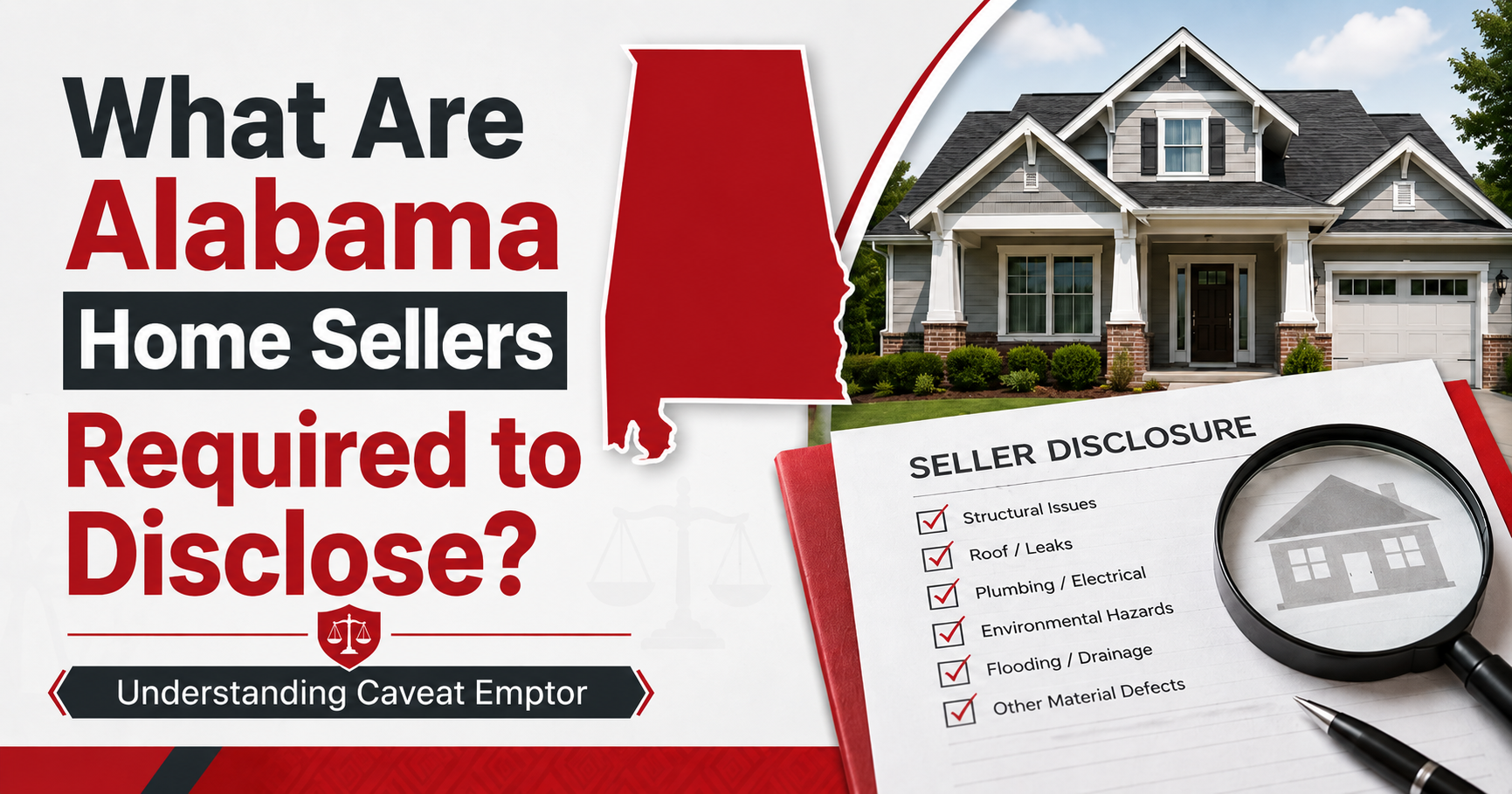
What Are Alabama Home Sellers Required to Disclose?
Answer: Alabama is one of only a handful of states with no required seller disclosure form. Under Alabama’s caveat emptor law, sellers are not legally obligated to proactively list or volunteer property defects to buyers. However, three specific exceptions apply: sellers must disclose known defects that affect health or safety and are not readily visible to the buyer, must answer direct buyer questions honestly, and cannot intentionally conceal material defects without risking fraud liability. Federal law also requires disclosure of known lead-based paint hazards in homes built before 1978. Choosing not to fill out a disclosure form is not the same as being legally protected from all liability and most experienced Alabama real estate attorneys will advise sellers to err toward disclosure, not away from it.
By Steve Stinson | May 23, 2026
What do Alabama home sellers have to disclose to buyers?
Alabama operates under a legal principle called caveat emptor. That’s Latin for “buyer beware.” As a seller in this state, you are not required to fill out a standard disclosure form listing what you know about the property’s condition. Alabama is one of only a few states in the country where this is still the law.
That fact surprises sellers who’ve bought or sold in other states. In Georgia, Tennessee, Florida, and most of the country, a multi-page seller disclosure form is a standard part of every residential transaction. In Alabama, it isn’t.
Here’s the complete picture of what is actually required and where sellers get into trouble assuming caveat emptor means they can say nothing at all.
What Caveat Emptor Actually Means in Alabama
Caveat emptor in Alabama means buyers are generally responsible for investigating the condition of the property they’re purchasing. They’re expected to hire inspectors, ask questions, and conduct their own due diligence. The seller has no general duty to hand them an itemized list of everything that might be wrong.
This is a meaningful legal difference from most states. A buyer in Alabama who purchases a home and later discovers a problem generally cannot come back to the seller and say “you should have told me about that”, unless one of three exceptions applies.
The Three Exceptions That Create Legal Obligations
First: known health and safety defects.
If you have knowledge of a material defect that affects the health or safety of future occupants, and that defect is not readily visible or discoverable through a normal inspection, you are required to disclose it. The key phrase is “not readily observable by the buyer.” You don’t have a proactive duty to hire inspectors and go looking for problems. But if you already know about them, and they’re the kind of thing that wouldn’t show up in a standard walkthrough, you must disclose.
Examples that have come up in Alabama real estate disputes: mold in a sealed crawl space, structural damage covered by new drywall, a history of flooding or water intrusion, a failing foundation that’s been patched cosmetically.
Second: direct buyer questions.
If a buyer asks you directly about a specific defect or condition, you must answer honestly. You cannot evade the question, give a misleading answer, or stay technically silent. A buyer who asks “has there ever been water in the basement?” or “has this home had termite damage?” deserves a truthful response. Your obligation isn’t to volunteer the information unprompted, but once asked, you’re on the hook.
Third: intentional concealment.
There’s a meaningful legal difference between not volunteering information and actively hiding it. Painting over water stains before listing, replacing trim to cover rot without repairing the underlying issue, or boarding over a foundation crack to obscure it; these actions could move from silence into fraud. Alabama courts have found sellers liable when they took affirmative steps to conceal defects rather than simply declining to bring them up.
The practical lesson: if you know about a problem, don’t cover it up. Disclose it, price for it, or fix it. Concealment is where sellers create real legal exposure.
Federal Requirements That Apply Regardless of State Law
One area where Alabama’s caveat emptor rule does not override your obligations: federal lead-based paint disclosure.
If your home was built before 1978, federal law requires you to provide buyers with an EPA-approved lead paint disclosure form and the EPA pamphlet “Protect Your Family from Lead in Your Home.” Buyers must be given a 10-day window to conduct lead paint testing if they choose. This applies to every residential sale of a pre-1978 home, in every state, including Alabama.
Violations of the federal lead paint disclosure law carry civil and potentially criminal penalties. This is not optional.
The RECAD Form: What It Is and Why It Matters
You will sign a document called the RECAD form in every Alabama real estate transaction. This stands for Real Estate Consumer’s Agency and Disclosure, and it’s required under Alabama law.
The RECAD form explains the different agency relationships in the transaction: who represents the seller, who represents the buyer, and what those relationships mean legally. Your listing agent is required to present this form and have it signed before or at the time of an offer.
This is not a property condition disclosure. It does not replace any obligation you have under the three exceptions above. It covers the agency relationship only.
Termites: The Alabama-Specific Issue Worth Addressing Directly
North Alabama is one of the highest-risk areas in the country for subterranean termite activity. Termites are active year-round in the Huntsville and Madison County area, and termite damage is one of the most common findings in home inspections here.
If you have knowledge of past or active termite damage, especially structural damage that wouldn’t be readily visible during a walkthrough, that knowledge may trigger a disclosure obligation under the health and safety exception.
Practically, most experienced agents in this market will advise you to have an active termite bond in place before you list. Buyers routinely request a current termite letter as part of the transaction. Surfacing a termite issue after an accepted offer is a common reason deals fall apart or get renegotiated. Addressing it before you go live removes that complication.
Why Smart Sellers Disclose More Than the Law Requires
There’s a practical argument beyond the legal one.
Sellers who stay completely silent on known issues tend to have harder closings. Buyers discover most things during inspection. When they do, they ask for repair credits, price reductions, or both. The negotiating position of a seller who voluntarily disclosed a known issue and priced accordingly is almost always stronger than the seller who said nothing and is now defending their position mid-contract.
There’s also the post-closing exposure. If a buyer discovers something significant after closing that you knew about, they could pursue legal action. Those disputes are expensive, stressful, and unpredictable.
The sellers I’ve worked with who have the cleanest closings address what they know upfront — either by fixing the issue, disclosing it clearly, or reflecting it in price. That’s true whether or not the law technically required it.
Schedule Your 20-Minute Strategy Call
Frequently Asked Questions
Does Alabama require a seller disclosure form?
No. Alabama is a buyer beware (caveat emptor) state, which means sellers are not legally required to complete a standard property disclosure form. However, sellers are still required to disclose known health and safety defects that are not readily observable, answer direct buyer questions honestly, and refrain from intentional concealment. Federal lead paint disclosure is also required for all homes built before 1978.
What happens if I sell a house with undisclosed defects in Alabama?
If a buyer discovers after closing that you knew about a significant defect and either concealed it or failed to disclose it under one of the legal exceptions, you could face legal liability for fraud or misrepresentation. Alabama’s caveat emptor rule does not protect sellers from liability for active concealment or knowing deception. Courts have found sellers liable in these situations, and damages can include repair costs, legal fees, and additional penalties.
Do I have to disclose termite damage when selling my home in Alabama?
If you have personal knowledge of past or active termite damage, especially structural damage that would not be readily visible to a buyer or inspector, that knowledge may create a disclosure obligation under Alabama’s health and safety exception. Most Huntsville-area agents and attorneys advise sellers to have an active termite bond in place before listing and to disclose any known termite history.
What is the RECAD form in Alabama real estate?
The RECAD form is the Real Estate Consumer’s Agency and Disclosure form, required in every Alabama real estate transaction. It explains the agency relationships between buyer, seller, and their respective agents. It must be signed before or at the time an offer is made. It is not a property condition disclosure, it covers the legal relationship between the parties and their agents only.
What is caveat emptor in Alabama real estate?
Caveat emptor means “buyer beware.” In Alabama real estate law, it means home sellers are not required to proactively complete a property condition disclosure form. Buyers are generally responsible for discovering property conditions through their own inspections and due diligence. However, this rule has three important exceptions involving health and safety defects, direct buyer inquiries, and intentional concealment and it does not override federal lead paint disclosure requirements.
Alabama’s disclosure rules give sellers more legal breathing room than most states. But “more breathing room” doesn’t mean “no obligations.” The three exceptions are real, the fraud standard is real, and the post-closing liability exposure for knowing concealment is real.
If you’re preparing to sell and want to think through what applies to your specific home, I’m glad to walk through it with you. Schedule a free 20-minute strategy call — we’ll work through what to address, what to disclose, and how to price for a clean, confident sale.
Have a question about the Huntsville housing market?
Get straight, local answers about selling, buying, relocating, investing, or building in the Huntsville area. No pressure.
Since 2005 · 500+ Families Served · 250+ Five-Star Reviews · BBB A+ Rated
About Steve Stinson
Steve Stinson is a REALTOR® and Broker Associate with Keller Williams Realty in Huntsville, Alabama. He has served buyers and sellers across Madison County since 2005.
Steve specializes in getting sellers the best result, with particular strength in new construction homes, relocation, downsizing, and buying or selling investment properties. He works with clients in Huntsville, Madison, Hampton Cove, Owens Cross Roads, and the surrounding North Alabama area, and helps owners weigh open-market sales against local cash-buyer offers so they can compare speed, price, and terms with confidence.
He has helped more than 500 families make A Wise Move and earned 250+ five-star reviews. Steve is a Best of Zillow award recipient and consistently ranks in the top 5% of the local MLS as a listing agent. A lifelong Alabamian and 40-plus-year resident of the area, he brings deep local knowledge and pricing strategy to every move, whether you’re navigating a seller’s market or deciding how to compete for a home in a hot one.
Disclaimer:
This article is for general informational purposes only and should not be considered tax, legal, financial, or investment advice. Real estate decisions can have important tax, legal, and financial consequences, and every situation is different. Before making decisions about selling a home, calculating proceeds, capital gains, investments, or legal obligations, consult with a qualified CPA, attorney, financial advisor, or other licensed professional familiar with your specific situation.