
Should I Accept a Contingent Offer on My Huntsville Home?
By Steve Stinson | June 14, 2026
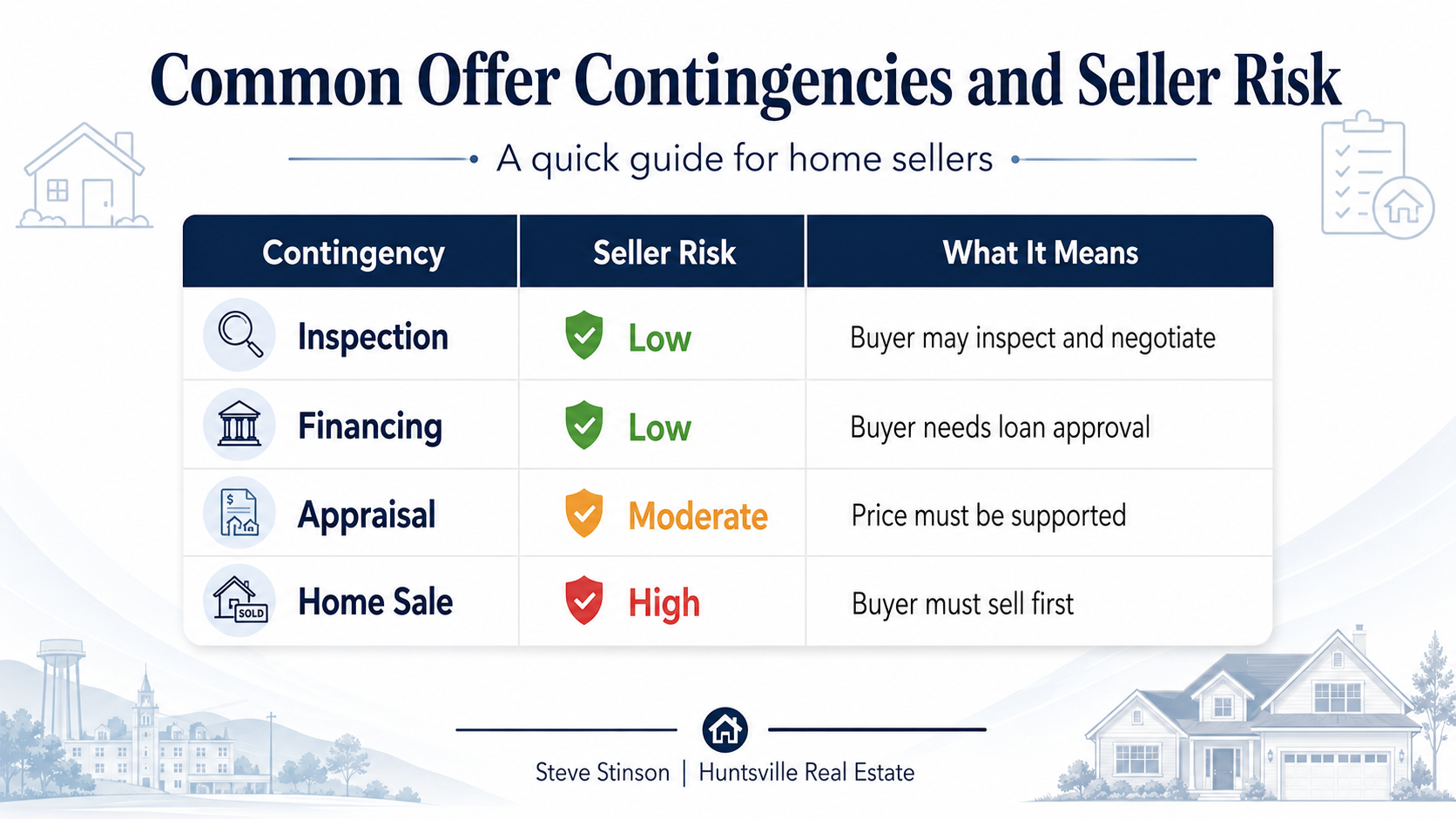
Yes, a contingent offer on your Huntsville home can be worth accepting, but only after you understand what type of contingency is involved and how much risk it creates. Inspection, financing, and appraisal contingencies are common in Alabama contracts. A home sale contingency is different because your closing depends on the buyer selling another property first.
This article explains the types of contingent offers, their risks, and how Huntsville sellers can evaluate and respond to them. If you are a Huntsville home seller considering contingent offers, this guide will help you make an informed decision.

In Huntsville’s current market, with about 5.9 months of inventory and homes averaging roughly 56 to 76 days on market, contingent offers are not unusual. The right answer is not simply yes or no. The right answer depends on the buyer’s timeline, the strength of their current-home sale, the price and terms of the offer, and whether your contract protects you with a kick-out clause.
Getting an offer on your home is good news. Finding out it is contingent is the moment most sellers pause.
The word contingent does not automatically mean the deal is weak. It means the sale is not final yet because one or more conditions still need to be met. The key is knowing which conditions are normal, which ones create more risk, and how to protect yourself before you sign.
What Is a Contingent Offer?
A contingent offer means the buyer has agreed to purchase your home, but the agreement depends on certain conditions being satisfied. A contingent offer is finalized only when the specified conditions are met. If those conditions are not met, the buyer may be able to cancel the contract and keep their earnest money, depending on the contract terms. Contingent offers may allow buyers to back out without penalty if the conditions are not met.
Some contingencies are standard in almost every Alabama home sale. Others deserve a much closer look.
The Standard Contingencies Most Sellers Should Expect
Most Alabama offers include three common contingencies: inspection, financing, and appraisal. These are not automatic red flags. They are normal parts of the transaction.
Inspection contingency
A home inspection contingency gives the buyer the right to have the home professionally inspected. After the inspection, the buyer may:
- Accept the home as-is
- Request repairs
- Ask for a credit
- Renegotiate
- Cancel within the agreed inspection period, which is usually a set timeframe of 5 to 14 days
A home inspection can uncover major issues and help avoid big surprises before closing.
Alabama is generally a buyer beware, or caveat emptor, state. That does not remove the buyer’s right to inspect the home. It also does not mean every inspection request is unreasonable. Most inspection issues are negotiated and resolved without the sale falling apart.
Financing contingency
A financing contingency, often called a mortgage contingency, protects the buyer if their mortgage approval falls through. This protection applies if financing is not secured within the specific period stated in the contract. If the lender will not approve the loan under the terms of the contract, the buyer may be able to cancel and recover their earnest money.
For any non-cash offer, this is standard. The better question is whether the buyer has a strong pre-approval, stable financing, and a lender who can perform on time, since most lenders still control approval timing and terms.
Appraisal contingency
An appraisal contingency means the home needs to appraise at or near the agreed purchase price. In practice, most lenders require the appraisal during underwriting unless a waiver applies. If the appraisal comes in low, the buyer and seller may:
- Renegotiate the price
- The buyer may bring additional cash, sometimes through a larger down payment to help bridge the gap
- The seller may adjust the price
- The contract may terminate depending on the terms
A low appraisal is not always the end of the deal. It is a problem to solve, but it is one sellers should think through before accepting an offer.
These three contingencies are common and usually manageable. The contingency that deserves a more serious review is the home sale contingency.
A Home Sale Contingency Is Different
A home sale contingency means your buyer needs to sell their current home before they can close on yours. They may be pre-approved, motivated, and financially responsible, but if their home does not sell, your closing may not happen.
That can introduce uncertainty into the process.
With an inspection contingency, you usually know the outcome within days. With financing and appraisal, the timeline is usually measured in weeks. With a home sale contingency, your sale depends on a second real estate transaction that you do not control. Sellers often worry the deal falls apart, but only 5% of sales contracts were terminated in early 2026.
In a market with about five to six months of inventory, this situation is common. Huntsville’s market conditions are shaped by tech and aerospace growth, and many buyers already own a home. They find the next one they want, but they need the proceeds from their current sale to complete the purchase.
That does not make the offer bad. It does mean the offer needs to be evaluated carefully in case contingent offers fall and financing can fall through.
How to Evaluate a Home Sale Contingent Offer
Before accepting a home sale contingent offer, ask these questions:
- How far along is the buyer’s current sale?
- How well is the buyer’s home priced?
- Where is the buyer’s home located?
- How strong are the rest of the terms?
- What are your other options?
How far along is the buyer’s current sale?
If the buyer’s home is already under contract, the risk is lower. If their home is active but not under contract, the risk is higher. If their home has not even been listed yet, the risk is much higher.
How well is the buyer’s home priced?
A buyer’s home can be listed, photographed, and marketed, but if it is overpriced, your closing timeline is still uncertain. Understanding how to price a home correctly in Huntsville helps you evaluate whether their property is positioned to sell. A home that is sitting with little activity may become your problem if you accept the offer without protection.
Where is the buyer’s home located?
A home listed in a fast-moving price range or strong neighborhood, like Madison, Hampton Cove, South Huntsville, may carry less risk than a home in a slower segment of the market. The local market for their property matters.
How strong are the rest of the terms?
Price is only one part of the offer. Look at the proposed closing date, earnest money, requested concessions, repair expectations, loan type, appraisal terms, and flexibility. In a seller’s market or when multiple offers are likely, sellers often prefer fewer or shorter contingencies, and certain contingencies can make a buyer’s offer less attractive even at a higher price. Understanding how VA loan offers work for Huntsville sellers is part of weighing different financing types. A slightly lower but cleaner offer may be better than a higher offer with more uncertainty.
What are your other options?
If your home has strong activity, multiple interested buyers, and other offers to weigh, you may not need to take on the added risk. If showings have slowed and inventory is rising, a protected contingent offer may be worth serious consideration, since waiting for a better offer may or may not be the right move depending on current market conditions. Paying attention to current Huntsville real estate market trends and expert tips can help you time that decision.
Why a Kick-Out Clause Matters
A kick-out clause, sometimes called a mutual release clause, is one of the most important protections when accepting a home sale contingent offer.
A kick-out clause allows you to keep marketing the house during the home sale contingency and continue showing it. If another acceptable offer comes in, you notify the contingent buyer. The buyer then has a set period of time, often 24 to 72 hours, to remove the home sale contingency or step aside. If they cannot remove it, you may be free to move forward with the new offer.
This often aligns with active contingent status, meaning the property is under contract but still available for backup offers.
Without a kick-out clause, you may be taking your home off the market while you wait on the buyer’s home to sell. That can be a significant bet, especially in a balanced market.
A kick-out clause does not eliminate all risk, but it gives you leverage and keeps your options open.
How Much Earnest Money Should Matter?
Earnest money is not the only factor, but it is a deposit that shows the buyer’s seriousness and remains an important signal, just like estimating what you will actually net from selling in Huntsville is essential to seeing the full picture.
In Huntsville, earnest money often falls around 1% of the purchase price. On a $350,000 home, that would be roughly $3,500.
A stronger earnest money deposit can show that the buyer is serious and willing to put real money at risk. A very low earnest money deposit on an already-contingent offer should be considered carefully.
The deposit does not make a risky offer safe by itself. It is one piece of the full process of evaluating the offer and should be weighed alongside how well the property is prepared, including what you should fix before selling a house in Huntsville.
How Sellers Should Respond to Each Contingency Type
Inspection, financing, and appraisal contingencies
These are common contingencies. Sellers should still review the specific conditions, dates, deadlines, and contract language closely, but do not assume the buyer is weak just because these contingencies are included. The inspection contingency can lead to repair requests, while the financing contingency protects the buyer if the loan is not approved on time.
Home sale contingency
Evaluate carefully. Before signing, find out whether the buyer’s home is listed, under contract, priced correctly, and likely to close. Strongly consider requiring a kick-out clause so your home can remain active and available to other buyers.
No-contingency or cash offer
These may be cleaner, but a non contingent offer is not automatically better. Price, closing terms, inspection rights, proof of funds, and timing still matter, and buyers often use stronger proof of funds, financing strength, or a larger payment to help an offer stand out. A clean offer only helps if the rest of the terms also work for you.
The Bottom Line for Huntsville Sellers
You should not reject a contingent offer just because it is contingent. In Huntsville’s current market, contingent offers can be part of a successful sale.
The key is separating normal contingencies from higher-risk ones. Inspection, financing, and appraisal contingencies are common. A home sale contingency deserves deeper review, stronger contract language, and usually a kick-out clause.
If you have received an offer and are unsure how to evaluate it, do not guess. The seller needs to decide based on risk, timing, price, and protections before signing.
Schedule a free 20-minute strategy call to walk through your timing, contingencies, and next move, especially if you are relocating to Huntsville and need a local guide.
Frequently Asked Questions
What is a contingent offer in Alabama real estate?
A contingent offer means the buyer’s purchase depends on one or more conditions being met. Common examples include inspection, mortgage approval, appraisal, the sale of the buyer’s current home, or a title contingency. It protects the buyer by requiring a title search that confirms a clean title before purchase. If a contingency is not satisfied, the buyer may be able to cancel under the contract terms.
Is a contingent offer bad for a seller?
Not always. Inspection, financing, and appraisal contingencies are common in Alabama home sales. A home sale contingency carries more risk because your closing depends on the buyer selling another property first.
What’s the difference between contingent and pending in Alabama?
Contingent usually means an offer has been accepted, but one or more conditions still need to be met. Pending usually means the major contingencies have been cleared and the sale is moving toward closing. Exact MLS status rules can vary, so sellers should confirm the status language with their agent.
Should I keep showing my home after accepting a contingent offer?
You can usually keep showing the home if the contract includes a kick-out clause or other language that allows continued marketing. Without that protection, accepting another offer can become complicated. Get the structure right before you sign.
How long does a buyer have to remove a home sale contingency in Alabama?
There is no single universal timeline. The deadline is negotiated in the contract. Many kick-out clauses give the buyer 24 to 72 hours after written notice of another acceptable offer to remove the home sale contingency or release the contract.
How much earnest money is standard in Huntsville for a contingent offer?
Earnest money in Huntsville often ranges around 1% of the purchase price. On a $350,000 home, that is roughly $3,500. A stronger deposit can signal buyer commitment, but it should be evaluated alongside the full offer.
Should I accept a home sale contingent offer if the buyer’s home is not listed yet?
Be careful. If the buyer’s home is not listed, your sale may depend on a transaction that has not even started. In that situation, a seller should strongly consider a short deadline, proof of the buyer’s listing plan, and a kick-out clause.
Ready to make A Wise Move?
If you’re thinking about selling in Huntsville or Madison County, let’s talk through the smartest way to approach it.
Since 2005 · 500+ families helped · 250+ five-star reviews · BBB A+ rated
About Steve Stinson
Steve Stinson is a REALTOR® and Broker Associate with Keller Williams Realty in Huntsville, Alabama, serving home buyers and sellers across Madison County since 2005. He specializes in seller representation, new construction homes, relocation moves, downsizing, and investment property guidance in Huntsville, Madison, Hampton Cove, Owens Cross Roads, and the surrounding North Alabama market.
Steve has helped more than 500 families make confident real estate decisions, earned 250+ verified 5-star reviews, received the Best of Zillow award, and consistently ranks in the top 5% of the local MLS as a listing agent. A lifelong Alabamian and 40+ year Huntsville-area resident, Steve brings local market knowledge, pricing strategy, and negotiation experience to every move, including for Huntsville real estate investors looking for local market guidance.
Learn more at stevestinsonhuntsvillehomes.com, including his privacy policy for client information and guidance for buyers considering brand new construction homes in Huntsville.