
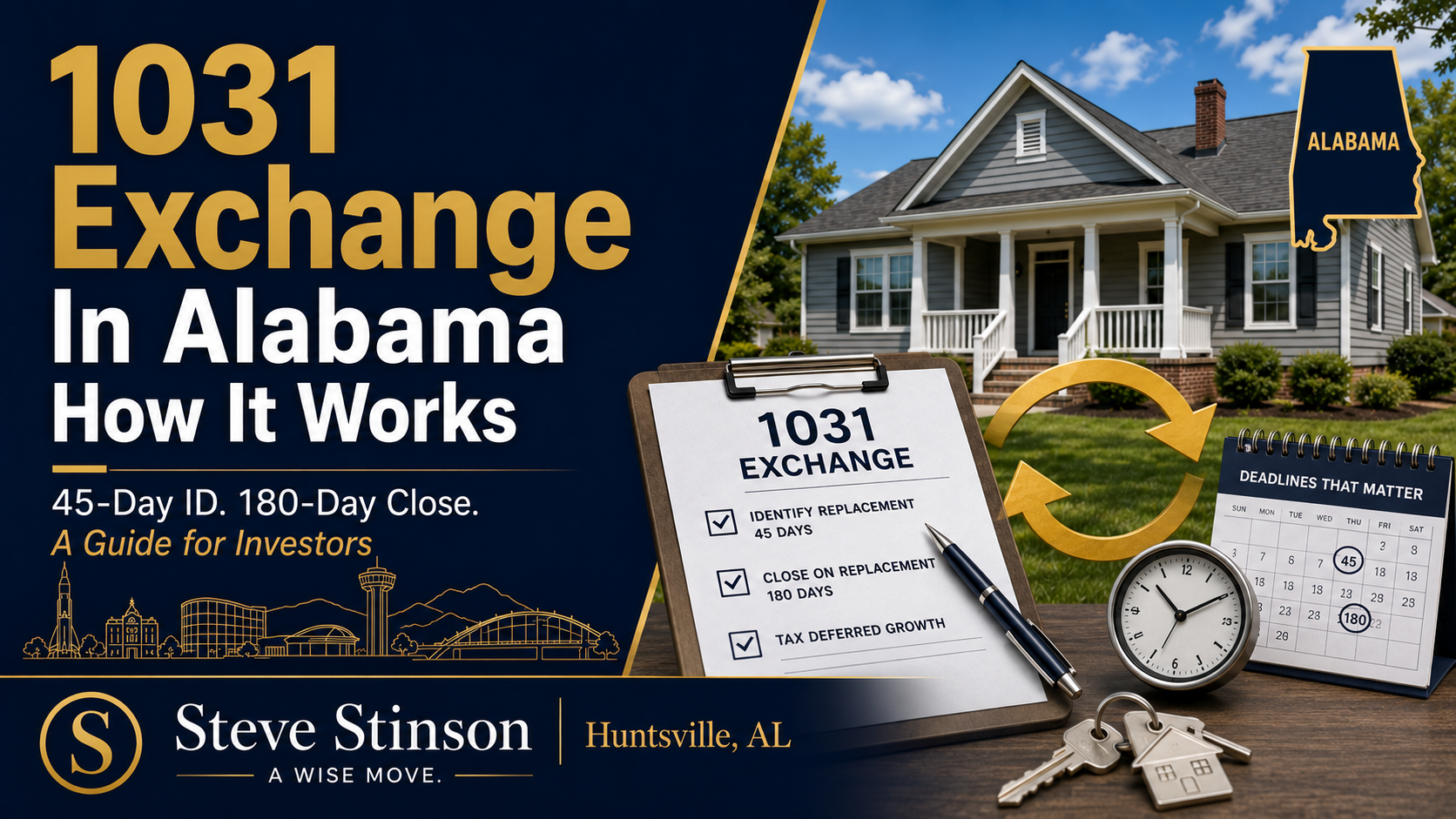
How Does a 1031 Exchange Work in Alabama?
A 1031 exchange in Alabama lets an investor defer federal and Alabama tax on eligible gain by exchanging investment or business real estate for like-kind real property. This process, often referred to as a “1031 exchange Alabama,” is especially relevant for real estate investors in Alabama—including those in Huntsville and Madison County—who want to maximize their reinvestment capital and minimize immediate tax liability.
By Steve Stinson | July 25, 2026
Introduction: Who Should Read This Guide and Why
This guide is designed for Alabama real estate investors, especially those in Huntsville and Madison County, who are considering selling investment or business property and want to understand how a 1031 exchange works in Alabama. We cover the key rules, Alabama-specific requirements, and practical steps to ensure a successful exchange. Understanding Alabama-specific rules is crucial because, while the 1031 exchange is governed by federal law, Alabama’s tax treatment, withholding requirements, and filing procedures can impact your transaction and overall tax outcome. This guide will help you avoid costly mistakes, protect your tax deferral, and make informed decisions about your real estate investments.
A 1031 exchange can be useful when an appreciated rental or other investment property is sold and the owner wants to keep more equity invested in real estate. The rules are federal, but Alabama tax treatment also matters, and the exchange must be planned before closing because the seller cannot receive the proceeds and fix the structure afterward.
For Huntsville and Madison County investors who own or plan to sell investment or business property, this guide explains how a 1031 exchange works in Alabama, which properties qualify, the role of a qualified intermediary, the key tax and timing rules, and practical steps to prepare. Understanding those details helps protect the tax deferral, preserve reinvestment capital, and avoid mistakes that can disqualify the exchange.
What Does a 1031 Exchange Do to Defer Capital Gains Taxes?
A 1031 exchange postpones recognition of eligible gain when qualifying real estate is exchanged for other like-kind real estate held for investment or business use. It is a tax deferred transaction used to defer capital gains taxes on the sale of investment and business property. It does not erase the tax. The deferred gain generally carries into the replacement property through its tax basis.
For a Huntsville rental owner, that can preserve more capital for the next investment. Local Huntsville real estate investors often use exchanges to align properties with longer-term goals while staying disciplined about market timing. An investor may exchange one investment property for another, including moving from a rental property into different commercial properties such as an office building, and some investors intentionally look for replacement rentals before year-end to maximize current-year depreciation and cash flow benefits. An investor may also combine several properties into a larger asset or shift into a different type of investment real estate.
The important word is defer. A future taxable sale may bring the deferred gain back into the calculation, since this strategy defers tax rather than eliminating capital gains tax liability unless another tax rule or another qualifying exchange applies.
Next, let’s look at which types of properties are eligible for a 1031 exchange.
Which Properties Qualify for a 1031 Exchange?
Real property held for investment or productive use in a trade or business may qualify. In general, owners of business or investment properties can defer taxes if the property qualify as real property held for investment or business use under Internal Revenue Service rules. A primary residence, property held mainly for personal use, and property held primarily for resale do not qualify under Section 1031.
For real estate, like-kind is broader than many investors expect. Most U.S. real estate held for investment can be exchanged for other U.S. investment real estate. Qualifying property types include:
- Single-family rentals
- Duplexes
- Residential multifamily properties
- Retail shopping centers
- Commercial real estate
- Vacant land
- Land improvements resulting from human effort
Some Huntsville owners first decide whether to sell or rent their current home before structuring an exchange around a new investment. The properties do not have to look alike or produce the same type of income.
Intent matters. The relinquished property and replacement property should be held for investment or business use. An investor should have a CPA or tax attorney review any property with mixed personal and investment use before the sale.
Before we move on, let’s clarify a common question about primary residences and 1031 exchanges.
Can I use a 1031 exchange for my primary residence in Alabama?
No. Section 1031 applies to real property held for investment or business use, not a home held primarily as your personal residence. A principal residence may qualify for a separate federal home-sale exclusion under Section 121, subject to its own requirements.
Now that you know which properties qualify, let’s review the critical timing rules for a 1031 exchange.
What Are the 45-Day and 180-Day Deadlines?
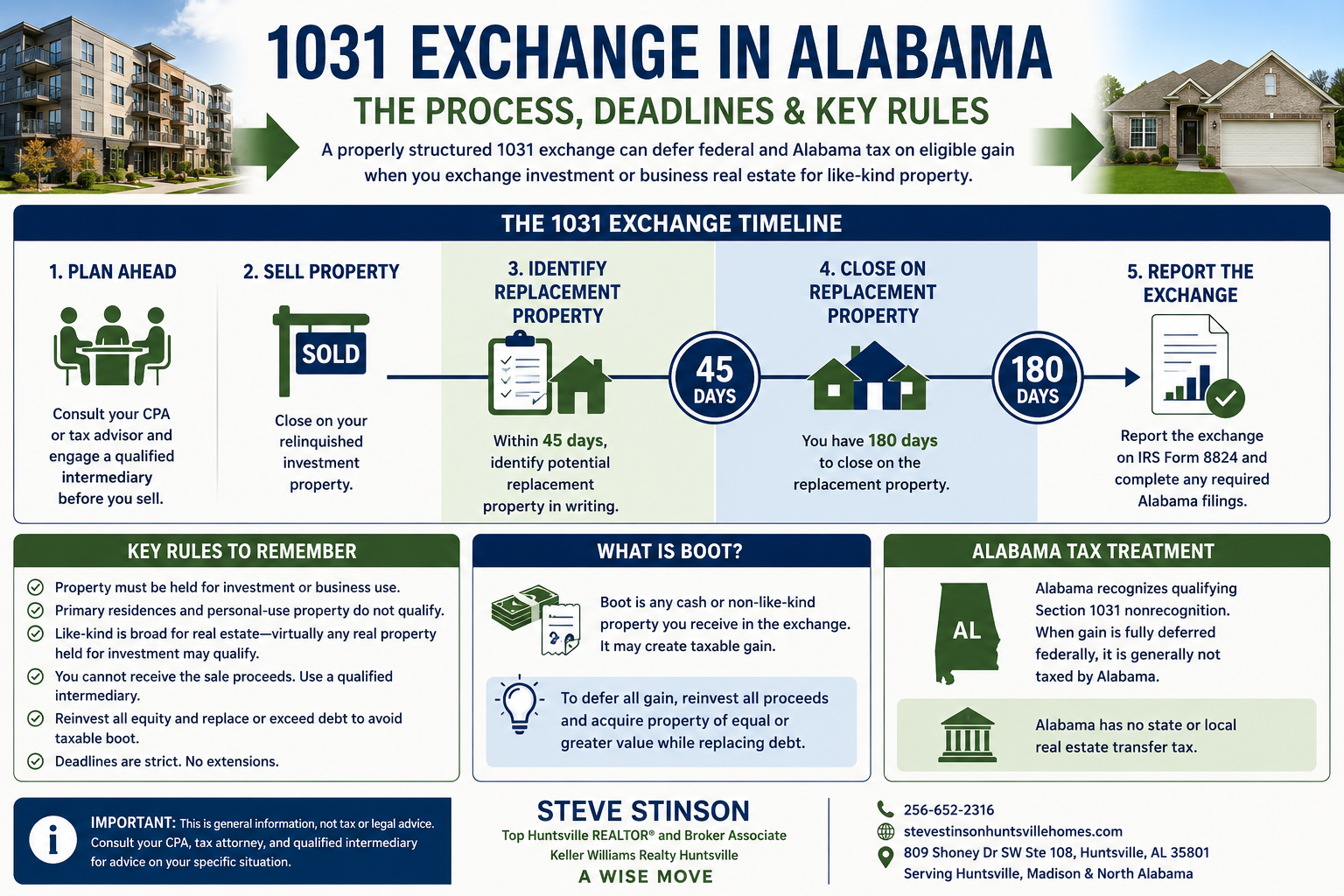
The investor must identify potential replacement property in writing within 45 days after transferring the property being sold. The investor must receive the replacement property by the earlier of 180 days after that transfer or the due date of the income tax return for the exchange year, including extensions.
The property identified must be clearly described in writing, and many investors use the 3-property rule to identify up to three options. Notice to a real estate agent alone does not satisfy the identification requirement.
Both periods begin when the relinquished property transfers. The 180-day period does not start after the 45-day identification period ends.
These deadlines are strict. Weekends and holidays usually do not pause the count. Huntsville investors should begin evaluating replacement options before the sale closes, especially when the target property type has limited inventory, and may want to coordinate the exchange with the best time to sell a house in Huntsville so listing and closing dates match the 45- and 180-day windows. In deferred exchanges generally, a common mistake is missing either the identification deadline or the acquisition deadline for the replacement property received.
Next, let’s discuss the role of a qualified intermediary in the 1031 exchange process.
Why Is a Qualified Intermediary Important?
A qualified intermediary is a third party who must hold the exchange proceeds during the transaction under exchange agreements pursuant to the applicable income tax regulations. The investor cannot take actual or constructive receipt of the money and still expect the deferred exchange to qualify.
The intermediary should be engaged before the relinquished property closes. Waiting until after closing is too late, because taxpayer simply selling the property first cannot recreate the tax deferral afterward.
A qualified intermediary is not a substitute for a CPA or attorney. The intermediary manages the exchange mechanics, while the investor’s tax and legal advisors evaluate basis, ownership, debt, related-party issues, and reporting, and experienced industry attorneys may be needed for complex structures or ownership issues.
With the intermediary’s role clear, let’s look at how “boot” can affect your tax deferral.
What Is Boot in a 1031 Exchange?
Boot is money or non-like-kind property received in the exchange, and it may create currently taxable gain. Cash or debt relief received in the transaction is a tax consequence generally treated as boot and may trigger tax on recognized capital gains, even when the rest of the transaction qualifies.
Buying a less expensive property does not automatically tell you the exact tax result. Purchase price, net equity, debt, exchange expenses, adjusted basis, the amount realized, and changes in property value or debt structure can all affect the boot analysis.
A practical planning goal for full tax deferral is often to reinvest the net proceeds and acquire replacement property with equal or greater value, while taking on equal or greater debt or adding cash if debt is reduced. That is a planning guideline, not a complete tax calculation.
Now, let’s examine how Alabama specifically treats 1031 exchanges and what state-level rules you need to know.
How Does Alabama Treat a 1031 Exchange?
Alabama recognizes qualifying Section 1031 nonrecognition for Alabama income-tax purposes and generally follows federal Section 1031 rules without a separate state eligibility system. Alabama fully follows IRS Section 1031 regulations without its own specific system, and does not have separate eligibility rules for 1031 exchanges; it generally follows federal guidelines. When gain is fully deferred federally and is not recognized by Alabama, the deferred portion is generally not taxed by Alabama in the exchange year.
Alabama does tax reportable gains from the sale or exchange of real estate. That makes proper exchange structure important for an Alabama property owner.
Alabama-Specific 1031 Exchange Rules:
- Alabama follows federal 1031 rules.
- Alabama does not have separate eligibility rules for 1031 exchanges; it generally follows federal guidelines.
- 3% withholding for nonresident individuals.
- 4% withholding for nonresident business entities.
- Withholding applies to sales of real property by nonresidents.
- Exemptions from withholding are available under certain conditions.
Nonresident sellers also need state-specific advice. Alabama typically requires withholding on certain sales of Alabama real property by nonresidents unless an exemption applies in a qualifying 1031 exchange, and the withholding is generally 3% for nonresident individuals and 4% for nonresident business entities, including limited liability companies. Some sellers use Form NR-AF2 to calculate withholding based on gain, and nonresident investors may seek an exemption when the exchange defers recognized gain. If tangible personal property transfers with the real estate, it can also affect the withholding analysis.
With Alabama’s rules in mind, let’s walk through the basic timeline for a 1031 exchange.
What Is the Basic 1031 Exchange Timeline?
A successful exchange begins before the property is sold. The investor should assemble the real estate, tax, legal, and qualified-intermediary pieces before closing.
- Review the proposed exchange with a CPA or tax attorney.
- Select a qualified intermediary before the sale closes.
- Sell the relinquished investment or business property.
- Identify up to three replacement property options in writing within 45 days under the three-property rule.
- Complete the replacement purchase within the required 180-day period.
- Report the exchange on IRS Form 8824 and complete any required Alabama filings.
Reviewing replacement property options early can help avoid deadline errors and preserve tax strategy flexibility. The identification rules can limit how many properties are named and how they are valued. An investor planning multiple backup properties should have the identification method reviewed before submitting the written notice.
Next, let’s discuss how Huntsville investors can best prepare before selling their property.
How Should Huntsville Investors Prepare Before Selling?
Key Steps for Huntsville Investors
Huntsville investors should identify the replacement strategy before setting the closing date on the property being sold and understand what they are likely to net after costs using a seller net proceeds estimate in Huntsville. The 45-day period is too short to begin from scratch after closing.
Start with the investment objectives. Decide whether the next property should prioritize monthly cash flow, lower maintenance, stronger long-term location, consolidation, or easier management. In some cases, that means moving out of a traditional property and into an asset type that better fits cash-flow or management goals, and reviewing broader Huntsville real estate market trends and scenarios can help shape those choices. Then establish a realistic price range and financing plan.
Steve Stinson can help with the real estate side of the exchange, including pricing the current property, evaluating likely net proceeds, locating replacement options in Huntsville and Madison County, and coordinating contract dates with the exchange timeline, drawing on his experience helping hundreds of Huntsville families move and invest. That can matter for commercial investors and residential investors who need replacement choices aligned with timing and financing. Tax structure should remain with the investor’s CPA, attorney, and qualified intermediary.
Have a question about the Huntsville housing market?
Get straight, local answers about selling, buying, relocating, investing, or building in the Huntsville area. No pressure.
Since 2005 · 500+ Families Served · 250+ Five-Star Reviews · BBB A+ Rated
Frequently Asked Questions
Can I exchange an Alabama rental for property in another state?
Yes. U.S. investment real estate can generally be like-kind to other U.S. investment real estate, even when the properties are in different states, so investors may exchange farmland for residential multifamily property in another state if both are held for investment, including student housing properties, or move from an older rental into new construction investment homes in Huntsville or Madison County. State filing, withholding, and future tax consequences should be reviewed with a tax professional.
Can I identify more than one replacement property in a 1031 exchange?
Yes. IRS identification rules allow multiple potential properties under specific limits, commonly the three-property rule or the 200 percent rule. The written identification must be timely, clear, and delivered to an eligible party.
What happens if I miss the 45-day deadline?
The deferred exchange generally fails if replacement property is not properly identified within 45 days. The sale is then treated as a taxable transaction unless another provision applies.
Do I have to spend every dollar from the sale?
Full tax deferral generally requires careful replacement of value, equity, and debt, and receiving debt relief can create taxable boot. Cash retained or other value not replaced may be taxable as boot, though replacement property with lower leverage may still work if you add cash to offset the reduction and maintain equal or greater debt. Your CPA or tax attorney should calculate the amount for your specific exchange.
How is a 1031 exchange reported?
The exchange is generally reported on the federal income tax return using Form 8824 for the year of the exchange, which helps track deferred gain and other tax consequences of the exchanged property. Alabama reporting may also be required. Keep the closing statements, identification notice, intermediary agreement, and basis records.
With these FAQs covered, let’s summarize the key takeaways and final considerations for Alabama investors.
Schedule Your 20-Minute Strategy Call
The Bottom Line
Final Considerations
A 1031 exchange can preserve investment capital by deferring eligible federal and Alabama gain, but the benefit depends on exact timing and structure, and for some owners estate planning also matters because deferred capital gains taxes may be eliminated at inheritance under current law. The qualified intermediary must be in place before closing, the replacement property must be identified within 45 days, and the purchase must be completed within the required 180-day period.
If you are considering the sale of a Huntsville or Madison County investment property, first make sure the exchange structure is in place. Then schedule a strategy call with Steve Stinson to discuss pricing the property and locating realistic replacement options within the exchange timeline, whether you are downsizing under a step-by-step Huntsville downsizing plan or preparing a larger home for sale and wondering what to fix before listing in Huntsville, while reviewing the replacement plan against long-term cash flow and potentially greater cash flow goals before choosing the next property.
This article is general information, not tax or legal advice. Before selling, speak with a qualified intermediary and a CPA or tax attorney who can evaluate your basis, ownership structure, debt, depreciation, and replacement plan.
About Steve Stinson
Steve Stinson is a REALTOR® and Broker Associate with Keller Williams Realty in Huntsville, Alabama. He has served buyers and sellers across Madison County since 2005.
Steve specializes in getting sellers the best result, with particular strength in new construction homes, relocation, downsizing, and buying or selling investment properties. He works with clients in Huntsville, Madison, Hampton Cove, Owens Cross Roads, and the surrounding North Alabama area, and helps owners weigh open-market sales against local cash-buyer offers so they can compare speed, price, and terms with confidence.
He has helped more than 500 families make A Wise Move and earned 250+ five-star reviews. Steve is a Best of Zillow award recipient and consistently ranks in the top 5% of the local MLS as a listing agent. A lifelong Alabamian and 40-plus-year resident of the area, he brings deep local knowledge and pricing strategy to every move, whether you’re navigating a seller’s market or deciding how to compete for a home in a hot one.