What Are the Biggest Home Buying Deal Breakers in Huntsville, Alabama?
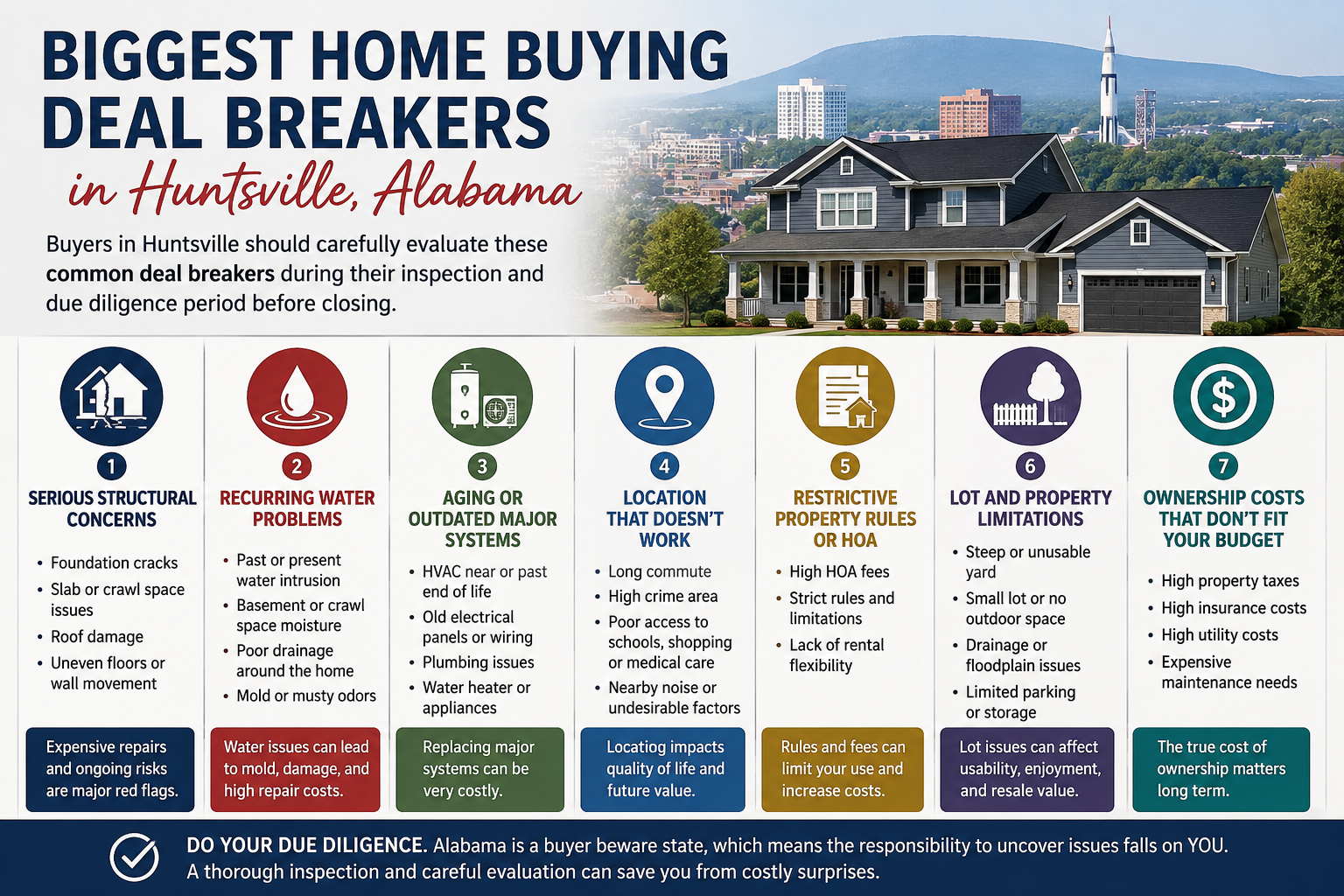
The biggest Huntsville home buying deal breakers are serious structural concerns, recurring water problems, aging major systems, an unsuitable location, restrictive property rules, lot limitations, and ownership costs that strain the buyer’s budget. Buyers should investigate these issues carefully during their inspection and due diligence period because Alabama generally places significant responsibility on buyers to evaluate a property before closing.
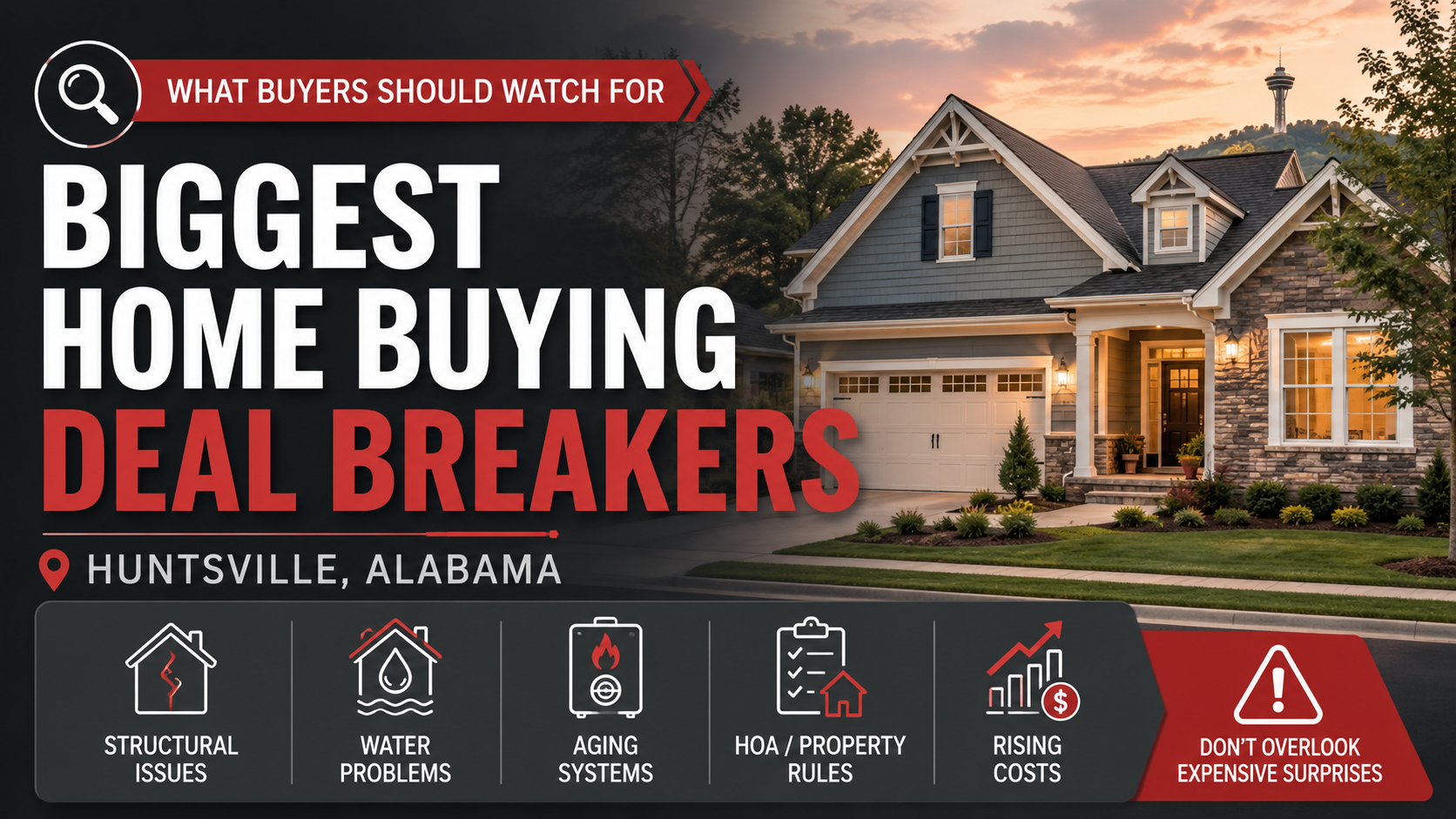
This guide is for anyone considering buying a home in Huntsville or North Alabama—including Madison, Harvest, Meridianville, Hampton Cove, Owens Cross Roads, and surrounding areas. Understanding huntsville home buying deal breakers is crucial to avoid costly mistakes and ensure a smooth home buying experience. Whether you’re a first-time buyer, relocating for work, or moving within the region, knowing what to watch out for can save you from unexpected headaches and financial pitfalls.
When it comes to huntsville home buying deal breakers, there are a few key issues that homebuyers in Madison County just can’t afford to overlook. This page addresses the biggest deal breakers for home buyers in Huntsville, including structural problems, water risks, expensive mechanical systems, location concerns, property restrictions, and surprise costs that can blow your budget. These issues can turn what seems like a dream home into a costly headache down the line.
Not every little imperfection is a deal breaker, of course. Scratched paint, outdated fixtures, and other cosmetic quibbles can usually be sorted out with a fresh coat of paint and a few new decorations. But a true deal breaker is something that’s going to end up costing you an arm and a leg, or making your life a whole lot harder.
Below, we’ll cover the seven biggest huntsville home buying deal breakers, with a focus on local risks such as foundation movement due to clay-rich soils, high humidity and moisture problems, crawl space moisture, flood risk even outside FEMA zones, unpermitted work, radon, pest infestations, and Alabama’s caveat emptor legal framework.
1. Serious Foundation or Structural Problems
Foundation issues are a big deal because they can affect how stable, safe, and valuable a home is in the long run. In Huntsville, clay-rich soils can cause foundation movement, and many homes are built on crawl spaces, making them prone to moisture problems.
Common Signs
Watch out for:
- Cracks in walls that are getting bigger
- Doors and windows that don’t close properly
- Floors that are sloping or uneven
- Gaps around exterior doors and windows
- Cracks in brickwork
- Moisture in the crawl space or basement (common in North Alabama due to high humidity and heavy seasonal rains)
- Any signs of previous structural repairs that you can’t get any documentation on
Local Risks
- Foundation movement due to clay-rich soils is a known issue in Huntsville.
- High humidity and moisture problems can accelerate structural deterioration.
- Crawl space moisture is especially common and can lead to rot or mold.
What to Do
A little bit of settling in your home is pretty normal in North Alabama—some cracks are just cosmetic and don’t mean a thing. But if you’re not sure what’s going on, don’t just guess. Get an expert to take a look and ask for any records they might have on previous repairs, warranties, or engineering reports.
If you do end up with a structural issue, it’s likely to be a deal breaker if you can’t figure out what’s going on, or if it’s going to cost you an arm and a leg to fix.
Transition: If the foundation checks out, the next major risk to consider is water intrusion and drainage.
2. Drainage, Flooding, or Ongoing Water Intrusion
Water is the enemy of a home—it can damage the foundation, crawl space, flooring, walls, insulation, and indoor air quality. It can also create maintenance nightmares that are a pain to deal with after closing. Severe water intrusion or major mold are significant deal-breakers for home buyers.
Warning Signs
Look out for:
- Water standing in the yard
- Soil sloping towards the house
- Water stains on walls or ceilings
- Musty odors
- Fresh paint in weird places
- Efflorescence on masonry
- Broken or missing gutters
- Downspouts that are releasing water right next to the foundation
- Sump pumps or drainage systems with no maintenance records
Local Risks
- North Alabama has high humidity and heavy seasonal rains, increasing the risk of moisture problems.
- Many Huntsville-area homes are built on crawl spaces, making them prone to moisture issues.
- Flood risk and poor drainage aren’t the same—even homes outside FEMA’s mapped floodplain can experience drainage problems due to land grading, surrounding development, or stormwater flow.
What to Do
You need to dig into whether there have been any previous flooding, drainage problems, roof leaks, plumbing leaks, or water intrusion. Don’t assume you can get insurance without checking—find out if coverage is available and affordable before the contingency period is up.
Transition: Once you’ve ruled out major water issues, it’s time to look at the home’s major systems and mechanicals.
3. Major Systems on the Frying Pan
An older roof, heating and cooling system, water heater, electrical panel, or plumbing system aren’t necessarily a problem in and of themselves—but when several of them are on the fritz, it can be a big financial burden.
What to Check
Pay attention to the condition and age of:
- Roof coverings
- HVAC equipment
- Water heaters
- Electrical panels and wiring
- Supply and drain lines
- Windows
- Septic systems
- Major appliances that come with the home
Local Risks
- High humidity and moisture can shorten the lifespan of HVAC and electrical systems.
- Pest infestations can compromise a home’s structural integrity and damage wiring or insulation.
What to Do
It’s not just about age—maintenance history, installation quality, current condition, and replacement cost all matter a lot more than just how old something is. For example, a buyer might be okay with a home that’s got an older HVAC system if the price of the home accounts for the cost of a new system down the line, and they’ve got enough cash set aside for future expenses. But to another buyer who’s using most of their cash for a down payment, it could be a major deal breaker.
Transition: Even if the systems are in good shape, the location of the home can present its own set of deal breakers.
4. A Location That Just Doesn’t Fit
You can renovate a kitchen, but you can’t just pick up a house and move it to a better spot. A house may look perfect over the weekend, but it can feel like an entirely different place when weekday traffic, school drop off, nearby construction, or evening chaos is factually in the picture.
Key Considerations
- Commute time during the actual hours you’ll be traveling (heavy traffic congestion on major Huntsville routes is common during peak hours)
- How easy is it to get on I-565, Research Park, Redstone Arsenal, or anywhere else you need to be regularly?
- Road noise and traffic volume—how are these going to affect your daily life, and could being near a busy road also make the home harder to resell to potential buyers?
- What’s the commercial or industrial activity like in the area?
- What about future development happening nearby, especially in rapidly growing neighborhoods where school crowding or larger class sizes can become an issue?
- How close is shopping, medical care, and all the services you use daily?
- Is cell reception and internet availability a problem in this area?
- How would you get out of the area in an emergency?
- What about the level of activity in the neighborhood at different times of day?
Local Risks
- Huntsville has relatively low walkability compared to larger cities, so daily driving matters more.
- Rapidly growing neighborhoods can lead to school crowding and larger class sizes.
- Location affects daily travel time to work and leisure activities.
- Homes near busy roads may deter potential buyers.
What to Do
Try driving the route to work rather than just relying on your phone to tell you how long it’ll take—see the area in the morning, evening, and after a big rain if you can, or use a local Huntsville relocation guide to help you think through commutes, neighborhoods, and day-to-day routines.
Transition: Beyond location, property restrictions and HOA rules can also be a deal breaker if they conflict with your plans.
5. HOA Rules or Property Restrictions That Conflict With Your Plans
Homeowners association rules, subdivision covenants, zoning regulations, and deed restrictions all have a say in how a property can be used.
Common Restrictions
Some actual restrictions you might come across could be things like:
- Fences
- Detached garages or workshops
- Recreational vehicles
- Boats and trailers
- Exterior paint colors
- Short or long term rentals
- Home-based businesses
- Parking
- Pets
- Landscaping
- Accessory structures
- Additions
What to Do
Before the purchase is finalized, buyers should get and carefully read through all the relevant documents—don’t rely on what the listing description says or a casual chat about what the association usually allows.
Also check into fees, pending assessments, how the association enforces rules, and the financial condition of the association when it matters. Outstanding HOA dues or similar balances can sometimes become your responsibility after purchase, and surprise dues or assessments can leave you with less money after closing.
Some restrictions aren’t automatically a bad thing—a lot of buyers like the consistency of neighborhood standards, for instance. But they can be a deal-breaker if they stop you from using the property as you intend.
Transition: Even if the rules work for you, the lot itself can present practical limitations that the house can’t fix.
6. The Lot Creates Problems That the House Can’t Fix
A house you like may actually have major practical limitations. A big lot doesn’t always mean it’s a usable lot—all the trouble with slopes, drainage paths, easements, and septic components can eat up a lot of space that’s supposed to be for a pool, workshop, fence, or other improvements.
Lot Features to Evaluate
Usability and Access
- How steep the slopes are
- Drainage areas
- How much usable yard space there is
Legal and Physical Constraints
- Easements
- Retaining walls
- Shared driveways
- Where the utilities and septic system are located
- Any encroachments on the property line
- Limited space for future additions
Local Risks
- Drainage problems can be hidden by landscaping or recent grading.
- Septic system location and condition are especially important in rural or semi-rural areas.
What to Do
When a survey is available, take a good look—if the boundaries or property improvements are unclear, it might be worth talking about doing a new survey.
Anytime someone is planning to build a separate structure or do a major remodel, they should check out whether it’s even feasible before closing. You can’t rely on verbal promises—it’s setbacks, restrictions, utilities, and site conditions that really matter, especially if you’re also weighing buying a brand new construction home in Huntsville as an alternative.
Transition: After evaluating the lot, it’s essential to understand the true monthly cost of homeownership.
7. The True Monthly Cost Isn’t Anything Like You Expected
The purchase price is only one part of homeownership. Utility costs vary widely across the country, so out-of-area buyers should not assume Huntsville ownership costs will match what they pay now.
Major Monthly Expenses
Mortgage and Taxes
- Principal and interest on the loan
- Property taxes (can significantly increase monthly payments and push buyers past their comfort zone)
- Homeowners insurance
- Mortgage insurance
Ongoing Costs
- HOA dues
- Utilities
- Lawn care
- Pest control (pest infestations can compromise a home’s structural integrity)
- Routine maintenance
- Repairs
- Commuting expenses
- Future system replacements
Local Risks
- High property taxes can make monthly costs higher than expected.
- Older homes, larger lots, pools, and extensive landscaping can add to maintenance and utility costs.
What to Do
A lender may say they’re approving you for a certain amount, but it won’t mean the actual cost of ownership is something you’ll feel okay about. Get realistic estimates—and compare them to the expenses you’ve got now.
A house may be financially possible—but still leave you with barely any room for savings, emergencies, travel, childcare, or other priorities. When the total cost of ownership is way too much to handle, then the house might not be the right choice after all.
Transition: Beyond these financial considerations, there are also important steps you can take to protect yourself before closing.
How to Protect Yourself Before Closing
Buyer due diligence is essential to uncover potential defects in homes in Huntsville. You need to be doing more than just taking a quick look around and a general home inspection.
Essential Steps Before Closing
- Hire a home inspector—and try to be there for the inspection if you can.
- Request specialized evaluations when there are any concerns, including radon testing when appropriate. Radon is an odorless radioactive gas, so testing is essential.
- Make sure you have information about insurance—including estimated premiums.
- Get and carefully read over the HOA documents, covenants, and property restrictions—don’t rely on a listing description or a casual chat.
- Check on flood information—and get a look at how water drains around the property. Remember, homes outside FEMA’s mapped floodplain can still experience drainage problems.
- Review a survey, or think about getting one done.
- Get repair estimates for major concerns.
- Research any permits or repair records when you can get them, because unpermitted work can hide serious safety issues, not just missing paperwork.
- Calculate the total cost of ownership.
- Don’t get caught out by looming deadlines—keep your contract dates on track.
Inspections and due diligence matter. Keep an eye on those dates in your contract and don’t put off the important evaluations—and don’t expect a general inspection to uncover every hidden issue without follow-up specialists; they could end up costing you in the long run.
Transition: Now that you know how to protect yourself, it’s important to clarify what really matters to you in your home search.
Know What Really Matters to You—Your Deal Breakers When Buying a Home
What is a deal breaker? Well, it’s all about what matters to you.
One person might be happy to live in an older home near downtown Huntsville because they want to be close to the action and don’t mind a bit of maintenance. Another might be looking for a brand new place further out of town so they can avoid the immediate costs of fixing up an older home. If you’re moving to Huntsville for work at Redstone Arsenal, your priority might be getting to and from work quickly while someone who works from home might care more about having a decent internet connection and plenty of space to spread out. Huntsville’s economy is heavily concentrated in aerospace, defense, and engineering, and the housing market is strongly influenced by defense-related employment, a pattern you can see clearly in the latest Huntsville real estate market report.
Setting Your Priorities
Before you even start looking at homes, make a list of your priorities and group them into three categories:
- Must-haves—the things you simply can’t live without
- Preferences—the things you’d like to have but aren’t deal-breakers if they’re not there
- Deal breakers—the things that would stop the deal in its tracks
Don’t fall in love with a home before you check it against those priorities.
Doing it this way makes it a lot easier to look at a property without getting caught up in the staging and finishes—you’ll be able to make a clear-headed decision instead of letting emotion get the better of you.
Transition: Once you’ve identified your deal breakers, make your decision with all the facts and a clear understanding of Alabama’s real estate laws.
Make Your Decision with All the Facts
The perfect home doesn’t exist—it’s about finding one that fits your budget, your lifestyle, and your plans for the future.
When something doesn’t feel right, slow down and dig in a bit deeper to find out more. Alabama generally follows caveat emptor in real estate, meaning the responsibility is on the buyer to uncover property defects, as sellers are not required to disclose all issues. A good local Huntsville real estate agent like Steve Stinson can help you navigate the process, and things like inspections, estimates, and insurance information will give you the details you need to make a decision.
Planning to buy a home in Huntsville, Madison, or another North Alabama community? A local real estate agent can help you evaluate potential issues in the local market before making an offer and help you focus on the homes that are right for you, while sellers in the same neighborhoods should start by asking, “What is my Huntsville home worth?”.
Have a question about the Huntsville housing market?
Get straight, local answers about selling, buying, relocating, investing, or building in the Huntsville area. No pressure.
Since 2005 · 500+ Families Served · 250+ Five-Star Reviews · BBB A+ Rated
Frequently Asked Questions
What’s the one thing that will make you walk away from a home?
It’s whatever issue is causing more cost, risk, or disruption than you’re willing or able to deal with. Some problems stand out immediately during a showing, while others only become clear after an inspection or a closer look at the numbers. Major structural problems or recurring water issues are a red flag when the cost or risk is simply too high, and high ownership costs or the wrong location are also common deal-breakers.
Do cracks in the foundation mean you should walk away from a home?
Not necessarily—but you do need to take a closer look. Some cracks are just cosmetic or caused by the house settling, but if they’re significant or the walls are moving then you’ll need to get a professional in to take a look before you decide what to do.
Is an old air con system a good enough reason to walk away?
Not always—it depends on the condition of the system, repair costs, how much it’s going to cost to replace it, and how much cash you’ve got available to put towards it, as well as the replacement timeline. If the system’s getting on a bit but only needs a few major components replacing, it might not be a deal-breaker, but a replacement may make more sense if the old unit is expensive to run and a newer one would be more energy efficient.
How do you know if a Huntsville-area property has a problem with flooding or bad drainage?
You need to look at the available flood data, the grading of the land, how the water moves away from the house, and any signs of water damage. Try to visit the property after a heavy downpour if you can, and if you see any warning signs then get a professional to take a closer look.
Are HOA restrictions a deal-breaker for you?
They can be—it’s really down to what the rules are and whether they fit with your plans for the property. If you’re not allowed to have pets or a big garden, it might not be the right home for you, and those same restrictions can matter even more if you later want to sell to a buyer with different priorities, since unusually limiting rules can also make a future sale harder.
What do you do if a home inspection turns up a major problem?
Get some more information before you decide what to do. You might need to get a specialist in to take a look, get a repair estimate, or talk to your insurance company before you can make a decision, and compare the asking price with those repair costs, neighborhood sales, and the home’s condition before negotiating. Then you can work out if you want to try and negotiate a better price, accept the condition of the property, or just walk away; if the offered price is well above what the home supports, a low appraisal in Huntsville can become its own deal breaker. Huntsville home prices rose sharply in recent years but have started to slow, so look at recent sales, neighborhood trends, and the best times of year to sell a home in Huntsville instead of assuming every listing is worth the asking price.
About Steve Stinson
Steve Stinson is a REALTOR® and Broker Associate with Keller Williams Realty in Huntsville, Alabama. He has served buyers and sellers across Madison County since 2005.
Steve specializes in getting sellers the best result, with particular strength in new construction homes, relocation, downsizing, and buying or selling investment properties. He works with clients in Huntsville, Madison, Hampton Cove, Owens Cross Roads, and the surrounding North Alabama area, and helps owners weigh open-market sales against local cash-buyer offers so they can compare speed, price, and terms with confidence.
He has helped more than 500 families make A Wise Move and earned 250+ five-star reviews. Steve is a Best of Zillow award recipient and consistently ranks in the top 5% of the local MLS as a listing agent. A lifelong Alabamian and 40-plus-year resident of the area, he brings deep local knowledge and pricing strategy to every move, whether you’re navigating a seller’s market or deciding how to compete for a home in a hot one.