
Do you pay capital gains tax when you sell your home in Alabama?
Most homeowners selling their primary residence in Alabama don’t pay capital gains tax, thanks to the federal home sale exclusion. If you’ve lived in the home for at least two of the last five years, you can exclude up to $250,000 of profit if you file single, or up to $500,000 if you file jointly. You only pay tax on gain above that exclusion. Investment properties and second homes don’t qualify, and Alabama has no state or local real estate transfer tax on top of this.
By Steve Stinson | July 4, 2026

Introduction
Are you an Alabama homeowner considering selling your home? Understanding capital gains tax when selling a home in Alabama is crucial for making informed decisions and maximizing your net proceeds. This article will walk you through everything you need to know about federal and Alabama capital gains tax rules, who qualifies for exclusions, and what sellers need to know before listing their property. Whether you’re a long-time homeowner, a recent buyer, or an investor, knowing how capital gains tax applies can help you avoid surprises at tax time and plan your next move with confidence.
We’ll cover the federal home sale exclusion, how Alabama taxes capital gains from home sales, who qualifies for these exclusions, how to calculate your taxable gain, and the key steps every seller should take to minimize their tax burden. This guide is designed for Alabama homeowners thinking about selling, as well as anyone interested in the tax implications of real estate transactions in the state.
Understanding capital gains tax matters because it directly affects how much money you keep from your home sale. Knowing the rules can help you plan ahead, avoid unnecessary taxes, and make the most of your investment.
Alabama Capital Gains Tax Summary
How does Alabama tax capital gains from home sales?
Alabama taxes all capital gains as ordinary income up to 5%. This means that any gain from the sale of your home that is taxable at the federal level will also be subject to Alabama state income tax, at rates ranging from 2% to 5%. Alabama does not differentiate between short-term and long-term capital gains; all are taxed as ordinary income.
How the home sale exclusion works
The federal capital gains exclusion is the rule that keeps most home sellers from paying anything. Here’s the bottom line.
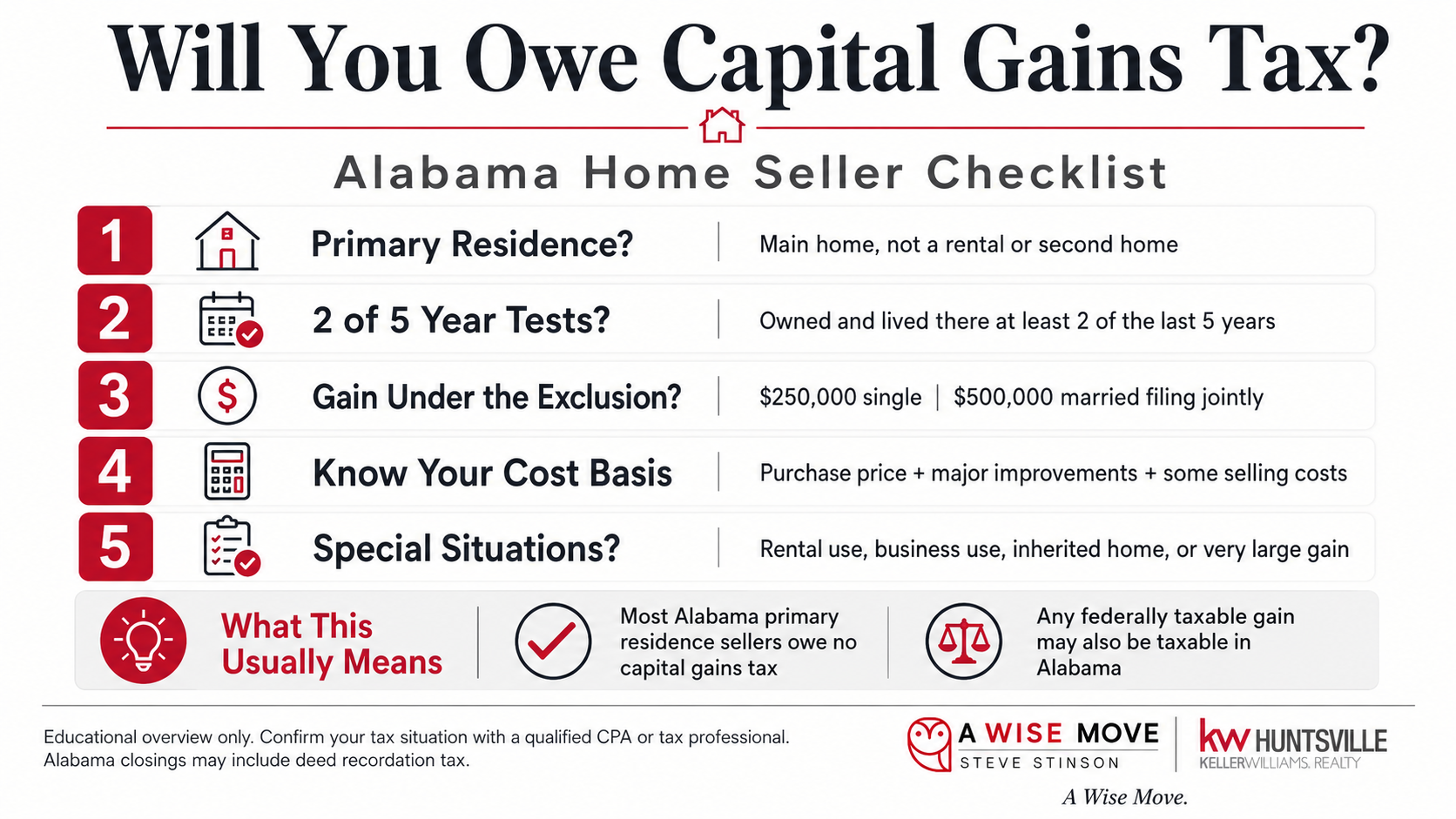
If you sell your primary residence, you can exclude your profit under federal law up to these limits:
● $250,000 for single filers
● $500,000 for married couples filing jointly
Qualifying for the Exclusion
To qualify, you have to pass two tests, both measured over the five years ending on your sale date:
- Ownership test. You owned the home for at least two of the past five years.
- Use test. You lived in the home as your primary residence for at least two of the past five years.
Those two years don’t have to be consecutive, and you don’t have to be living there on the day you sell. You also can’t have claimed this exclusion on another home sale in the past two years. These federal rules are what create the most favorable tax treatment for many homeowners before you look at Alabama income taxes.
Here’s what that means for a typical Huntsville seller. Say you bought your home for $230,000 and sell it for $400,000. Your gain is about $170,000 before adjustments. As a single filer, your entire gain is under the $250,000 limit, so you pay no federal capital gains tax. For married filing jointly, the exclusion is larger, while married filing separately follows different limits and planning considerations at the federal level.
Calculating Your Gain
What counts as your “gain” (it’s not just the price difference)
A lot of sellers overestimate their taxable gain because they only look at purchase price versus sale price. Your real gain is based on your cost basis, which is usually higher than what you paid. That works in your favor.
Cost basis is the total amount you have invested in your home, including the original purchase price and certain improvements and expenses. To calculate your taxable gain, deduct selling expenses and your adjusted basis from the selling price.
Your cost basis generally includes:
- The original purchase price
- Major capital improvements (a room addition, a new roof, a renovated kitchen, a new HVAC system, and similar lasting upgrades)
- Certain closing costs from when you bought
- Selling costs, including the real estate commission and attorney fees
So if you bought at $230,000, added a $40,000 addition over the years, and paid roughly $28,000 in selling expenses, your adjusted basis is closer to $298,000. On a $400,000 sale, your realized capital gains would be about $102,000, not $170,000. That net gain is what matters for many property sales, and if the calculation produces a loss, there is no capital gains tax. For most sellers, this pushes the number even further below the exclusion limit.
Keep records of your improvements. Receipts and invoices over the years can meaningfully lower your gain if you ever do approach the exclusion limits, especially when capital assets are sold and the sale may need to be reported on your tax return.
When you might actually owe capital gains tax
The exclusion covers most homeowners, but not everyone. You should plan for possible capital gains tax if any of these apply:
- Your gain exceeds the exclusion. A single filer with $300,000 of gain would owe tax on the $50,000 above the $250,000 limit. This is more common with long-held homes in high-appreciation areas.
- The property is not your primary residence. Investment properties, rentals, and second homes do not qualify for the exclusion. A separate strategy, such as a 1031 exchange, may apply to investment property.
- You did not meet the two-year tests. If you owned or lived in the home for less than two of the last five years, you may not qualify, though partial exclusions exist for certain situations like a job-related move.
- You already used the exclusion recently. You can only claim it once every two years.
Alabama Tax Treatment of Capital Gains
Alabama taxes all capital gains as ordinary income up to 5%. The state does not differentiate between short-term and long-term capital gains; all are taxed at the same ordinary income rates. Any gain above the federal exclusion can carry both a federal and a state component. This is exactly where a quick conversation with a tax professional pays for itself, because your specific basis and filing status drive the answer.
Alabama-specific benefits
Selling in Alabama has a couple of cost advantages.
No state or local real estate transfer tax. Many states charge a transfer or deed tax that can be thousands of dollars. You won’t see that here, though in Alabama property sales can still include closing items like prorated property tax on the settlement statement.
Alabama closings are handled by a real estate attorney, not a title company. The attorney prepares your settlement statement, which is the document your tax preparer will want when calculating any gain. Keep it.
This is what I help my clients think through before they list, because your tax picture, possible tax savings, and your net proceeds from selling a home in Huntsville are connected. A little tax planning here can reduce your tax burden. Good financial planning also helps you weigh timing, closing costs, and how the sale fits your financial future. Knowing roughly where you stand on capital gains helps you plan your next move with clear eyes instead of a surprise at tax time. Holding assets for over one year can lower your overall tax burden because federal long-term capital gains rates are usually lower than ordinary income rates, even though Alabama income taxes still apply.
I’m a REALTOR®, not a tax advisor or CPA.
The exclusion rules are well established, but your personal situation, your basis, and your filing status determine what you actually owe. For federal taxes, rates depend in part on how long you owned the home: short-term capital gains are taxed at ordinary income rates, while assets held for over one year qualify for long-term rates. Alabama does not differentiate between short-term and long-term capital gains; for state income tax purposes, federally taxable gain is generally taxed as ordinary income. If you sold after owning the home for less than a year, the gain is generally treated as short-term and taxed at ordinary income tax rates. Always confirm the specifics with a qualified tax professional before you make decisions based on the tax outcome.
Frequently Asked Questions
How much can I exclude from capital gains when selling my home in Alabama?
You can exclude up to $250,000 of gain as a single filer and up to $500,000 as a married couple filing jointly, as long as the home was your primary residence for at least two of the last five years. Gain above that limit is taxable.
Is there an Alabama capital gains tax, home sale, or transfer tax?
No. Alabama has no state or local real estate transfer tax. The capital gains question is a matter of federal taxes first, not state taxes, and Alabama income tax applies only to gain that is taxable at the federal level above the exclusion. Your tax liability begins if your profit exceeds the exclusion limit or if the property was not your primary residence.
How does Alabama tax capital gains from home sales?
Alabama taxes all capital gains as ordinary income up to 5%. This means that any taxable gain from your home sale, after federal exclusions, will be taxed at Alabama’s ordinary income tax rates, which range from 2% to 5%. Alabama does not distinguish between short-term and long-term capital gains.
Do home improvements reduce my capital gains tax?
Yes. Major capital improvements add to your cost basis, which can help reduce capital gains tax by lowering your net gain. Keep receipts for additions, renovations, roofing, HVAC, and similar lasting upgrades, along with documentation for selling expenses such as commission and attorney fees.
How do I calculate my taxable gain when selling a home?
To calculate your taxable gain, deduct selling expenses and your adjusted basis from the selling price. Your adjusted basis includes your original purchase price plus the cost of major improvements and certain buying and selling expenses.
Do I owe capital gains tax on a rental or investment property in Alabama?
The primary residence exclusion does not apply to investment or rental properties, which are generally treated as capital assets, and improvements can reduce capital gains tax by increasing your basis and lowering the net gain. You may owe capital gains tax on the sale, and when selling assets like a rental home, a 1031 exchange can defer it if you reinvest in another investment property, while documented selling expenses also reduce the gain calculation. Broader tax planning may also help in some cases. For investors with taxable accounts, tax loss harvesting may offset gains elsewhere. Complex situations can also create additional taxes. Talk to tax professionals about your options.
The Bottom Line
Most Huntsville homeowners selling their primary residence will owe no capital gains tax because of the federal exclusion, and Alabama adds no transfer tax on top. The exceptions involve very large gains, investment properties, or not meeting the two-year tests. Knowing your cost basis is the key to an accurate picture. If you’re considering a 1031 exchange, remember that rental-property sales can carry broader tax implications beyond the home-sale exclusion rules, so they often call for more careful financial planning. Investors should also ask a tax professional whether strategies such as tax-loss harvesting could improve after-tax returns. In the right overall plan, charitable donations of appreciated stock may help reduce tax burden, but that is an investor strategy rather than a home-sale exclusion rule.
If you want help estimating your net and understanding how taxes fit into your specific sale, I’d be glad to walk through it with you. Schedule a free 20-minute strategy call. No pressure, just straight answers. You can also learn more about working with Huntsville REALTOR® Steve Stinson and how I approach helping families buy and sell in North Alabama. We can also estimate what you’d actually net at closing, and if you’ve inherited a property, my guide to selling an inherited house in Alabama covers the disclosure side of things.
Have a question about the Huntsville housing market?
Get straight, local answers about buying, relocating, investing, or building in the area. For ongoing insights into pricing, trends, and timing your sale, my Huntsville real estate blog with market trends and tips is updated regularly. If you’re planning a move into the area, this relocation guide for moving to Huntsville, AL walks through neighborhoods, commutes, and how to buy from out of state. Investors can dive deeper into opportunities and strategy in my Huntsville real estate investing market guide, and if you’re eyeing new subdivisions, start with this resource on buying brand new homes in Huntsville and Madison County.
Search Huntsville Homes
Have a question about the Huntsville housing market?
Get straight, local answers about selling, buying, relocating, investing, or building in the Huntsville area. No pressure.
Since 2005 · 500+ Families Served · 250+ Five-Star Reviews · BBB A+ Rated
About Steve Stinson
I track the local data closely, from quarterly updates like the Q1 2026 Huntsville housing market report to what I’m seeing on the ground in specific neighborhoods. That helps my sellers price accurately, avoid surprises like a low appraisal on a Huntsville home sale, and decide whether it makes more sense to sell or rent out a Huntsville property based on their goals. If you’re starting to plan a sale, I can give you a grounded view of what your Huntsville home is really worth and how that ties into your overall financial picture.
Disclaimer:
This article is for general informational purposes only and should not be considered tax, legal, financial, or investment advice. Real estate decisions can have important tax, legal, and financial consequences, and every situation is different. Before making decisions about selling a home, calculating proceeds, capital gains, investments, or legal obligations, consult with a qualified CPA, attorney, financial advisor, or other licensed professional familiar with your specific situation.